Geostrategic Media Political Commentary, Analysis, Security, Defense

The future of Gulf security will depend not only on the military balance between Washington, Tehran and Jerusalem, but also on how American domestic politics reshapes the calculations of regional powers.
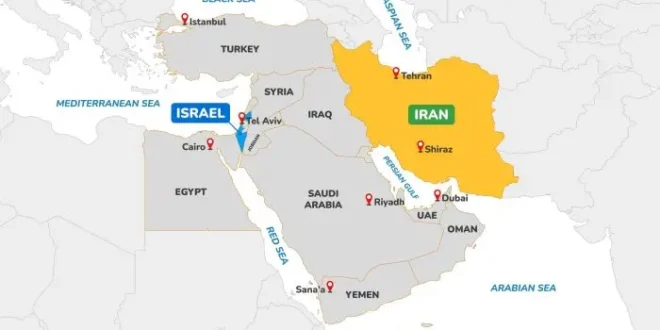
The Persian Gulf has become the central geographical arena in which three competing strategic calculations intersect: Iran’s determination to preserve its regional influence, Israel’s efforts to constrain Iranian military capabilities, and America’s attempt to maintain regional security without becoming trapped in another prolonged Middle Eastern war. The American midterm elections introduce an additional variable into this already complicated equation. They raise questions about the durability of Washington’s military commitments, the political sustainability of its confrontation with Tehran and the willingness of the United States to absorb the economic costs of regional instability.
The conflict has exposed a fundamental contradiction in American Middle Eastern policy. Washington seeks to prevent Iran from acquiring strategic capabilities that could threaten its regional partners and international interests. At the same time, it must prevent military operations from producing an uncontrollable escalation that threatens international shipping, energy infrastructure and the stability of friendly governments. The United States therefore faces a difficult balance between demonstrating military resolve and avoiding the strategic consequences of an expanding war.
Iran understands that geography provides it with considerable leverage. Its position along the northern shores of the Persian Gulf, combined with its proximity to the Strait of Hormuz, gives Tehran the ability to threaten international commercial routes even when its conventional military capabilities are under pressure. Its maritime strategy, missile systems, unmanned aerial vehicles and relationships with regional armed groups form part of a broader deterrence architecture. These capabilities do not necessarily provide Iran with conventional military superiority, but they complicate the calculations of any power contemplating a prolonged confrontation.
The Strait of Hormuz is especially important because its security cannot be separated from the economic stability of the international system. A sustained interruption would affect energy-importing economies in Asia and Europe, increase transportation costs and create inflationary pressure across multiple markets. The economic consequences would extend well beyond the immediate participants in the conflict. The disruption of maritime traffic has already demonstrated how regional military developments can translate into international economic shocks.
For Israel, the strategic challenge is different. Its leadership has consistently treated Iran’s military and nuclear capabilities as a long-term security concern. Yet the question of what constitutes a sustainable military outcome remains unresolved. Destroying infrastructure, degrading missile capabilities or damaging military installations does not necessarily eliminate the political and technological foundations of a country’s strategic ambitions. A military campaign can weaken an adversary while simultaneously strengthening its determination to rebuild, adapt and seek alternative methods of deterrence.
This is where American electoral politics becomes particularly significant. Israeli security calculations are influenced by the degree of American political and military support available to sustain operations. A change in congressional control could increase scrutiny of military appropriations, weapons transfers and the administration’s regional strategy. It could also create opportunities for a renewed diplomatic approach. Nevertheless, a congressional change would not automatically translate into a fundamental transformation of the American-Israeli security relationship.
The Gulf monarchies must navigate this environment with particular caution. Saudi Arabia has sought to strengthen its international position through economic diversification, investment, infrastructure development and a more flexible diplomatic posture. The UAE has built an international commercial and financial network whose resilience depends on stability and predictability. Qatar has developed a diplomatic role that allows it to maintain communication channels with actors whose relationships with one another are frequently adversarial.
For these countries, a regional war threatens much more than oil exports. It places airports, ports, financial centres, industrial facilities, tourism, foreign investment and long-term development strategies at risk. Their economic transformation requires a stable environment in which international companies can operate, expatriate professionals can live and investors can make long-term commitments. Even without a direct attack on critical infrastructure, persistent uncertainty can increase insurance premiums, delay investment decisions and encourage businesses to reconsider their regional exposure.
The Gulf states therefore have incentives to pursue diplomatic channels with Tehran even while maintaining their security partnerships with Washington. This approach should not be interpreted as an endorsement of Iranian regional policy. It reflects the practical recognition that geography makes permanent confrontation extremely costly. Saudi-Iranian diplomatic engagement, Emirati commercial pragmatism and Qatari mediation all demonstrate the importance of maintaining communication mechanisms even during periods of heightened tension.
The relationship between Washington and the Gulf capitals could also become more transactional. Regional governments may seek clearer assurances concerning the protection of critical infrastructure, the defence of maritime routes and the availability of American military support in an emergency. At the same time, they may accelerate defence procurement diversification and expand cooperation with international partners. China could benefit diplomatically and commercially from such diversification, although it cannot simply replace the United States as the principal external security actor in the Gulf.
Another important factor is Türkiye. Ankara’s regional position gives it diplomatic, military and economic interests that overlap with those of the Gulf states without being identical to them. Türkiye could become increasingly relevant in efforts to contain regional escalation, preserve commercial routes and maintain diplomatic communication. Its relationship with NATO, its regional security interests and its expanding economic relationships give it an important position in the evolving strategic environment.
The greatest danger for the Gulf is not necessarily a single military confrontation, but the emergence of a prolonged condition of strategic uncertainty. Governments and investors can adapt to identifiable risks. They find it much harder to operate when the possibility of escalation remains permanently present and the intentions of major powers are difficult to anticipate.
The American elections will contribute to this uncertainty because they will influence the domestic political environment in which Washington makes its decisions. Yet regional actors should avoid assuming that a change in congressional composition will automatically produce a new American Middle East doctrine. Institutional continuity, defence commitments, executive powers and strategic interests will remain important.
Ultimately, the Gulf requires an arrangement that protects sovereignty, maritime commerce and energy infrastructure while addressing the security concerns of Iran, Israel and the United States. Such an arrangement will not emerge through military pressure alone. It requires diplomatic mechanisms capable of reducing the incentives for escalation.
The central lesson of the present crisis is that the Gulf cannot afford to become merely the geographical theatre in which Washington, Tehran and Jerusalem settle their strategic differences. Its governments have their own interests, economic ambitions and security priorities. The future regional order will increasingly depend on their ability to coordinate those interests rather than simply react to decisions taken elsewhere.