Geostrategic Media Political Commentary, Analysis, Security, Defense


The American midterms are no longer merely a domestic referendum on the presidency. They have become a strategic inflection point for Tehran, Jerusalem and the Gulf capitals, with consequences for the international order.
The American electoral calendar has acquired an international dimension that few political contests can escape. As voters head to the polls on November 3, 2026, the United States finds itself confronting a combination of military confrontation, economic uncertainty and increasingly complicated regional commitments. The war involving Iran, Israel and the United States has transformed the Middle East into a testing ground for American military power, diplomatic credibility and political endurance. What happens in Washington will therefore resonate far beyond the boundaries of the United States, particularly in capitals whose security and economic calculations remain closely connected to American policy.
For President Donald Trump, the elections represent a domestic political test at a particularly sensitive moment. The administration must reconcile its declared security objectives against Iran with the economic consequences of a prolonged conflict. Rising energy costs, disruptions to maritime transportation and uncertainty surrounding the Strait of Hormuz have made foreign policy increasingly tangible to American households. The traditional distinction between overseas military operations and domestic economic priorities has consequently become less convincing. A conflict thousands of kilometres from American shores can now influence the price of gasoline, transportation, food and industrial production.
The political significance of the election extends beyond the number of seats won by either party. Control of Congress determines the administration’s ability to secure appropriations, sustain military deployments, finance regional security commitments and defend the political legitimacy of its foreign policy. A change in congressional control would not automatically terminate American military operations or compel the White House to abandon its objectives. Nevertheless, congressional oversight, budget negotiations and legislative investigations could impose additional constraints on the administration’s freedom of action.
For Tehran, the American electoral process presents both risks and opportunities. Iranian decision-makers have historically attempted to exploit political divisions within the United States, calculating that public opposition to prolonged military engagements could eventually constrain Washington’s strategic options. The Iranian leadership may interpret electoral dissatisfaction with the economic costs of war as an indication that the American political system has limited tolerance for an extended confrontation. Such an interpretation, however, could prove dangerous if Tehran mistakes political disagreement over the duration of military operations for an absence of American willingness to respond to attacks against its forces or allies.
Israel faces a different calculation. Its security establishment has long regarded Iran’s military capabilities, nuclear programme and regional network of armed partners as interconnected strategic challenges. Yet Israeli preferences regarding the timing, scope and objectives of military operations do not necessarily coincide with Washington’s domestic political requirements. A prolonged campaign could generate pressure on the Israeli government to secure a decisive outcome, while the American administration might seek to avoid an open-ended commitment that damages its electoral position or economic agenda.
This divergence is particularly important because military cooperation between Washington and Jerusalem does not eliminate differences over escalation management. American officials must consider the protection of military personnel, the security of Gulf partners, the availability of precision munitions and the potential consequences of Iranian retaliation. Israeli leaders, meanwhile, must assess whether military pressure can produce durable strategic results or simply postpone future confrontations. The relationship remains consequential, but it is not immune to competing calculations.
The Gulf states are perhaps the actors most directly exposed to the consequences of these competing priorities. Saudi Arabia, the United Arab Emirates, Qatar, Kuwait and Bahrain must protect their energy infrastructure, commercial centres, maritime routes and international investment relationships. Their strategic dilemma is that they depend on American security partnerships while simultaneously bearing the geographical and economic consequences of a conflict involving Iran. They cannot assume that military escalation will remain confined to Iranian and Israeli territory.
The Strait of Hormuz illustrates the problem. The waterway is not simply a regional maritime passage; it is a critical artery connecting Gulf energy producers to international markets. Disruption threatens oil and liquefied natural gas exports, shipping insurance, refinery operations and the reliability of global supply chains. According to the Council on Foreign Relations, approximately one-quarter of global maritime oil trade and 19 percent of liquefied natural gas trade passed through the strait in 2025.
The consequences of American electoral politics are therefore transmitted through several interconnected channels. A more restrictive congressional environment could complicate military financing and encourage diplomatic initiatives. Conversely, continued congressional support for military appropriations could provide the administration with greater operational flexibility. Neither outcome alone would determine the trajectory of the conflict, because Tehran’s decisions, Israeli security calculations and the actions of Gulf governments will remain equally important.
There is also a wider question concerning American credibility. Washington has spent decades constructing a regional security architecture based on military partnerships, arms transfers, intelligence cooperation and maritime protection. If Gulf governments conclude that American commitments are increasingly influenced by domestic electoral cycles, they may accelerate efforts to diversify their diplomatic and defence relationships. This would not necessarily mean abandoning the United States. Rather, it could encourage a more autonomous regional policy involving China, European powers, Türkiye and other international actors.
The elections could consequently influence not only the future of the Iran war but also the architecture of the Middle East after it. The central question is whether American political institutions can sustain a coherent regional strategy while responding to the economic and political demands of the electorate. For Tehran, the temptation will be to test the limits of American patience. For Israel, it will be to preserve strategic pressure. For the Gulf states, the priority will be to prevent their economic transformation from becoming collateral damage in a confrontation they did not choose.
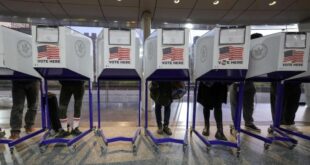
The ballot boxes in the United States will not determine the future of the Middle East on their own. But they will help establish the political conditions under which the next phase of the conflict unfolds. In an increasingly interconnected international system, the distance between an American polling station and an oil terminal in the Gulf has become considerably shorter than Washington’s political establishment might wish to acknowledge.