Geostrategic Media Political Commentary, Analysis, Security, Defense

Lisdey Espinoza Pedraza
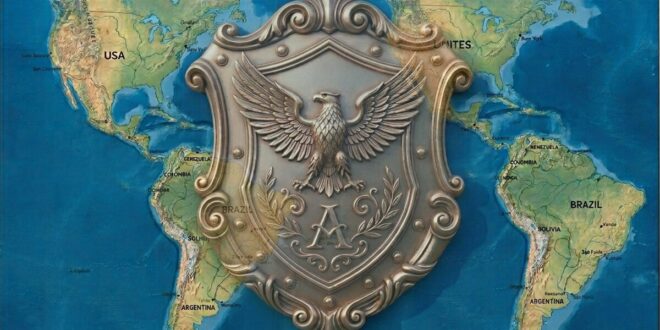
In early March 2026, Donald Trump convened a select group of Latin American and Caribbean leaders at his golf resort in Doral, Florida, under the banner of the “Shield of the Americas”.
Trumpian optics, no substance
The optics were deliberately chosen to symbolize strength, unity and urgency. The setting itself was telling in a different way.
This was not a neutral diplomatic venue or the site of a multilateral institution. Rather, it was a private Trump property, channeling summit fees directly into the president’s pocket.
The term “Shield of the Americas” that was chosen not just for the event, but the initiative suggests protection and resolve.
Lurking in the background: Five decades of pursuing a militarized drug war policy
The Shield’s actual substance evokes something far older and far less heroic. There is a history of five decades of pursuing a militarized drug war policy that has, in every country and every era it has touched, produced more violence, more corruption, more dead civilians and more drugs.
Moreover, contrary to the claims of the Trump administration, the “Shield of the Americas” is not a policy innovation. It is a continuation of a long-standing paradigm in U.S. hemispheric strategy.
It has the same assumptions, the same tools and the same contradictions baked in as before, even if they were repackaged for a new political moment.
Background: What really drove Trump to create this initiative
The emergence of the Shield initiative is best understood as a convergence of political, geopolitical and strategic pressures rather than any genuine reassessment of what works.
In the U.S. domestic context, drug consumption has shifted but not diminished. The opioid crisis, the proliferation of synthetic drugs and the persistence of cocaine markets continue to generate political demand for visible action.
Trump had spent his campaign years demonizing migrants solely as vectors of cartel power and crime, designating Mexican criminal organizations as foreign terrorist organizations, and threatening military strikes across the southern border.
Another reincarnation of the Monroe Doctrine?
The March summit at Doral was the institutional crystallization of that rhetoric, a way of giving operational form to the Monroe Doctrine revived, the hemisphere reimagined as a U.S. security perimeter.
In the international context, the launch of the Shield initiative reflects the reality of a more competitive geopolitical environment, particularly with China’s expanding economic presence across Latin America.
The Shield initiative thus operates simultaneously as a counter-narcotics framework and a U.S.-driven mechanism for reasserting regional influence.
A partisan endeavor
It is no surprise then that participation skewed heavily toward the right-leaning administrations of the region that are willing to align with Washington’s security agenda.
Argentina’s Javier Milei, Ecuador’s Daniel Noboa, El Salvador’s Nayib Bukele and Chile’s president-elect José Antonio Kast figured prominently among them.
This selective inclusion is not incidental. It reinforces a bloc politics logic in which counter-narcotics cooperation becomes a vehicle for broader political alignment. The Shield is as much about political ordering in the hemisphere as it is about drug interdiction.
A strategy merely on paper
The official objectives, as released in the summit communiqué, were strikingly thin: expand multilateral security cooperation, conduct “whole of government” efforts on border security and counter-narcotics, advance peace through strength and combat narco-terrorism.
This amounted to a half-page declaration and four general points. It may have been noble in aspiration but, as it currently stands, the Shield initiative is entirely devoid of possible implementation mechanisms, funding commitments or even any acknowledgement of the root causes of the trade – i.e., poverty, weak states and corruption.
Meanwhile, 17 Latin American countries signed on to the Americas Counter Cartel Coalition, with the explicit promise of U.S. military assistance in targeting cartel infrastructure.
What it conspicuously did not offer was resources for the cash-strapped armed forces of its members, nor any strategy that departed from the supply-side orthodoxy that has governed U.S. drug policy since 1971.
The politics of exclusion: Who was left out and why it matters
One of the Shield’s most significant structural weaknesses lies in who was not at the Doral summit. Brazil, Mexico and Colombia, the three largest economies in Latin America, were missing.
Each of these three countries confronts organized crime at enormous scale, each possesses sophisticated law enforcement institutions and capable military forces. But they were absent.
Mexico is the primary corridor for drugs entering the United States. Colombia remains the world’s largest cocaine producer. Brazil is the largest domestic market in South America and a critical transshipment node.
Pointless coalition building
Without these three countries being directly and closely involved, the coalition building is ultimately pointless. What can be the purpose of a discussion about hemispheric security from which the hemisphere’s most consequential actors – Brazil, Mexico and Colombia – are excluded?
Moreover, the countries that were absent represent precisely the alternative approaches the Shield refuses to consider. Colombia under Gustavo Petro has pursued negotiated settlements with armed groups over bombardment.
Mexico, for its part, has repeatedly resisted U.S. military operations on its territory. Brazil under Lula has been cautious about any initiative that replicates patterns of U.S. military dominance in the region.
Choosing symbolism over substance
In true keeping with the U.S. President’s own preferences, what the Shield of the Americas does accomplish, quite effectively, is political performance.
It projects U.S. dominance in the hemisphere, rewards aligned governments with the legitimacy of a White House photo opportunity and creates a legal and rhetorical framework for military operations that, crucially, might otherwise require Congressional authorization.
Assembling “Christian nations under God”?
It was as telling as it was revealing that U.S. Secretary of War Pete Hegseth opened his remarks at the summit with a quotation from Andrew Jackson and rallied the assembled leaders as “Christian nations under God” against “radical narco-communism and narco-tyranny”.
This clearly signaled the primary ideological purpose beneath all the counter-narcotics framing.
It also indirectly underscored that the real enemy is not the cartels. It is any political project in the region – whether in Mexico, Brazil, Colombia, Bolivia or elsewhere – that challenges the U.S.’s terms of hemispheric subordination.
Fighting China more than fighting drugs
The other part of the U.S. agenda was made plain in Kristi Noem’s remarks. She called on coalition members to reverse Chinese influence in their region’s business, technology and infrastructure. China is now Latin America’s largest lender and trading partner.
However, even the Shield’s most committed members, Milei’s Argentina and Bukele’s El Salvador, depend on Chinese commerce and investment for their economies.
The drug war thus is the cover story. The deeper contest is with Beijing. And that is a policy target which the Shield of the Americas, as currently constituted, is unequipped to prosecute.
Author’s Bio: