Geostrategic Media Political Commentary, Analysis, Security, Defense

By Dr. Shehab Al Makahleh
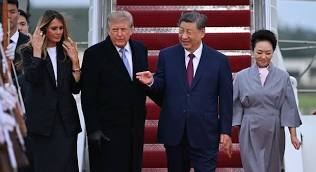
The most consequential question surrounding Chinese President Xi Jinping’s visit to Washington is not whether Donald Trump and Xi can announce another trade arrangement. It is whether the two leaders can prevent two separate geopolitical crises—one unfolding in the Middle East and the other simmering in the Taiwan Strait—from becoming interconnected tests of American and Chinese power. Xi’s September 23–25 visit, his first trip to Washington in more than a decade, comes at an unusually complicated moment: the United States remains engaged in a protracted war with Iran, Washington is struggling to restore freedom of navigation through the Strait of Hormuz, China remains economically connected to Tehran, and Taiwan has become entangled with the broader debate over U.S. military resources and strategic priorities. The White House has confirmed that Xi will meet Trump at the White House on September 24, while current reporting indicates that trade, artificial intelligence, rare earths, Iran and Taiwan are all likely to figure prominently in the discussions.
For Trump, the Iran war has become a problem that cannot be separated from the global economy. The longer the conflict persists, the more difficult it becomes to distinguish between a military campaign against Tehran and a broader contest over the architecture of energy security. Washington’s stated objective of maintaining maritime access through Hormuz has already turned the waterway into a strategic test of American power. CENTCOM said on September 19 that U.S. forces and partners had facilitated the passage of more than one billion barrels of crude oil and more than 2,000 commercial vessels through the strait over the preceding two months, while reporting that the principal transit lanes had been cleared of mines. Yet the very fact that the United States must actively secure one of the world’s most important energy corridors demonstrates how far the conflict has moved beyond the battlefield. Hormuz, Bab al-Mandab, shipping insurance, oil prices and supply chains are now part of the strategic equation.
That creates a dilemma for Washington. The United States wants to pressure Tehran without allowing the conflict to become an open-ended regional war, while Iran has demonstrated that its ability to disrupt maritime commerce can generate costs far beyond the immediate military theatre. The problem is compounded by the geography of the conflict: Hormuz connects the Gulf to global energy markets, while Bab al-Mandab links the Red Sea to the Indian Ocean and the Mediterranean. Any settlement that addresses the first while ignoring the second would risk leaving a structural vulnerability in place. The future security arrangement therefore cannot be defined exclusively by what happens between Washington and Tehran; it must also address the regional networks, maritime chokepoints and armed actors that have transformed the conflict into a wider contest over trade and energy.
This is where China enters the equation.
Beijing has no interest in seeing the Iranian conflict evolve into a permanent disruption of the global energy system. China is deeply exposed to international trade and remains one of Iran’s most important economic partners. A recent U.S.-China Economic and Security Review Commission assessment described China as Iran’s most important economic lifeline, particularly through Chinese purchases of Iranian oil, while Reuters has reported on mechanisms through which Iranian oil revenues have been exchanged for Chinese goods despite U.S. sanctions. For Washington, therefore, Beijing is not merely another diplomatic actor. It is part of the economic infrastructure that determines how much pressure sanctions can actually exert on Tehran.
But Xi is unlikely to approach the Iran question simply as an American mediator. China’s interests are broader. Beijing wants to preserve access to energy, protect commercial routes, prevent a regional war from damaging Chinese economic interests, and avoid creating a precedent in which Washington dictates the security architecture of another strategically important region. China can therefore cooperate with the United States on de-escalation without accepting an American monopoly over the post-war order.
That distinction matters because the Trump–Xi summit is taking place against a much deeper strategic dispute: Taiwan.
For Beijing, Taiwan remains a fundamentally different issue from Iran. Iran is a geopolitical problem in which China has economic and strategic interests; Taiwan is directly connected to China’s conception of sovereignty, national reunification and the legitimacy of the Chinese state. China’s defense ministry continues to describe reunification as a national objective while maintaining that Beijing does not renounce the option of using force. This is why Beijing’s calculations regarding Taiwan cannot simply be reduced to a bargaining position over tariffs, technology or energy.
The United States, meanwhile, has increasingly found itself balancing its commitments in the Indo-Pacific against the military demands of the Middle East. In May, Trump acknowledged discussing Taiwan arms sales with Xi and said he had not yet decided whether to approve a proposed $14 billion package. Subsequent reporting described the package as being held in abeyance, while U.S. officials later emphasized that the proposed sale remained a presidential decision and was not formally tied to negotiations with Beijing. The issue has nevertheless become politically significant because Taiwan’s security is now being discussed alongside the United States’ broader resource constraints created by the Iran war.
That is precisely what makes the current summit so consequential. For Taiwan and U.S. allies in Asia, the concern is not necessarily that Washington will formally abandon its position. The greater concern is whether Taiwan could become an informal bargaining chip in a larger negotiation over trade, technology, rare earths, energy and Iran. The New York Times reported this week that persuading Trump to continue delaying the proposed $14 billion arms package is among Beijing’s objectives for the Washington talks. Japan and other regional allies therefore have an interest in ensuring that any economic accommodation between Washington and Beijing does not create ambiguity about the broader strategic balance in the Taiwan Strait.
At the same time, Trump has substantial economic incentives to stabilize relations with Beijing. U.S. goods trade with China totaled approximately $414.7 billion in 2025, comprising $106.3 billion in U.S. exports and $308.4 billion in imports. The resulting U.S. goods deficit was approximately $202.1 billion—large enough to remain politically important, but considerably below the roughly $300 billion figure sometimes cited in public commentary. The economic relationship has therefore changed substantially since the trade war that began in 2018, but it has not disappeared. It has evolved from a dispute centered primarily on tariffs and the bilateral trade balance into a much broader contest involving semiconductors, artificial intelligence, critical minerals, supply chains and strategic technologies.
Rare earths illustrate this transformation particularly well. The White House has already linked the U.S.–China relationship to critical minerals and supply-chain security, while current reporting indicates that rare earths, AI and trade will be important subjects during the Washington summit. These are not merely commercial questions. They have become instruments of geopolitical leverage because the same technologies and materials that support civilian industries also underpin advanced military systems.
The result is a form of strategic competition that increasingly resembles a managed cold war rather than a traditional one. Washington and Beijing compete militarily, technologically and diplomatically while simultaneously maintaining commercial relationships neither side can easily abandon. They threaten each other’s economic interests while negotiating trade agreements; they compete for influence across the Global South while attempting to prevent direct military confrontation; and they increasingly use supply chains, artificial intelligence, investment restrictions and critical minerals as instruments of state power.
The Iran war adds another layer to this competition. Washington wants Beijing to reduce its economic support for Tehran and to use its influence to encourage an end to the conflict. Beijing, however, has little incentive to accept responsibility for implementing American pressure on Iran. China can encourage negotiations while simultaneously protecting its own interests in Iranian energy and trade. That makes Beijing potentially useful to diplomacy but not necessarily a reliable instrument of American policy.
The deeper question, therefore, is whether China is prepared to become part of a new system of shared regional crisis management.
Beijing has already demonstrated an appetite for diplomatic involvement in the Middle East, including its role in facilitating the Saudi-Iran rapprochement in 2023. But acting as a diplomatic broker is different from assuming responsibility for regional security. China has historically benefited from an international security environment in which the United States carried much of the military burden while Beijing expanded its economic presence. The emerging question is whether that division of labor can survive as American strategy increasingly asks regional partners to assume greater responsibility for their own security.
This may eventually produce a new form of geopolitical burden-sharing. The United States would retain the central military role in the Indo-Pacific and continue to provide security capabilities in the Middle East, but Gulf states would assume greater responsibility for regional defense, maritime security and crisis management. China, meanwhile, could expand its diplomatic and economic role without becoming the region’s dominant military power.
Such an arrangement would not constitute a new U.S.–China condominium. Nor would it mean that Washington and Beijing have resolved their strategic differences. It would instead represent an uneasy form of managed multipolarity, in which competing powers cooperate selectively because the costs of uncontrolled escalation are greater than the benefits of unilateral dominance.
This is ultimately what makes the Trump–Xi meeting more important than any single trade agreement announced in Washington.
Iran and Taiwan may appear to be separate crises, separated by thousands of miles and radically different histories. Strategically, however, they are increasingly connected by the same question: How will the United States allocate power, resources and strategic attention when it faces simultaneous challenges in Europe, the Middle East and the Indo-Pacific?
China understands that question. Taiwan understands it. America’s Gulf partners understand it. Iran understands it as well.
For Xi, the objective will be to prevent the Iran conflict from becoming a mechanism through which Washington strengthens its position against China while preserving Beijing’s economic relationship with Tehran. For Trump, the challenge will be to secure a pathway toward an end to the Iran war without allowing Beijing to acquire disproportionate influence over the post-war Gulf order, while simultaneously protecting U.S. leverage on trade, technology and Taiwan.
That is a difficult balancing act.
The most consequential outcome of the Washington summit may therefore not be a spectacular announcement but a series of carefully calibrated signals: what Trump says about Taiwan, what Xi says about Iran, whether Beijing offers meaningful help on de-escalation, whether Washington provides concessions on trade or technology, and whether both leaders can establish mechanisms that prevent competition from sliding into confrontation.
The Middle East war and the Taiwan question are not the same conflict. But they are becoming part of the same strategic calculation.
And that is the real significance of the Trump–Xi summit: the future of the international order may be shaped not by whether Washington and Beijing become friends, but by whether their rivalry can be managed while two of the world’s most dangerous geopolitical fault lines—Iran and Taiwan—remain contained.