 Geostrategic Media Political Commentary, Analysis, Security, Defense
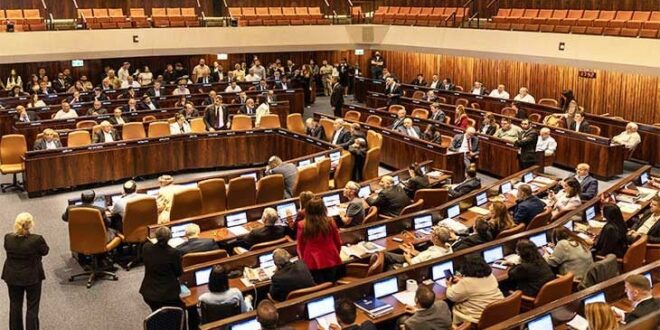

At first glance, Israel’s current political scene may look like the familiar turbulence that precedes a Knesset election. As voting day approaches on October 27, political rhetoric intensifies, parties sharpen their attacks, and campaigns increasingly appeal to some of the most sensitive instincts among voters. Fear, security, national identity, and the question of who belongs within the political community inevitably become more prominent as the contest for power tightens.
But reducing what is happening in Israel to election-season hysteria would miss the deeper transformation taking place beneath the campaign rhetoric. Elections may explain the timing of the escalation, but they do not fully explain its character. What is emerging is the product of years of political, legislative, and social changes that have steadily pushed Israeli politics toward greater exclusion, sharper identity politics, and a more restrictive conception of political belonging. The effort to limit Arab political representation is therefore not simply an electoral tactic of the moment. It reflects a broader struggle over who is entitled to participate fully in the political system.
When Exclusion Becomes Part of the Electoral Game
The latest manifestation of this trend came with the Central Elections Committee’s vote to bar the United Arab List (Ra’am) and the Joint List from competing in the Knesset election, on allegations related to support for terrorism.
The vote, reportedly 18 to 5, was not merely a technical electoral procedure. It touched directly on the ability of Arab citizens to participate in the political process and choose representatives of their own. It also revived a much larger question about the boundaries of Israeli democracy when the rights of its Arab minority are at stake.
More revealing is that calls to exclude Arab parties are not confined to the political right or to religious-nationalist forces. Similar positions have emerged from politicians and parties that present themselves as alternatives to the current government, including figures such as Naftali Bennett, Yair Lapid, Avigdor Lieberman, and Gadi Eisenkot. Other opposition figures, including Yair Golan, have also operated within a political environment in which questions of Arab political participation are increasingly framed through the language of security and national loyalty.
That is where the deeper contradiction emerges.
An electoral contest that should revolve around economic policy, social priorities, security, governance, and the future direction of the state can instead become a competition over who can take the hardest position toward Arab citizens.
National loyalty, in such an environment, risks being measured less by citizenship and equal political rights than by a willingness to exclude the political other.
The Supreme Court Is Not the Whole Answer
Some may expect Israel’s Supreme Court to intervene and overturn the decision, as it has done in previous cases involving the eligibility of political parties and candidates.
It may yet do so.
But even if the court reverses the decision, that would not resolve the deeper problem.
The issue is not only the final legal outcome. It is the fact that excluding an Arab political party can become a legitimate subject for political campaigning, institutional debate, and electoral calculation in the first place.
Once the exclusion of a substantial segment of the citizenry becomes politically marketable, the problem extends beyond the committee that made the decision or the court that may overturn it. It becomes a question about the political environment that made exclusion conceivable as an electoral strategy.
That raises a broader question: how long can a judicial institution serve as a barrier against a political and legislative current moving steadily toward greater emphasis on nationalism, identity, and exclusion?
A democracy is measured not only by whether its highest court can overturn a discriminatory decision. It is also measured by whether its political system repeatedly produces decisions that require judicial intervention in the first place.
The Problem Predates the Current Election
What is happening today did not begin with the upcoming election.
Over the past several years, the Knesset has witnessed repeated attempts to restrict or challenge Arab political participation, alongside legislation and political initiatives that have generated sustained controversy over their implications for equality and minority rights.
Efforts in previous election cycles to disqualify Arab lists and candidates have repeatedly brought questions of political loyalty, citizenship, national identity, and the boundaries of legitimate political participation back to the center of Israeli public debate. These controversies have unfolded alongside wider disputes over religious and cultural expression, the status of Arab citizens, and the balance between national identity and equal citizenship.
The current episode therefore cannot be understood in isolation.
Every new attempt to narrow Arab political participation adds another layer to a broader trajectory in which national and religious identity increasingly influence the definition of who is regarded as a full participant in the political sphere.
The danger is not necessarily that every such initiative will succeed. The more consequential development is that the political threshold for proposing them appears to have fallen.
Netanyahu and an Increasingly Blurred Political Landscape
The turbulence does not stop with the Central Elections Committee or the parties competing for seats in the Knesset.
Prime Minister Benjamin Netanyahu remains at the center of Israel’s deeply polarized political environment. From displays of military power and highly charged international speeches to diplomatic and security initiatives across the region, Israeli politics increasingly operates at the intersection of domestic electoral calculations and broader strategic messaging.
Almost every major move can carry several messages simultaneously.
A message to Israeli voters.
A message to political rivals.
A message to allies.
And a message to Palestinians, Arab states, and the wider international community.
This overlap between domestic politics and foreign policy has made it increasingly difficult to determine where electoral calculation ends and strategic statecraft begins. A diplomatic visit, a speech, a military operation, or a confrontation can rapidly become campaign material.
The process also works in the opposite direction. Domestic political decisions can become part of a broader strategy for mobilizing society around perceptions of danger, insecurity, and national threat.
The Opposition Is Not Outside the Problem
The problem cannot simply be attributed to the current government.
One of the more revealing features of Israeli politics is that some forces presenting themselves as alternatives to Netanyahu have not always managed to escape the same political framework.
Rather than offering a fundamentally different vision of the relationship between the state and its Arab citizens, or a dramatically different approach to the occupation, war, or the Israeli-Palestinian conflict, opposition parties often find themselves competing within a familiar vocabulary: security, fear, deterrence, strength, and suspicion of the political other.
This makes the problem increasingly structural rather than merely partisan.
If the government moves further to the right while opposition parties respond by demonstrating that they can be equally uncompromising on questions of security and national identity, the result may not be a change in direction. It may instead be a gradual movement of the entire political center toward a harder position.
That is what makes the current Israeli political landscape different from a conventional electoral contest.
The competition is no longer simply over who governs. It is increasingly over the boundaries of political legitimacy itself.
When Fear Becomes Electoral Fuel
Israeli politics has relied on security concerns as a central feature of electoral campaigns for decades.
What is particularly significant now is the expansion of that logic. The perceived threat is no longer necessarily external. Arab citizens themselves can become part of an electoral narrative in which political discourse divides society between those considered securely inside the national community and those whose political loyalties are treated with suspicion.
At that point, the issue moves beyond ordinary political disagreement.
Elections are supposed to provide mechanisms for expanding political participation, not narrowing it. Pluralism does not mean allowing only ideologically compatible parties to compete. It also means protecting the ability of different communities to organize and represent themselves politically, provided they operate within the law.
When national, ethnic, or political identity becomes grounds for automatic exclusion, however, an essential part of democratic participation is weakened.
The question is therefore not whether every Arab political position should be accepted without scrutiny. The question is whether political disagreement and minority identity are being increasingly treated as security problems rather than as legitimate components of democratic competition.
A Crisis Deeper Than Netanyahu
It may be tempting to explain everything through Netanyahu or his current government.
But that explanation is too narrow.
Netanyahu is undoubtedly one of the most consequential figures in Israel’s political transformation, but the environment surrounding him is larger than one politician or one coalition. It includes broader religious, nationalist, and ideological currents, changes in public discourse, and opposition parties that often adapt to those currents rather than directly challenge them.
The question, therefore, is bigger than whether Netanyahu wins or loses.
The more important question is: What kind of Israel will emerge from this election?
Will political pluralism continue to accommodate Arab citizens as legitimate participants in the political system, or will the space available to them continue to narrow?
Will Israeli politics return to a broader debate about the economy, social policy, civil liberties, governance, and the future of the state, or will security, fear, and national identity remain its dominant political currency?
And can the opposition offer a genuinely different political direction, or will it continue operating within boundaries increasingly defined by the right?
Elections Reveal More Than They Change
The upcoming election may alter the composition of the Knesset and determine the next government. But it will not, by itself, resolve the deeper political tensions confronting Israel.
The central issue is not simply who wins. It is the nature of the political rules within which everyone is competing.
When parties compete over who can take the toughest position toward Arab citizens, when political exclusion becomes an electoral instrument, and when nationalist and religious rhetoric becomes a primary means of mobilizing voters, the crisis becomes larger than any individual party or government.
It becomes a question about the meaning of democracy itself.
Perhaps the most consequential feature of the current moment is that practices that once might have been regarded as exceptional or politically marginal can increasingly enter the mainstream of political debate. The normalization of such arguments may matter as much as the outcome of any individual vote.
That is the real test facing the coming election.
It is not simply which party will win the largest number of seats. It is whether Israel’s political system will emerge from the ballot box more capable of accommodating political diversity and equal citizenship—or further entrenched in exclusion and polarization.
Elections can change the faces in the Knesset.
They cannot, on their own, change the political direction of a society.