Geostrategic Media Political Commentary, Analysis, Security, Defense

William Robertson
Key Points
- The November 3 midterm elections have become a significant test of President Donald Trump’s political standing and the Republican Party’s ability to retain control of Congress.
- The Economist‘s forecasting model puts the Democrats’ chances of capturing the House of Representatives at 94%, while offering a much more cautious assessment of their prospects in the Senate.
- Disagreement between polling models and prediction markets reflects uncertainty over whether Democratic momentum can extend into traditionally Republican states.
- Economic dissatisfaction, the consequences of the war with Iran and controversy surrounding Trump’s political conduct have become central campaign issues.
- The final results will determine not only congressional control but also the political constraints facing the administration during the remainder of Trump’s second term.
A Political Test Beyond the White House
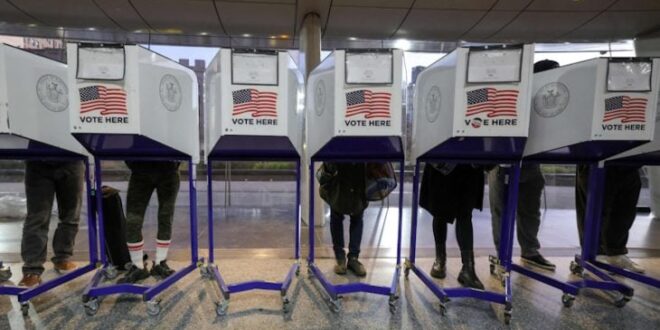
As Americans head to the polls on November 3, the midterm elections have become a critical test of whether public dissatisfaction with Donald Trump can be translated into tangible political gains for the Democratic Party. The contest is no longer simply about the distribution of seats in the House of Representatives and the Senate. It is also about the limits of presidential authority, the resilience of the Republican coalition and the extent to which voters are prepared to challenge an administration whose policies have generated considerable controversy at home and abroad.
For Republicans, the campaign has been particularly difficult. Trump remains a dominant presence in American politics, but his visibility has not necessarily translated into broader public approval. Having promised to reduce the cost of living, his administration has faced criticism over inflation, tariffs and the economic consequences of the war with Iran. Higher energy and fuel prices have added to household pressures, while concerns about America’s military involvement in the Middle East have created another political vulnerability for the White House.
The central Democratic argument is straightforward: the administration has failed to deliver the economic relief it promised, while its policies have introduced additional uncertainty into the lives of ordinary Americans. Republicans, by contrast, have sought to defend the president’s economic and security agenda, arguing that its longer-term objectives should be judged beyond the immediate pressures of the election cycle.
The Economist‘s latest forecasting model illustrates the scale of the challenge facing Republicans. It assigns Democrats a 94% probability of regaining control of the House of Representatives. The Senate contest, however, is considerably less certain. The magazine’s model places the probability of a Democratic takeover at approximately 53%, reflecting the difficulty of converting favourable national political conditions into victories across individual states. <Cite refs={[“turn734037search7”]}/>
The House: A Different Political Balance
The House of Representatives is emerging as the most immediate institutional battleground. Democrats do not need an overwhelming electoral victory to change the balance of power. A relatively small number of gains could give them control of the chamber, allowing them to reshape congressional committees, initiate investigations and intensify oversight of the administration.
A Democratic majority would provide the party with greater authority to scrutinise executive decisions, examine government spending and summon senior officials to testify. It could also complicate the passage of legislation central to Trump’s domestic agenda, particularly on immigration, taxation, federal expenditure and regulatory policy.
The implications would extend beyond legislative disagreements. Control of the House would give Democrats a platform from which to challenge the administration’s political narrative, investigate controversial decisions and frame the debate ahead of the next presidential election. Even without control of the Senate, a Democratic majority could turn the remaining years of Trump’s term into a period of sustained congressional confrontation.
The Republican effort to protect its House majority has therefore become closely linked to Trump’s personal political standing. The president’s ability to mobilise his supporters remains significant, but the election will test whether that mobilisation can compensate for dissatisfaction among less committed voters and independents.
The Senate: Where the Forecasts Diverge
The Senate presents a more complicated picture. Democrats must make a net gain of four seats to secure a majority, assuming the existing balance remains unchanged. Several races in traditionally Republican states have become competitive, creating a possible path to Democratic control but also exposing the limits of national polling.
The Economist model is more cautious than prediction markets. While its assessment places the Democratic probability of winning the Senate at approximately 53%, Kalshi’s market pricing has placed it around 75% in the final hours before voting. Nate Silver’s election model has also assigned Democrats a higher probability, at approximately 82%. These figures are not directly comparable: they reflect different methodologies, assumptions and approaches to uncertainty. <Cite refs={[“turn734037search7″,”turn734037search0″,”turn734037search1”]}/>
The difference is important because national political momentum does not automatically translate into Senate victories. Senate elections are decided state by state, and the political character of individual constituencies can produce outcomes that diverge from national trends. A party may perform strongly across the country while still falling short in states where its candidates face a more difficult electoral environment.
The Economist‘s model incorporates the historical tendency of polls to overstate Democratic margins in certain Republican-leaning states. That caution is particularly relevant in Alaska, Iowa, Kansas, Ohio and Texas, where the party’s prospects have attracted considerable attention. The model is therefore less confident than prediction markets about the Democrats’ ability to make substantial gains in traditionally Republican territory.
The New York Times/Siena polling released on November 1 nevertheless indicated competitive races in several states. In Michigan, Democrat Abdul El-Sayed was measured at 53% against Republican Mike Rogers at 42%. In Ohio, Sherrod Brown led Jon Husted 49% to 44%, while in Texas, James Talarico led Ken Paxton 50% to 43%. These are measurements of surveyed likely voters, not predictions of final results, and their margins should be interpreted in light of sampling uncertainty and the timing of fieldwork. <Cite refs={[“turn734037search3”]}/>
Michigan: A Campaign Reflecting Democratic Divisions
The Michigan Senate race has attracted particular attention because it combines a competitive statewide contest with a broader debate over the Democratic Party’s position on Israel and the war in Gaza.
Abdul El-Sayed, the Democratic nominee, has faced criticism from some party figures over his positions on Israeli military operations and American military assistance to Israel. Haley Stevens, who lost the Democratic primary to El-Sayed, subsequently endorsed Republican candidate Mike Rogers. Her decision exposed divisions within the party at a moment when Democratic unity could be important to its broader congressional ambitions.
Yet the endorsement did not appear to produce an immediate shift in the available polling or prediction-market indicators. The New York Times/Siena survey published on November 1 showed El-Sayed with an 11-point advantage among likely voters. Kalshi’s market pricing also placed his prospects at approximately 78% by midday on November 2. Neither figure should be interpreted as a guarantee of victory, but together they illustrate how the race has become a focal point of national attention. <Cite refs={[“turn734037search3″,”turn734037search2″,”turn734037search14”]}/>
Michigan is especially significant because of its large Arab American population and the political attention generated by the war in Gaza. The outcome could provide an indication of how foreign-policy disagreements, particularly over American support for Israel, interact with economic concerns and party loyalty in a closely contested state.
Alaska, Ohio and Texas: The Limits of Political Momentum
Other races illustrate the challenges facing both parties. In Alaska, Democrat Mary Peltola has faced controversy following allegations concerning the recruitment of a candidate with a similar name to her Republican opponent, reportedly intended to divide the opposing vote. The allegations have generated legal and political scrutiny, although their ultimate electoral significance remains uncertain.
In Ohio, Sherrod Brown’s campaign has sought to maintain its advantage over Republican Jon Husted. The contest is important because a Democratic victory there could contribute to the party’s effort to secure a Senate majority. In Texas, James Talarico’s campaign against Ken Paxton has attracted national attention, with the race becoming a test of whether Democratic candidates can compete beyond the states traditionally considered battlegrounds.
South Carolina presents another interesting case. The state’s political environment has historically favoured Republicans, but the Senate contest has attracted attention following the death of longtime Senator Lindsey Graham in July and the succession of his sister, Darlene, who entered the political arena with limited previous experience. The New York Times/Siena polling described the race as competitive, illustrating how individual circumstances can complicate assumptions based on a state’s traditional voting patterns.
These contests demonstrate why forecasting elections remains difficult. National dissatisfaction with a president may create favourable conditions for the opposition, but local political dynamics, candidate profiles, campaign organisation and voter turnout can all influence the final outcome.
Trump’s Closing Message and the Democratic Counterargument
In the final days of the campaign, both parties sought to consolidate their supporters and persuade undecided voters. Trump’s closing appearances were marked by his familiar combative style, personal attacks and provocative claims about political opponents. His remarks included allegations concerning El-Sayed’s religious and political identity, as well as comments directed at Republican and Democratic candidates.
Such rhetoric can energise a committed political base, but it also carries risks in competitive states where candidates need to appeal beyond their most loyal supporters. The question is whether Trump’s approach can mobilise enough Republican voters to offset dissatisfaction among independents and voters concerned about the economy.
Democrats have attempted to maintain a more concentrated message around affordability, public accountability and the administration’s economic record. In Texas, Democratic candidate James Talarico framed the cost-of-living crisis as a problem linked to political corruption and the distribution of economic benefits. His campaign has sought to connect everyday financial pressures with a broader argument about the priorities of the federal government.
For Democrats, the challenge is to make that argument resonate beyond their existing electoral coalition. Criticism of Trump may mobilise voters who already oppose the administration, but winning congressional seats requires attracting independents and voters who may be dissatisfied with the president without necessarily identifying with the Democratic Party.
What the Election Could Mean for America
The midterm elections will have consequences that extend beyond the immediate question of congressional control. If Democrats regain the House, Trump will face a more assertive legislature with greater capacity to investigate his administration, scrutinise executive decisions and obstruct parts of his domestic programme. If they also secure the Senate, the political balance in Washington would change more substantially, particularly in relation to presidential appointments and legislative negotiations.
Foreign policy, however, is unlikely to undergo an automatic transformation. The president retains considerable executive authority over diplomacy and military operations, although Congress can influence the financial resources available to the administration, scrutinise military commitments and impose political pressure through hearings and legislation. A Democratic-controlled Congress could therefore increase scrutiny of the war with Iran, American support for Israel and the costs of regional military involvement without necessarily possessing the votes to impose a completely different strategic direction.
The deeper question is whether Democrats can turn public dissatisfaction into a durable political coalition. A successful midterm campaign would provide them with institutional leverage, but it would not by itself resolve questions about their economic programme, foreign-policy positions or long-term political identity.
For Republicans, the election will test whether Trump’s personal political influence remains sufficient to protect the party’s congressional position despite economic and foreign-policy controversies. For Democrats, it will test whether opposition to the president can become a convincing governing alternative.
The 2026 midterms therefore represent more than a contest over congressional seats. They are a measure of the relationship between presidential power, public accountability and the capacity of America’s political institutions to respond to voter dissatisfaction. The central uncertainty is not simply whether Democrats can gain ground, but how far that momentum can extend—and whether it can reshape the political environment in Washington for the remainder of Trump’s second term.