 Geostrategic Media Political Commentary, Analysis, Security, Defense

Hosein Mortada
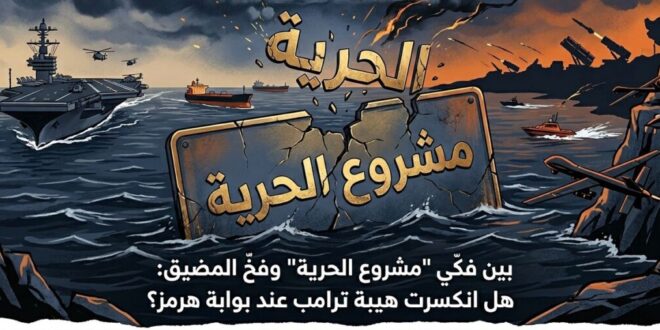
The announcement was bold, almost theatrical: a presidential push branded as “Project Freedom,” aimed at securing maritime navigation in the Gulf and projecting American resolve at one of the world’s most sensitive chokepoints.
But within hours, the narrative shifted.
What was presented as an assertive effort to reshape security in the Strait of Hormuz quickly gave way to a pause—an abrupt recalibration that has raised uncomfortable questions about the gap between strategic ambition and operational reality.
At the heart of the episode lies a familiar but unresolved dilemma: the limits of coercive power in a theater where escalation is not linear, and where deterrence is constantly tested at the edge of risk.
The Strait of Hormuz is not merely a shipping lane. It is a geopolitical pressure point through which a significant share of global energy flows. Any attempt to unilaterally impose control over it is therefore not just a military operation—it is a direct confrontation with a deeply embedded regional balance.
The reported suspension of the initiative, following immediate security challenges and rapid escalation risks, is already being interpreted in competing ways. Supporters of the move frame it as tactical flexibility, a recalibration in response to shifting conditions and international consultations. Critics see something more fundamental: an early signal that the costs of enforcement exceeded initial assumptions.
In practical terms, global shipping actors did what they often do in moments of uncertainty—they stepped back. Commercial operators, sensitive to insurance risk, disruption, and escalation timelines, tend to avoid reliance on contested security guarantees unless they are consistently enforced. The result was not a test of rhetoric, but of credibility.
The underlying equation remains unchanged: maritime security in the Gulf cannot be separated from the broader question of regional strategic balance. Attempts to guarantee safe passage without addressing the political and military environment that surrounds it have repeatedly run into the same obstacle—deterrence is reciprocal, not unilateral.
In this context, Iran’s long-standing approach to “brinkmanship”—calibrated escalation designed to shape rather than simply reject outcomes—has once again demonstrated its relevance. Whether one views it as deterrence or disruption depends on perspective, but its effect is consistent: it raises the cost of any imposed security architecture.
The result is a stalemate disguised as movement.
Efforts to project strength through maritime enforcement encounter countermeasures that are not symmetrical in form but are effective in impact. Missile capabilities, drone warfare, and the implicit threat to energy flows have collectively altered the risk calculus for external actors considering direct intervention in this space.
Against this backdrop, any strategic withdrawal or suspension is unlikely to be read purely in procedural terms. In the language of regional politics, perception often matters as much as intent. What one actor frames as tactical adjustment, another may interpret as constraint.
Yet it would be a mistake to reduce the moment to a binary of success or failure. The deeper issue is structural. The Gulf has entered a phase in which maritime security, energy exports, and geopolitical competition are fully intertwined. No single actor—external or regional—can fully separate these dimensions or control them in isolation.
This is why repeated attempts to impose “order” on the Strait through force or demonstration alone have struggled to produce durable outcomes. Each escalation is met with counter-escalation, each assertion of control with mechanisms of disruption, until equilibrium reasserts itself—not as stability, but as managed tension.
The broader question, then, is not whether one initiative succeeds or fails, but whether the region is entering yet another cycle of temporary fixes over structural resolution.
If “Project Freedom” was intended as a demonstration of decisive capability, its rapid suspension instead highlights the constraints under which such strategies operate. Power in the Strait of Hormuz is not exercised in a vacuum; it is negotiated continuously, under pressure, and often at the edge of escalation.
What remains now is an open-ended situation—one in which neither full enforcement nor full retreat has been established. That ambiguity itself is instructive.
Because in this region, pauses are rarely neutral.
They are part of the escalation ladder.
About the Author:
Hosein Mortada is a prominient Lebanese journalist.