 Geostrategic Media Political Commentary, Analysis, Security, Defense

Sachin Yadav
Could Taiwan Trigger the Next Global Crisis?
In an era already shaped by the Russia–Ukraine war, the West Asia conflict, and rising geopolitical fragmentation, one issue continues to keep military planners in Washington, Beijing, Tokyo, and even New Delhi awake at night which is related to Taiwan. The small democratic island of 23 million people has increasingly become the epicenter of strategic rivalry between the United States and China. What was once a diplomatic dispute has now evolved into a high-stakes military and technological confrontation with global consequences.
The Taiwan crisis is no longer simply about sovereignty. It is about the future balance of power in the Indo-Pacific, the credibility of American alliances, China’s rise as a superpower, and control over the world’s most advanced semiconductor industry. If a conflict erupts in the Taiwan Strait, it would not remain regional for long. It could rapidly escalate into the first direct military confrontation between nuclear-armed great powers in the 21st century.
China considers Taiwan a “core national interest” and has repeatedly refused to rule out the use of force for reunification. Taiwanese leaders, meanwhile, increasingly emphasize a distinct Taiwanese identity and democratic sovereignty. The United States officially follows the “One China Policy” but continues to arm Taiwanand strengthen unofficial ties under the Taiwan Relations Act of 1979. These contradictory positions have created a fragile equilibrium that is becoming harder to sustain every year.
The Island at the Center of a Superpower Showdown
Geography alone explains much of Taiwan’s importance. Located roughly 160 kilometers off China’s southeastern coast, Taiwan sits at the center of the so-called “First Island Chain,” a strategic line stretching from Japan to the Philippines that can constrain Chinese naval access to the Pacific
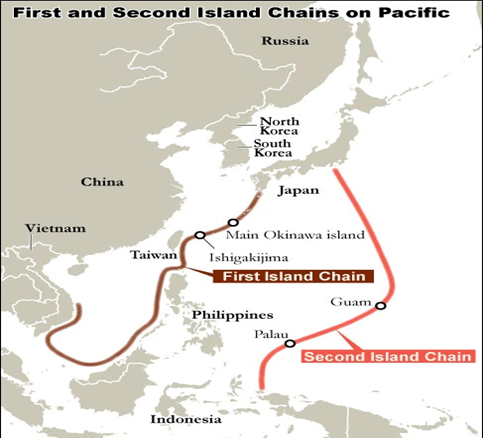
Source: University of Navarra, Spain
For Beijing, bringing Taiwan under mainland control would fundamentally alter the Indo-Pacific military balance. It would allow the People’s Liberation Army Navy (PLAN) to project power deeper into the Pacific Ocean, challenge American naval dominance, and weaken U.S. alliances with Japan and South Korea. Strategic analysts increasingly argue that Taiwan is not merely symbolic for China, it is militarily indispensable.
This explains why China’s military buildup around Taiwan has been staggering in scale. According to the data from Taiwan’s Ministry of Defence, In 2024, out of 365 days the Chinese military aircraft crossed the Taiwan Strait median line 313 days, which is the highest in the last 4 years. The data also reveals that the People’s Liberation Army (PLA) aircrafts conducted 3070 sorties across the Median line in 2024, with an average of 8.4 sorties per day.
Monthly Days of Chinese Aircraft Crossing the Taiwan Strait Median Line
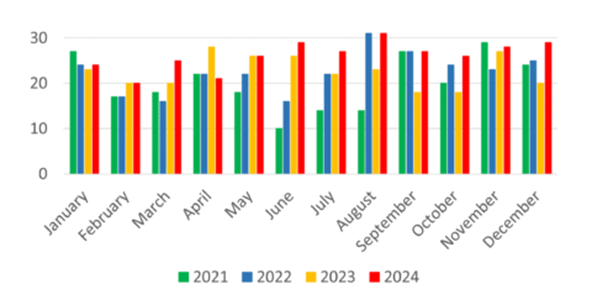
Source: Jamestown
Monthly Sorties of Chinese Aircraft Crossing the Taiwan Strait Median Line
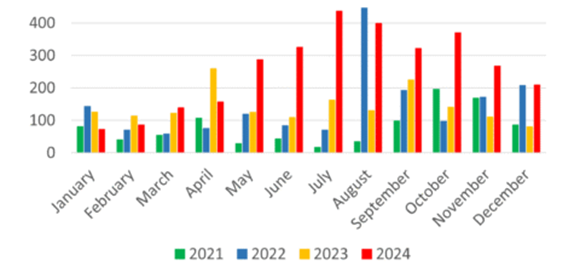
Source: Jamestown
The PLA Navy is now the world’s largest navy by number of ships, while China is rapidly expanding its missile forces, cyberwarfare capabilities, space assets, and nuclear arsenal. CSIS estimates show China’s nuclear stockpile has already reached approximately 600 warheads and could climb to 1,500 by 2035. President Xi Jinping has also linked Taiwan reunification directly to his vision of “national rejuvenation.” Reports indicate that Xi has instructed the PLA to develop the capability to invade Taiwan by 2027, a date now closely watched by Western intelligence agencies.
Why Taiwan Keeps Washington and Beijing on Edge
The United States views Taiwan through both strategic and ideological lenses. Strategically, losing Taiwan to China would severely damage American credibility in Asia. U.S. allies such as Japan, South Korea, and the Philippines would question Washington’s security guarantees. Militarily, it would weaken the US’s forward defense posture in the Pacific.
Economically, Taiwan is indispensable to the global technology supply chain. Led by Taiwan Semiconductor Manufacturing Company (TSMC), Taiwan accounts for over 60 percent of global foundry revenue and more than 90 percent of leading-edge chip production . These chips power everything from smartphones and artificial intelligence systems to military equipment and advanced computing. Hence, any disruption in Taiwan would create catastrophic consequences for the global economy.
This is precisely why the United States has intensified arms sales and military cooperation with Taiwan. Since 1950, Washington has approved more than $50 billion in military sales to Taipei. Recently in December 2025, the US announced its largest arms package of $11 billion for Taiwan,
Taiwan itself is dramatically increasing defense spending. President Lai Ching-te has pushed for major military reforms, indigenous drone programs, expanded missile production, and enhanced civil defense initiatives. Recently in May 2026, Taiwan proposed a defense package worth nearly $40 billion, though domestic political disputes have delayed parts of the budget.
At the same time, rhetoric on both sides is hardening. In March 2025, President Lai publicly labeled China a “foreign hostile force” and announced stronger counter-infiltration measures against Beijing’s espionage activities. China responded with intensified military drills and larger naval deployments around Taiwan.
The risk is that constant military signaling increases the possibility of miscalculation. Chinese warships and aircraft now routinely operate near Taiwan, while U.S. naval vessels continue freedom of navigation operationsthrough the Taiwan Strait. Each side believes it is deterring the other. Yet history shows that crises often emerge not from deliberate war plans but from accidents, escalation, and political misjudgment.
The Numbers Tell a Dangerous Story
What makes Taiwan especially dangerous is the scale of military and economic consequences that experts now anticipate in the event of conflict.
A major Centre for Strategic and International Studies (CSIS) war game conducted across multiple scenarios concluded that although the United States, Japan and Taiwan could likely repel a Chinese invasion, the costs would be devastating. The US and its allies can lose tens of thousands of soldiers, hundreds of aircrafts and dozens of ships. Economically this might give a major blow to the Taiwan economy and the US can lose its global position for many years. Similarly, China is also likely to suffer an economic shock and a failed attempt to occupy Taiwan might destabilize Chinese Communist Party (CCP)
Even a blockade scenario increasingly seen as more plausible than a full amphibious invasion could trigger a global economic shock. Taiwan sits on critical shipping lanes as 88 per cent of the world’s largest ships by tonnage pass through the Taiwan Strait every year. Therefore the recent CSIS blockade simulations also warned that a Taiwan crisis could produce economic damage exceeding that of the Ukraine war.
Conclusion
Unlike Ukraine or the South China Sea, Taiwan directly involves two global superpowers with enormous military capabilities and nuclear arsenals. It is the rare issue where neither Beijing nor Washington believes it can afford to back down. For China, Taiwan represents unfinished national unification and the legitimacy of Communist Party rule. For the United States, Taiwan has become a test of credibility, deterrence, and the broader Indo-Pacific order. The deeper the rivalry grows, the narrower the diplomatic space becomes. Yet war is not inevitable. Both sides still understand the catastrophic costs of direct conflict. China’s economy remains vulnerable, while the United States is stretched across multiple theaters globally. This mutual awareness has so far preserved uneasy stability.




You must be logged in to post a comment.