 Geostrategic Media Political Commentary, Analysis, Security, Defense

Rafaeil Christiano
The world is fixated on oil prices again. Tankers, benchmarks, and barrels dominate the headlines. But this time, the real shock is not only flowing through energy markets—it is quietly seeping into the soil.
What is at stake in the Strait of Hormuz is not just oil. It is food.
Modern agriculture does not run on water and seeds alone. It depends on something far more fragile: a precisely timed chain of energy, fertilizers, and shipping. Break that chain—even briefly—and the consequences do not show up at the pump. They show up on the dinner table.
And that is exactly what is now unfolding.
Hormuz: More Than an Oil Chokepoint
For decades, the Strait of Hormuz has been understood as the world’s most critical oil corridor. Roughly a fifth of global oil trade passes through it. But that definition is incomplete—and dangerously outdated.
Hormuz is also a lifeline for fertilizers.
A significant share of global urea—the backbone of nitrogen fertilizers—moves through this narrow passage. And that matters because nitrogen fertilizers are not optional. They are the foundation of modern crop yields.
The Gulf produces these fertilizers using natural gas, which accounts for up to 70% of production costs. When gas flows are disrupted, fertilizer production contracts. When shipping lanes close, supply chains fracture.
This is no longer a maritime issue. It is an agricultural one.
From Energy Shock to Food Shock
The disruption triggered by the recent conflict involving Iran has already moved beyond oil into something far more consequential.
Shipping through Hormuz has collapsed. Insurance costs have surged. Gas supply has been disrupted. Fertilizer plants have slowed or halted production.
And the shock has traveled—fast.
From gas fields to fertilizer plants.
From fertilizer plants to global markets.
From markets to farmers—just as planting season begins.
The timing could not be worse.
Farmers can absorb price increases, to a degree. What they cannot absorb is delay. Miss the fertilization window, and no amount of late supply can recover lost yield.
This is the brutal asymmetry of agriculture: timing is everything.
The Price Spike Is Just the Beginning
The numbers already tell part of the story.
- Nitrogen fertilizer prices in Europe have surged roughly 58% above 2024 averages
- Urea prices have doubled in a matter of weeks, with Indian tenders approaching $1,000 per ton
- War-risk insurance for shipping has jumped from 0.25% to as high as 3% of vessel value
But higher prices are not the real danger.
Scarcity is.
When shipping slows and supply tightens, what begins as inflation quickly becomes unavailability. And in agriculture, scarcity translates directly into lower yields.
A Crisis That Hits Unevenly—and Hardest at the Margins
Not all regions will feel this shock equally.
Asia and Africa are on the front lines. Countries such as Kenya, Uganda, Thailand, and Sri Lanka rely heavily on imported nitrogen fertilizers—often arriving on tight seasonal schedules. For them, delay is more destructive than cost.
Major agricultural exporters like Brazil and Australia are also exposed, given their dependence on imported urea. Even a short disruption can ripple through global grain markets.
The United States is relatively more insulated, thanks to stronger domestic production—but not immune. Higher global prices will still feed into domestic costs.
And then there are the most vulnerable: small farmers in developing economies, operating within narrow planting windows, with limited financial buffers and no access to alternatives.
For them, this is not a market fluctuation.
It is a potential collapse.
The Crops That Will Take the First Hit
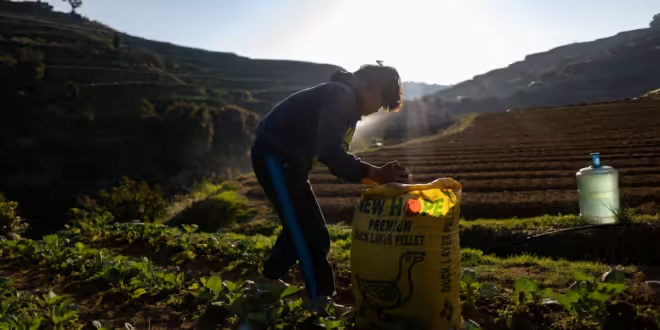
The impact will not be abstract. It will be visible—in the fields.
Nitrogen-intensive crops like:
- Corn
- Wheat
- Rice
are the most exposed. Urea alone accounts for more than half of global nitrogen fertilizer use. Any disruption in its supply directly reduces yields.
Already, farmers in Latin America are reconsidering second planting cycles. In Africa, critical agricultural windows are at risk. In parts of Asia, producers are shifting toward less nitrogen-intensive crops—reshaping next year’s food supply before it is even planted.
This is how a shipping disruption becomes a global food crisis.
The Invisible Multiplier: Timing
Perhaps the most dangerous aspect of this crisis is not its scale—but its timing.
According to global development institutions, even a small reduction in fertilizer use can lead to disproportionately large declines in output. The relationship is not linear—it is exponential.
Miss the application window, and yields do not fall slightly.
They collapse.
And once a planting season is lost, it cannot be recovered.
From Inflation to Hunger
If Hormuz reopens quickly, the damage may remain contained—higher prices, tighter margins, but manageable outcomes.
But if disruption persists for months, the consequences escalate dramatically:
- Reduced fertilizer use
- Lower agricultural yields
- Tightened global food supply
- Rising food prices
- Expanding food insecurity
At that point, this is no longer about markets.
It is about millions of people pushed closer to hunger.
A Fragile System Exposed
What this crisis reveals is something deeper—and more unsettling.
The global food system is far more fragile than it appears.
It depends not only on land and labor, but on invisible flows of energy, chemicals, and logistics—flows that can be disrupted thousands of miles away from the nearest farm.
Hormuz is not just a geopolitical chokepoint.
It is a systemic vulnerability.
Final Thought
When oil stops flowing, economies slow.
But when fertilizer stops flowing, the world does not just slow—it goes hungry.
The lesson is stark:
in an interconnected world, the distance between a naval chokepoint and a farmer’s field is far shorter than we think.
And when that connection breaks, the consequences are not measured in barrels—
but in bread.