 Geostrategic Media Political Commentary, Analysis, Security, Defense

Hadi Elis
Since his election as prime minister in 2002, Recep Tayyip Erdogan — now president of Turkey — has worked relentlessly to expand the role of Islam in every corner of political life. What Western observers once called a drift toward Islamic conservatism has become a systematic transformation: from secular democracy to something else entirely.
The struggle to lift Turkey’s headscarf ban was never just about religious freedom. It was an ideological battle to win public support against Kemalism — the secular, state-centered ideology of Mustafa Kemal Ataturk — and the entire system built upon it. Turkish political Islam, dormant after World War II, spent decades learning how to islamize the country from within. Erdogan’s goal, stated openly, is to create a “pious generation.” To that end, vast sums have poured into religious schools, especially after the military coup of September 12, 1980.
Now, Erdogan and his AK Party want to restructure Turkey politically. The authoritarian presidential system they designed is meant as an ideological counterforce to Kemalism — an Islamist mirror image of Ataturk’s one-party state. And observers agree on one striking fact: Erdogan has already served longer than Ataturk himself, who ruled for 15 years from 1923 to 1938.
So what comes next? The question often asked is why Turkey embraced the risky path of the Arab Spring. But that misses the point. Neo-Ottomanists saw an opportunity to reclaim former Ottoman territories — especially Kurdish-majority lands in Syria and Iraq rich in oil and gas. The old Ottoman provinces of Mosul (lost to Britain) and Sham (lost to France) could be recovered a century later, as international treaties expired. By connecting with Muslim Brotherhood movements in Syria and Egypt, Turkey aimed to position itself as the leader of the Arab-Islamic world — still seen by Neo-Ottomanists as their natural sphere of influence.
But the strategy has darker dimensions. Turkey became a gateway for global jihadi armed movements. Turkish jihadis have reportedly been armed inside the country as a future militia — to carry out massacres of Kurds and leftists when political conditions mature. Consider this chilling detail: a pro-Erdogan woman speaking on national television once boasted that the weapons stored in her apartment were enough to kill every resident in her gated community. Private military contractors like SADAT have set up paramilitary forces across Turkey. And alongside the old Grey Wolves (NATO’s Gladio creation, nominally anti-communist but focused on crushing Kurdish nationalism), a new Turco-Islamist movement has emerged: the “Ottoman Hearts.”
Erdogan’s decision to make Huda-Par — Turkey’s version of Hezbollah — a junior partner in the AKP-led coalition government is another clear signal of his intentions. He wants an Islamic Republic.
Listen to his own words. On April 30, 2015, Erdogan said: “Turkey’s democracy is currently Anglo-Saxon in model and French in spirit. This causes an intermingling of democracy and the republic. … While this system was being reinforced through a bureaucratic oligarchy, the people’s participation was ignored.” He called the existing system “itself an obstacle to change” and demanded a presidential system as “a profound reform, a radical step.” After the 2015 election, he got his wish. The constitution was rewritten, and Turkey’s parliamentary democracy gave way to a presidential system granting Erdogan extensive autocratic powers — much like Ataturk in his time.
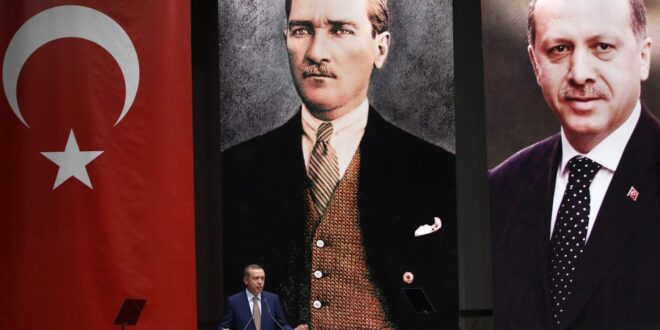
The symbolism is deliberate. Erdogan donned a military uniform during the occupation of Afrin, mimicking Ataturk’s own martial imagery. But where Ataturk made Turkey a secular, pro-Western nation-state, Erdogan is reversing the process — taking Turkey back toward its Ottoman past.
Which brings us to the current crisis. What is Erdogan trying to achieve by splitting the Republican People’s Party (CHP), the last great Kemalist institution? Simple: liquidation. This is not a “post-Kemalist” period. It is de-Kemalization — the systematic erasure of Ataturk’s legacy.
The final move awaits the 2028 presidential election. But the ongoing CHP crisis suggests a change of plan. Erdogan may call an early election to bypass the constitutional limit of two terms. If the faction loyal to former CHP leader Kemal Kılıçdaroğlu — with at least 28 MPs — decides to support Erdogan, he would secure the 400 votes needed to rewrite the constitution once more.
What everyone is starting to believe, watching these events unfold, is that the Kemalist Republic is living its final days. Whether Turkey emerges as an Islamic Republic or something else entirely depends on how quickly — and how violently — Erdogan chooses to complete his long march.
*Sources: Birol Baskan, “Turkey’s Pan-Islamist Foreign Policy,” The Cairo Review of Global Affairs, Spring 2019; Turkishminute.com, May 10, 2020; Hürriyet Daily News, 2015.*