

 Geostrategic Media Political Commentary, Analysis, Security, Defense

The Persian Gulf Strait Authority, launched by Iran on 5 May 2026, is the institutional capstone of a longer manoeuvre. Its visible apparatus reduces to an email address, a logo, and a permit form. Its operating significance is the formalisation of a coherent instrument for discretionary, sanctions-resilient pricing …
May, 2026
-
14 May
The Trump–Xi Summit and the Decline of American Crisis Management
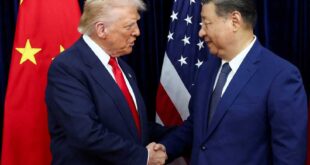
The upcoming meeting between Donald Trump and Xi Jinping in Beijing is not a bilateral summit between two competing powers. It is a test of whether the United States can still manage major international crises on its own terms. The agenda is expected to include Iran, Taiwan, trade, …
-
14 May
Trump and Xi Meet: The Key Issues Behind America’s Most Important Summit of 2026
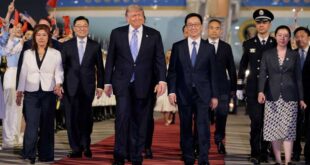
Trump is heading to Beijing for the most consequential foreign policy meeting of his second term. He arrives as the first US president to visit China in nearly nine years — the last visit was his own, in November 2017, when Xi rolled out a “state visit-plus” with …
-
14 May
Al-Makahleh: The Beijing Summit: Trump’s High-Stakes Pilgrimage to the Court of Xi Amid a Fracturing World Order
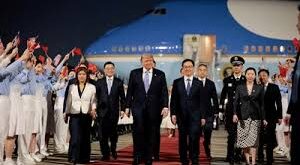
Dr. Shehab Al-Makahleh On the eve of his arrival in Beijing, Donald Trump chose a phrase that was deceptively simple: “I respect Xi, and I hope he respects me.” Beneath that carefully calibrated diplomatic phrase lies a far more consequential reality: this is not a courtesy visit between …
-
12 May
Beijing’s Persian Gambit: How the Iran War Became China’s Strategic Opening — and America’s Diplomatic Trap

Dr. Shehab Al-Makahleh In war, the first casualty is not truth. It is hierarchy. The missiles over Iran did more than rupture military installations and redraw escalation maps across the Gulf. They exposed something larger and far more consequential: the quiet disintegration of the geopolitical order that governed …
-
12 May
Will Turkey Ever Lay Down Its Arms Against the Kurds?

Hadi Elis For decades, Turkey has systematically created problems for the Kurdish people. Those problems did not emerge from thin air. They forced the Kurds to form the PKK as a resistance movement against deliberate, state-driven assimilation policies—policies that many would argue amount to an effort to exterminate …
-
11 May
US Senate minority leader vows to push new vote to end Iran war

US Senate Minority Leader Chuck Schumer accused President Donald Trump on Monday of dragging the US into war with Iran and announced that Senate Democrats will force another vote on legislation seeking to end US military involvement. Speaking on the Senate floor, Schumer said that the Trump administration …
-
11 May
The Race for Data: The New Era of Digital Armament

Dr. Nessrine Mesto-Assaad On January 21, 2025, during his first press conference following the start of his second term as President of the United States, Donald Trump announced his support for the largest artificial intelligence (AI) infrastructure project to date—the Stargate Project—under Executive Order No. 14179. He was …
-
11 May
AI without humans risks creating ‘world beyond our control,’ expert warns

Gokhan Ergocun If we rely on machines only, ‘then we are creating a world which is beyond our control,’ Bouee tells Anadolu Imagine a world where machines replace humans entirely. That worst-case scenario can be avoided if AI is used to augment — rather than replace — human …
