 Geostrategic Media Political Commentary, Analysis, Security, Defense

By Geostrategic Media Analysis Desk | October 28, 2026
Europe is entering winter with a gas tank barely three-quarters full, a vital supply route largely shut and a familiar supplier pitching itself as the answer. The coming weeks will test the continent’s energy security more than any moment since the autumn of 2022.
The numbers behind the squeeze
The Dutch TTF benchmark touched about €97.50 per megawatt-hour on 26 October, its highest since late 2022, before easing to around €96 on Tuesday after four straight sessions of gains. EU storage stood at 74.6 percent on 25 October, which analysts describe as the lowest for the time of year since records began in 2009. Cold weather has pushed several countries to start withdrawing gas earlier than usual, and an outage at Norway’s Oseberg field has trimmed pipeline supply. Forecasts point to a colder early November in northern Europe.
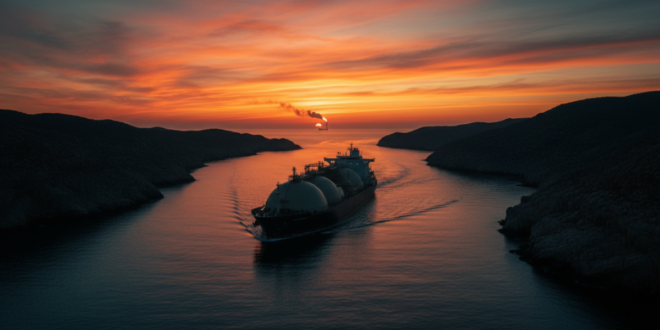
The deeper cause sits in the Gulf. Qatar, the world’s second-largest LNG exporter before the Iran war, has seen cargoes slow to a trickle for about seven months. QatarEnergy has reported damage to two of its 14 liquefaction trains, and analytics firm Kpler estimates that LNG traffic through the Strait of Hormuz in October is about 75 percent below pre-escalation levels. Europe’s October LNG imports are projected at roughly 9.1 million tonnes, down from 10.6 million a year earlier, while Asian buyers compete for the same flexible cargoes.
A price gap that tells a story
On 22 October US Henry Hub gas settled near $2.80 per million BTU, while European TTF traded above €90 per megawatt-hour, roughly $30. That is about an elevenfold gap, and it explains a striking deal: Cheniere announced two long-term agreements to supply QatarEnergy with a combined 4 million tonnes a year of US LNG from Louisiana and Texas. A Gulf producer buying American gas to honour its own contracts shows how badly its own export route is constrained, and how much US supply has become the world’s safety valve.
Moscow’s pitch
Against this backdrop, the Gas Exporting Countries Forum (GECF) held its eighth summit in Moscow on 27 October. According to RIA Novosti, President Vladimir Putin warned that attempts to exclude Russia from the global gas market would carry serious consequences. He argued that sanctions harm both producers and consumers, and that the forum’s members hold about 70 percent of the world’s gas reserves, a figure that comes from the Russian side. Participants adopted the Moscow Declaration and, according to Russian media, signalled an intention to respond jointly to gas crises.
It is a politically convenient moment for that message. Brussels’ stated goal remains to end reliance on Russian energy, yet the continent’s storage deficit makes every cargo count. Moscow is positioning itself as the reliable supplier at the exact time European buyers are paying a steep price for alternatives.
The forum’s ability to act as a bloc should not be overstated. Its members have divergent interests, and its roster includes both Qatar and Iran, whose conflict has damaged Qatari export capacity. A coordinated gas “cartel” is far harder to build than the oil model.
Foresight: what the next 60 days look like
- Base case: prices stay elevated and volatile, swinging on Gulf diplomacy headlines. Storage empties faster than normal, leaving little buffer by February.
- Upside shock: a cold snap or a fresh attack on shipping could push prices above recent highs and trigger emergency demand measures, such as industrial curtailment or joint purchasing.
- Relief case: a verifiable reopening of Hormuz to LNG traffic would cut the risk premium quickly, though damaged Qatari trains will take time to repair.
Watch three indicators: weekly storage drawdown rates, LNG transit data through Hormuz, and whether US export capacity can keep absorbing demand. Policy pressure to loosen Russia-related restrictions will grow if prices rise further, which makes this winter as political as it is physical.
Sources: Reuters-based reporting via OGJ and OilPrice, Forbes, Goldman Sachs commentary, Kpler, RIA Novosti, Interfax, 22–28 October 2026.