Geostrategic Media Political Commentary, Analysis, Security, Defense

Dr. Shehab Al-Makahleh
Key points
- The Democratic victory in both chambers of Congress represents a significant political setback for Donald Trump.
- Congressional opposition will increase scrutiny of military spending, foreign commitments and executive decisions.
- The president nevertheless retains considerable constitutional authority over foreign policy and military operations.
- Allies and adversaries will increasingly assess Washington through the lens of domestic political divisions.
- America’s international influence will depend not only on military power but also on institutional credibility and political consistency.
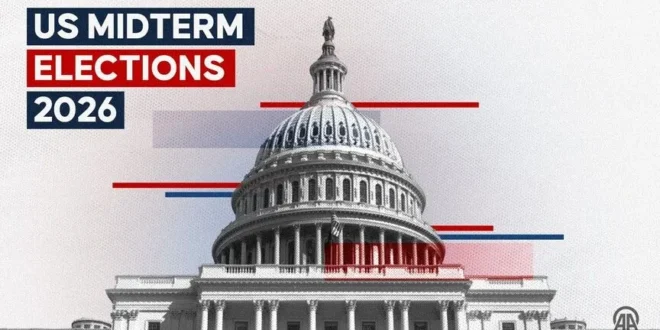
The American midterm elections have delivered a political message that extends far beyond Washington. By securing control of both chambers of Congress, the Democrats have significantly altered the domestic political environment confronting President Donald Trump during the final two years of his term. Yet the most consequential question is not whether the president has lost political ground. It is whether the United States can maintain a coherent international strategy when its domestic institutions are increasingly divided over the country’s direction.
The distinction between congressional power and presidential authority is particularly important. Congress can investigate the administration, challenge appropriations, scrutinise military expenditure and obstruct legislative initiatives. It can also reshape the political debate surrounding America’s international commitments. However, the president retains substantial constitutional authority over diplomacy, military command and national security decision-making. The result is likely to be a more complicated foreign-policy environment rather than an immediate reversal of American strategy.
For America’s allies, particularly in Europe and the Middle East, this uncertainty creates a difficult strategic calculation. Governments cannot assume that an American commitment announced by one administration will necessarily enjoy the same political support across Washington. Nor can they afford to treat congressional opposition as an automatic guarantee of a different foreign policy. The institutions of American power may disagree over methods while remaining broadly committed to strategic competition and national security objectives.
The Middle East will provide an immediate test. The confrontation with Iran, the security of maritime routes, the future of Gaza and the strategic relationship with Israel will continue to demand presidential decisions. A divided Congress could increase scrutiny of military operations, arms transfers and financial commitments, but it may not prevent the administration from pursuing its preferred regional policy.
The consequences extend to Ukraine and the wider European security architecture. Congressional pressure may create opportunities to reassess assistance to Kyiv and rebuild transatlantic coordination. Nevertheless, European governments should recognise that American political disagreement does not automatically translate into a sustainable European strategy. Strategic autonomy requires more than declarations; it requires industrial capacity, defence investment and political coordination.
China, meanwhile, will watch whether domestic divisions weaken America’s ability to maintain a consistent approach to trade, technology and regional security. Beijing may see opportunities in Washington’s political uncertainty, but it must also recognise that competition with China remains one of the few issues capable of attracting bipartisan support.
Ultimately, the midterms have exposed a central contradiction in American power: the United States remains capable of projecting enormous military, economic and diplomatic influence, yet its ability to sustain a predictable international role is increasingly affected by domestic political conflict.
The next two years will therefore be a test not simply of presidential leadership, but of American institutional resilience. The world does not need an America that dominates every crisis. It needs an America whose commitments can be understood, whose policies can be anticipated and whose international partnerships survive changes in political leadership.
The greatest strategic danger for Washington is not that its adversaries will become stronger overnight. It is that its allies will gradually conclude that American power remains formidable, but American policy has become increasingly difficult to trust.