 Geostrategic Media Political Commentary, Analysis, Security, Defense
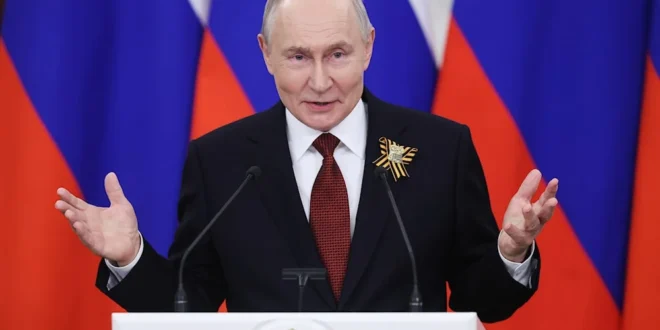

Russian President Vladimir Putin said on Saturday that Russia immediately agreed to a proposal from US President Donald Trump to extend the ceasefire with Ukraineand carry out a prisoner-of-war exchange.
“We immediately agreed to this. Moreover, in my view, it is a justified proposal, motivated by considerations of respect for our shared victory over Nazism, and clearly of a clear humanitarian nature,” Putin told reporters.
He said Russia’s response to Ukrainian threats ahead of Victory Day was firm and coordinated, noting that both the Defense Ministry and the Foreign Ministry issued official statements.
Russia, he added, has no interest in worsening relations with other countries but warned that Ukraine’s provocations could have led to escalation.
Putin also said he had not yet received confirmation from the Defense Ministry on whether any provocations actually occurred during Victory Day.
“The armed forces must focus their attention on the final defeat of the enemy through a special military operation,” he stressed.
Russia consults China, India, and US over Ukraine tensions
Putin said Russia held discussions with China, India, and the United States regarding possible consequences of Ukrainian provocations on May 9.
“We have begun working with our key partners and friends. First and foremost, with our friends from the People’s Republic of China, India, and several other countries, including with the US administration,” he said.
Zelensky meeting reasonable at final stage of settlement
Putin said a direct meeting with Ukrainian President Volodymyr Zelensky would only make sense as the final stage of a settlement, not during negotiations.
“If the Ukrainian side, that is, Mr. Zelensky, is ready to hold a personal meeting… In order for me to participate in this event, or sign anything, it must be a final point, not part of the negotiations,” he stated.
Furthermore, he confirmed that Slovak Prime Minister Robert Fico had delivered a message from Zelensky, but said there was “nothing new” in it.
Putin added that he did not reject the idea of a meeting, but also did not agree to it under current conditions.
“It is possible to meet in a third country, but only if final agreements are reached on a peace treaty, which should be calculated for a long-term historical perspective,” he said.
He also stated that Zelensky could come to Moscow if he wanted a personal meeting.
Putin praises foreign leaders visiting Moscow for Victory Day
Putin said foreign leaders who attended Victory Day celebrations in Moscow showed “personal courage”, given Ukrainian threats and uncertainty surrounding the situation.
“Those who came demonstrated a certain degree of personal courage,” he said.
He added that many arrived before learning about easing tensions linked to proposals by Trump on ceasefire extension and prisoner exchanges.
Putin said their attendance deserved “special respect” but noted that the absence of some usual guests was not significant.
“We did not extend formal invitations this year. This was not a special anniversary celebration. But we sent out information to everyone that we would be happy if they came,” he noted.
Russia ready to repeat Iranian Uranium transfer model
Putin also said Russia is prepared to repeat a previous arrangement involving the transfer of Iran’s enriched uranium, referencing a 2005 precedent.
He said Moscow had once proposed moving Iranian uranium to Russian territory and that “everyone agreed” at the time.
However, he noted that the United States later changed its position and demanded that the uranium be transferred elsewhere.
Putin added that Ali Larijani, Secretary of Iran’s Supreme National Security Council, later informed Moscow that after Washington’s reversal, Iran was “no longer willing to transfer the uranium.”
It is worth noting that one of Trump’s central foreign policy goals since the US-Israeli aggression on Iran started in February has been forcing Tehran to surrender its estimated 408-kilogram stockpile of highly enriched uranium.
Nearly a month after the temporary ceasefire and indirect negotiations involving Iran, the United States, and “Israel”, Washington continues to push for major concessions from Tehran.
Iranian officials, however, have repeatedly insisted that the country will not compromise on sovereign issues, particularly those tied to control of the Strait of Hormuz and its uranium enrichment program.