Geostrategic Media Political Commentary, Analysis, Security, Defense

Dr. Shehab Al-Makahleh
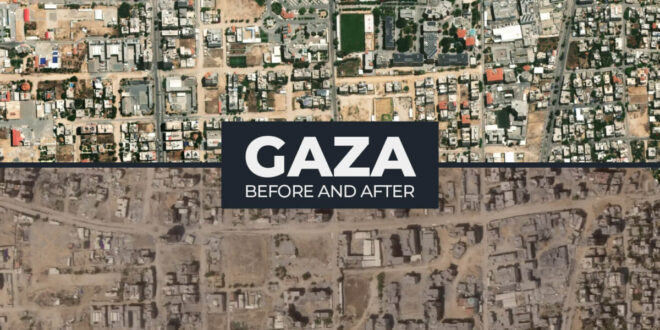
There are wars conducted with missiles, drones, and precision-guided munitions, and then there are wars waged more quietly, more insidiously, against memory itself. The tragedy of Gaza today lies not merely in the pulverized skeletons of its streets, the collapse of its hospitals, the obliteration of its homes, nor even in the unspeakable toll of civilian suffering. There is something far more dangerous unfolding: the gradual, deliberate, yet strangely unremarked disappearance of Gaza from the center of the world’s moral imagination. As the confrontation between Israel and Iran expanded into a regional spectacle of missile exchanges, deterrence doctrines, intelligence leaks, maritime brinkmanship in the Strait of Hormuz, and renewed nuclear anxieties, Gaza slowly became what strategic planners, with their chilling clinicality, term a “secondary theatre.” Yet history teaches, with brutal regularity, that forgotten battlefields are precisely the ones that return to reshape the geopolitical future with the most violent and unpredictable force.
The modern world suffers from what may be called a profound strategic attention deficit, a cognitive affliction of the global media age. The international information ecosystem no longer processes suffering according to its moral weight or humanitarian urgency, but rather by its geopolitical market value — its capacity to generate headlines, shift oil prices, or threaten Western security interests. Once the skies above Tehran, Tel Aviv, the Strait of Hormuz, and the Red Sea became saturated with the language of escalation, oil shocks, drone warfare, cyber intrusions, and nuclear thresholds, Gaza was inexorably pushed into the background noise of history. The cameras moved elsewhere. Diplomats quietly reprioritized their dossiers. Intelligence agencies recalibrated their threat matrices away from the coastal enclave. And in that deafening silence, Gaza entered a more dangerous phase than open warfare: the phase of normalization through neglect.
I. The Politics of Forgetting: How Strategic Attention Deficit Became an Instrument of Erasure
George Orwell once issued a warning that reverberates across the decades with terrifying contemporary relevance: “The most effective way to destroy people is to deny and obliterate their own understanding of their history.” What is unfolding today in Gaza is not merely military attrition, nor the grim arithmetic of casualties, nor even the collapse of infrastructure. It is something more systemic and more enduring: the slow, methodical political erasure of Gaza from the hierarchy of urgent global crises. In cold geopolitical terms, Gaza has become trapped between two competing and equally absolutist strategic doctrines. On one side stands Israel’s doctrine of permanent security management—an approach that seeks not resolution but containment, not peace but the indefinite suppression of threats through technological superiority and periodic military campaigns. On the other side stands the regional axis doctrine of permanent resistance—a philosophy that elevates armed struggle from a tactic into an eternal principle, rendering any political compromise tantamount to betrayal. Between these two absolutes, civilian life itself has become negotiable, reduced to a variable in a calculus of force.
The irony is as brutal as it is tragic. The Iran war was initially framed by many analysts, pundits, and strategic commentators as inseparable from Gaza, as though the long-marginalized Palestinian question had finally become central to the evolving architecture of Middle Eastern conflict. Yet precisely the opposite occurred. Gaza became absorbed into a larger regional storm, a maelstrom of competing great-power rivalries, in which its specific humanitarian catastrophe lost all diplomatic uniqueness. The world became fascinated—indeed, almost mesmerized—by the theatrical possibility of a direct Iran-Israel confrontation, while simultaneously becoming psychologically desensitized to the grinding, daily, almost routine reality of destruction in Gaza. William Shakespeare’s haunting lines from Macbeth now seem to define the psychology of all parties entangled in this morass: “I am in blood stepped in so far that, should I wade no more, returning were as tedious as go o’er.” Israel, Hamas, Iran, Hezbollah, and even the international actors who claim to mediate have become trapped inside self-reinforcing cycles of escalation from which strategic retreat has come to appear more dangerous than continued confrontation. The result, in its most distilled essence, is the militarization of political paralysis—a condition in which the instruments of war are continuously refined while the goals of peace are continuously deferred.
For Hamas, the calculus is particularly unforgiving. Disarmament without a credible political horizon resembles not statesmanship but surrender without history. The movement understands, with a clarity born of decades of survival, that weapons are not merely military tools for inflicting damage upon an adversary; they are existential bargaining instruments, the only currency of leverage in a political marketplace that offers nothing else. Unlike the African National Congress in South Africa, which could eventually trade armed struggle for a post-apartheid state, or the Irish Republican Army in Northern Ireland, which could demobilize into a power-sharing assembly, Hamas sees no credible political architecture waiting on the other side of demobilization. No sovereign Palestinian state is emerging on the horizon. No meaningful peace process exists, let alone one with binding force. No international guarantees appear enforceable against an Israel that has repeatedly demonstrated its willingness to act unilaterally. Under such conditions, armed resistance transforms from a strategic choice into an ontological identity—a way of being that cannot be negotiated away. Samuel Beckett’s devastating words from Waiting for Godot become terrifyingly relevant to Gaza’s condition: “Nothing happens. Nobody comes. Nobody goes. It’s awful.” Gaza today exists inside a Beckettian political void: endless negotiations without resolution, endless diplomacy without sovereignty, endless ceasefires without peace. Entire generations are now growing up inside suspended history, trapped between temporary truces and permanent uncertainty, their childhoods consumed by what was once optimistically described as “interim arrangements” but has mutated into a system of indefinite limbo.
II. The Engineering of Permanent War: How Controlled Instability Became a Sustainable Model
At the same time, Israel increasingly appears to have abandoned the language of temporary military operations—the vocabulary of “limited incursions,” “mowing the grass,” or “deterrence restoration”—in favor of long-term territorial-security engineering. The expansion of buffer zones, restricted corridors, military control grids, surveillance sectors, and demographic fragmentation along Gaza’s perimeter reflects not merely wartime tactics adapted to immediate threats, but the quiet emergence of a new strategic doctrine: controlled instability as a sustainable security model. From a cold military-intelligence perspective, Israel’s calculations are rooted in painful lessons drawn from nearly two decades of entanglement in southern Lebanon, from the inconclusive campaigns in Syria, and from the traumatic psychological aftershocks of October 7. Israeli planners increasingly believe that strategic depth achieved through territorial buffers, technological dominance maintained through constant innovation, and fragmented adversaries kept perpetually off-balance provide more reliable security than any political agreement ever could. The “Yellow Line” in Gaza—that ambiguous, shifting, lethal boundary—risks becoming what intelligence theorists call a “temporary permanence”: borders never officially declared, never recognized by international law, but gradually normalized through the relentless application of force, the silent accretion of bureaucratic regulation, and the corrosive passage of time.
Henry Kissinger, with his characteristic blend of cynicism and realism, once observed: “There cannot be a crisis next week. My schedule is already full.” Behind the irony of that statement lies the brutal truth of power politics: crises are managed, prioritized, scheduled, and ranked according to their strategic utility for the great powers. Gaza’s tragedy today is that it no longer generates sufficient strategic urgency for an international community exhausted by simultaneous confrontations stretching from the frozen trenches of Ukraine to the rising tensions of the South China Sea, and from the nuclear anxieties of Iran to the maritime chokepoints of the Red Sea. This geopolitical fatigue is profoundly dangerous, because neglected conflicts rarely freeze peacefully into stable equilibria. They metastasize. They fester beneath the surface of global attention. Zbigniew Brzezinski warned repeatedly, with a prescience that now seems almost prophetic, that unresolved humiliation in the Middle East would eventually produce explosions extending far beyond the region’s artificial borders. He understood that prolonged instability generates psychological ecosystems of rage, nihilism, radicalization, and revenge that cannot remain geographically contained forever. Gaza today is no longer merely a territorial conflict; it is becoming a laboratory for future generations shaped by siege psychology, displacement trauma, algorithmic radicalization, and the collapse of any remaining faith in international law.
Ernest Hemingway famously wrote that “the world breaks everyone, and afterward, many are strong at the broken places.” But the Middle East has entered a darker, more disturbing phase in which entire societies are no longer merely broken—they are being systematically reorganized around brokenness itself. Permanent war economies, militia governance, surveillance states, privatized security systems, AI-driven targeting algorithms, cyber manipulation, and demographic engineering are becoming normalized structures rather than emergency exceptions. Meanwhile, the diplomatic architecture surrounding Gaza is collapsing into a tangle of contradictions. Israel rejects any meaningful role for Hamas while simultaneously preventing the emergence of viable political alternatives on the ground. The National Committee for the Administration of Gaza remains physically absent and politically impotent, a ghost institution without a constituency. The Palestinian Authority lacks legitimacy in the eyes of its own people, perceived as a subcontractor of occupation rather than a precursor to liberation. Arab states are divided between normalization agendas with Israel, domestic stability concerns, and strategic calculations involving Iran and Washington. Western governments remain trapped between the language of humanitarian morality and the hard reality of strategic alliances. The result is an extraordinary vacuum of authority in which no actor possesses both political legitimacy and operational control. Machiavelli’s cold observation in The Prince now summarizes the fate of nearly every ceasefire agreement in modern Middle Eastern politics: “The promise given was a necessity of the past: the word broken is a necessity of the present.” Temporary agreements increasingly function not as pathways to peace, but as instruments for military recalibration—ceasefires become pauses for rearmament, repositioning, psychological operations, and diplomatic theater, rather than genuine conflict resolution.
And yet the deeper danger lies not only in military escalation, nor even in diplomatic collapse, but in a profound psychological transformation. The Gaza war, combined with the broader Iran confrontation, is accelerating the emergence of a new regional consciousness shaped by three dangerously interconnected beliefs: that international law is enforced selectively according to the identity of the violator and the power of the victim; that military force remains the only language of strategic survival in a world where diplomacy without power is merely ceremonial rhetoric; and that the global order offers justice only to those who can compel it through violence. This transformation will echo for decades. A generation across the Middle East is now watching a world where borders are altered by force without consequence, where humanitarian law appears conditional upon great-power interests, where global institutions appear powerless to prevent mass suffering, and where media attention itself has become a geopolitical weapon wielded according to the strategic importance of the victim. From an intelligence and strategic forecasting perspective, several future trajectories now appear increasingly plausible. First, Gaza risks evolving into a permanently fragmented security zone resembling a hybrid between southern Lebanon after 1982 and post-2003 Iraq—a territory dominated by overlapping armed structures, foreign intelligence penetration, localized militias, and recurring low-intensity warfare that never quite rises to the level of full conflict nor ever quite subsides into peace. Second, Israel’s expanding buffer-zone doctrine may gradually normalize a wider regional architecture of “managed frontiers” extending across Gaza, southern Lebanon, parts of Syria, and potentially maritime corridors—a model that prioritizes containment over resolution, management over justice. Third, the longer Gaza remains politically unresolved, the greater the probability that decentralized militant networks—less disciplined, less politically accountable, and more transnational in orientation than Hamas itself—will emerge across the region, as history consistently demonstrates that when political movements are denied the possibility of evolution, fragmentation inevitably follows. Fourth, even the Arab regimes themselves may face long-term legitimacy pressures: while governments can suppress public anger in the short term, collective psychological humiliation accumulates beneath the surface like tectonic stress, and the memory of Gaza may become politically explosive years after the war itself has faded from Western headlines. Finally, the greatest strategic consequence may not be territorial at all, but civilizational: the collapse of belief in the post-Cold War international order. The wars of Gaza, Ukraine, and Iran together are accelerating the birth of a harsher, more unforgiving multipolar era in which morality increasingly submits to raw geopolitical competition, and the language of human rights becomes a rhetorical ornament rather than a binding constraint.
And perhaps this is the cruelest paradox of all: while the world obsessively speculates about the possibility of a future regional explosion—a fifth Arab-Israeli war, a direct Iran-Israel confrontation, a collapse of the Gulf monarchies—it ignores the fact that the explosion has already begun. Slowly, psychologically, morally, and structurally, inside the ruins of Gaza itself, a fire is burning that may eventually consume the very foundations of regional order. The world may believe it has merely postponed the Palestinian question yet again, adding another layer of deferral to decades of deferral. History, that unforgiving judge, may later conclude with terrible finality that it did not postpone it at all. It merely buried it alive.