Geostrategic Media Political Commentary, Analysis, Security, Defense

By Leslie Shean
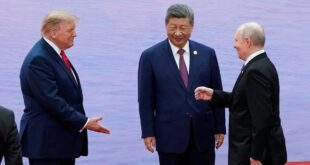
The forthcoming meeting between Donald Trump, Xi Jinping and Vladimir Putin in Shenzhen could become one of the most consequential diplomatic encounters of 2026. Its significance, however, should not be measured by the number of agreements announced or the photographs released afterwards. It should be assessed through the conflicts, strategic rivalries and nuclear risks that the three leaders will bring into the room.
For Washington, the meeting offers an opportunity to explore nuclear arms control with two major competitors while addressing the war involving Iran. For Beijing, it provides a platform to demonstrate international leadership without compromising its strategic relationship with Moscow. For the Kremlin, it offers recognition as an indispensable participant in discussions about the international security architecture. These objectives overlap in some areas, but they are far from identical.
The nuclear dimension is particularly urgent. The expiration of the New START treaty in February 2026 removed the final major bilateral framework restricting American and Russian strategic nuclear arsenals. For more than half a century, arms-control agreements provided mechanisms through which Washington and Moscow could establish limits, exchange information and reduce the risks of miscalculation. Their disappearance creates a more uncertain strategic environment.
Trump’s ambition to bring China into a new nuclear framework is understandable. China’s nuclear capabilities are expanding, and any future international arms-control arrangement that excludes Beijing will face questions about its long-term effectiveness. Yet expecting China to accept restrictions comparable to those imposed on the United States and Russia is unrealistic without addressing the considerable differences between their arsenals.
Beijing’s position is not difficult to understand. China possesses a much smaller nuclear arsenal than either Washington or Moscow and has little incentive to accept limitations that could institutionalise an existing strategic imbalance. It is also concerned that nuclear negotiations could become another instrument through which the United States seeks to constrain its military development.
A sustainable arms-control process must therefore begin with realistic expectations. It requires transparency, communication channels, crisis-management mechanisms and reciprocal commitments. The alternative is a diplomatic exercise that produces headlines without reducing nuclear dangers.
Iran introduces an even more complicated dimension. The war involving Tehran has placed regional security, maritime routes and the wider international energy system under considerable pressure. Trump wants to explore whether Beijing and Moscow can contribute to ending the conflict. Both countries maintain important relationships with Iran, although their influence over Tehran should not be confused with an ability to dictate Iranian policy.
China has significant economic interests in regional stability and the uninterrupted movement of energy supplies. Russia, meanwhile, has developed strategic, military and diplomatic ties with Iran. Both have reasons to oppose a prolonged regional confrontation, but neither necessarily shares Washington’s preferred terms for ending it.
The central question is whether the three leaders can identify common interests in preventing further escalation without turning the meeting into an attempt to impose a settlement on an absent regional actor. Iran’s security concerns, political calculations and sovereignty cannot be resolved simply through discussions between Washington, Beijing and Moscow.
Ukraine presents another test of the credibility of great-power diplomacy. Russia’s continuing war has transformed European security and reinforced the importance of sovereignty and territorial integrity. Any discussion of a settlement that excludes Ukrainian participation would risk undermining the very principles that international diplomacy is supposed to protect.
The possibility that Ukraine may not feature prominently in the trilateral agenda is therefore troubling. A ceasefire or political settlement cannot be durable if the country directly affected is treated as an object of negotiation rather than an essential participant. Nor should European security be determined exclusively through an understanding between Washington and Moscow.
There is a broader contradiction in the summit itself. China has presented the APEC gathering as an opportunity to promote open trade, regional integration and multilateral cooperation. Yet a high-profile meeting among three major powers can reinforce the impression that the most consequential international decisions are made outside multilateral institutions.
That contradiction matters because the world is facing several interconnected crises. Nuclear proliferation, regional wars, technological competition, energy insecurity and the erosion of arms-control mechanisms cannot be addressed through personal diplomacy alone. They require institutions capable of monitoring commitments, resolving disputes and maintaining communication when political relationships deteriorate.
The three presidents may find areas of agreement in preventing uncontrolled escalation. That would be valuable. But cooperation on one issue should not become a justification for ignoring the rights and interests of other countries. Strategic stability cannot be achieved by sacrificing the sovereignty of smaller states or legitimising territorial aggression.
The Shenzhen meeting should be an opportunity to restore serious diplomacy, not to establish a private directorate for managing the world. Its success will depend on whether the leaders move beyond political theatre and commit themselves to verifiable progress on nuclear risk reduction, conflict prevention and international security.
In the end, the most important question is not whether Trump, Xi and Putin can reach an understanding. It is whether that understanding can make the world safer for everyone else.