Geostrategic Media Political Commentary, Analysis, Security, Defense

By Alexander Dougan
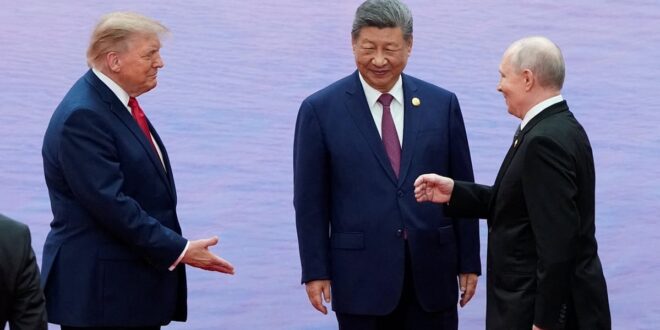
The planned meeting between Donald Trump, Xi Jinping and Vladimir Putin in Shenzhen carries an uncomfortable message for the rest of the international community: the world’s most powerful countries increasingly expect to shape global affairs through direct negotiations, even when the consequences extend far beyond their own borders.
The gathering on the sidelines of the Asia-Pacific Economic Cooperation summit is unprecedented in bringing together the leaders of the United States, China and Russia in a trilateral format. Yet its importance lies less in the diplomatic novelty than in the political environment surrounding it. International institutions are under pressure, economic interdependence is increasingly weaponised and regional conflicts are becoming entangled with competition between major powers.
For smaller states, this is not an abstract debate about the future of the international system. It concerns sovereignty, economic security, access to markets and the ability to determine national policy without being forced to choose between competing international blocs.
China has approached the APEC summit with an emphasis on openness, trade and technological cooperation. Beijing wants to present itself as a reliable economic partner at a time when Washington has intensified restrictions on Chinese access to advanced technologies and pursued a more protectionist trade policy. The contrast is politically useful to Xi Jinping, particularly among developing economies that remain concerned about the consequences of tariffs, sanctions and supply-chain fragmentation.
Russia’s position is different. Moscow seeks to demonstrate that its international isolation has not prevented it from participating in discussions at the highest level. Its strategic partnership with China has become increasingly important, particularly in trade, energy and diplomatic coordination. However, this relationship is not an equal partnership in every respect. Russia’s growing dependence on Chinese markets and economic channels has created an asymmetry that Moscow cannot ignore.
The United States retains considerable advantages in finance, technology, military capabilities and international alliances. Yet Washington’s influence is also being tested by questions about the consistency of its foreign policy and the future of its economic relationships. For many countries, the central concern is no longer simply which major power offers the greatest benefits, but how to avoid becoming excessively dependent on any one of them.
This is where APEC’s wider significance becomes important. Its 21 member economies represent approximately 60 per cent of global GDP and nearly half of world trade. The organisation was established to promote economic cooperation across the Pacific, not to serve as an instrument for negotiating the geopolitical preferences of three major powers. Its consensus-based approach and voluntary commitments reflect the recognition that regional cooperation requires participation rather than domination.
Nevertheless, the Shenzhen summit risks allowing the bilateral and trilateral ambitions of the major powers to overshadow the economic concerns of the wider membership. Trade barriers, industrial subsidies, technological restrictions and competition over artificial intelligence are already reshaping international commerce. Smaller economies are particularly exposed because they often lack the financial and technological resources to absorb the consequences of prolonged confrontation between Washington and Beijing.
The developing world should therefore resist the temptation to view great-power competition as an opportunity that automatically produces strategic advantages. Chinese investment may offer infrastructure and industrial opportunities, but it can also create financial and technological dependencies. American security partnerships provide deterrence and access to advanced capabilities, but they can also involve political expectations. Russian relationships may provide energy and diplomatic options, yet Moscow’s own economic and military constraints limit what it can offer.
Strategic diversification is not the same as strategic independence. Governments that cultivate several international partnerships may improve their negotiating positions, but genuine autonomy requires domestic economic resilience, technological capacity, institutional credibility and the ability to withstand external pressure.
The Middle East offers a particularly revealing example. Gulf governments have expanded their economic and diplomatic engagement with China while maintaining significant security relationships with the United States. Türkiye has pursued a similarly complex strategy, combining NATO membership with relationships involving Russia, China and regional powers. These policies demonstrate that countries do not necessarily have to align themselves exclusively with one international camp. They can pursue overlapping partnerships when their national interests permit.
However, such flexibility has limits. During a major security crisis, governments may discover that their economic partners cannot provide the military assistance or intelligence capabilities they need. Likewise, diplomatic access does not guarantee that an external power can persuade another government to change its behaviour.
The Shenzhen meeting should therefore be judged against a broader question: will the three major powers strengthen international cooperation or reinforce the perception that the global order is becoming an arena for privileged negotiations among a small number of capitals?
Smaller nations cannot afford to remain spectators. They need stronger regional institutions, diversified economic relationships, credible national capabilities and coordinated diplomatic positions. They must also defend the principle that sovereignty cannot be treated as a bargaining chip in negotiations between larger countries.
A genuinely stable international order cannot be constructed by three presidents alone. It must include the countries that bear the consequences of their decisions. If Shenzhen becomes another exercise in great-power symbolism, the rest of the world should draw a clear lesson: influence belongs not only to those who sit at the table, but also to those who organise themselves well enough to ensure that their interests cannot be ignored.