Geostrategic Media Political Commentary, Analysis, Security, Defense
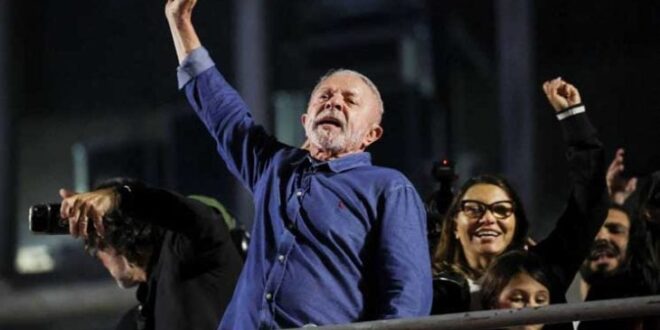

Luiz Inácio Lula da Silva has capped a remarkable political journey by winning a fourth presidential term, following a career that took him from factory work to the presidency, through imprisonment and ultimately back to power.
The Workers’ Party candidate secured 51.79 per cent of valid votes in Sunday’s presidential runoff, defeating Senator Flávio Bolsonaro, who received 48.21 per cent, according to the final results announced by Brazil’s Superior Electoral Court.
Lula received more than 64.256 million votes, compared with approximately 59.826 million for Bolsonaro.
Bolsonaro had led the first round of voting on October 4, winning 47.03 per cent of valid votes against Lula’s 45.16 per cent. Lula’s victory made him the first Brazilian presidential candidate since the two-round system was introduced in 1989 to overturn a first-round deficit and defeat his rival in the runoff.
The campaign centred on the cost of living, public security, corruption and foreign policy, particularly Brazil’s strained relations with the administration of US President Donald Trump.
From factory worker to president
Lula was born on October 27, 1945, in Garanhuns, in the northeastern state of Pernambuco. He grew up in a poor family before moving with his relatives to São Paulo, where he began working at an early age.
As a young man, he worked in a factory and received vocational training in metalworking. He later lost a finger in an industrial accident.
During Brazil’s period of military rule, Lula became involved in the labour movement and eventually led the metalworkers’ union in São Bernardo do Campo, an industrial centre near São Paulo.
He rose to national prominence in the late 1970s by leading major labour strikes. In 1980, he helped establish the Workers’ Party alongside trade unionists, intellectuals and opponents of military rule.
Lula was elected to Brazil’s federal legislature in 1986, representing São Paulo. He ran for president in 1989, 1994 and 1998 without winning before securing victory in 2002. He took office in January 2003.
During his first two presidential terms, Brazil experienced growth in exports and economic activity. Social programmes, particularly Bolsa Família, provided financial assistance to millions of low-income households and contributed to a substantial reduction in poverty.
However, his administrations were also affected by corruption scandals involving senior officials and members of Congress.
After completing the constitutional maximum of two consecutive presidential terms, Lula was succeeded by his political ally Dilma Rousseff, who won the 2010 election.
Imprisonment and political comeback
Lula’s political career suffered a major setback during the sweeping investigation known as Operation Car Wash, which examined allegations of bribery and money laundering involving politicians and business executives.
He was convicted of corruption and money laundering and imprisoned in April 2018, preventing him from contesting that year’s presidential election.
After spending 580 days in prison, he was released in November 2019.
In 2021, Brazil’s Supreme Federal Court annulled his convictions on jurisdictional grounds, ruling that the court that had handled the cases lacked the authority to hear them. The court also found that former judge Sergio Moro had demonstrated bias in one of the proceedings.
The decisions restored Lula’s political rights and enabled him to return to electoral politics.
In the 2022 election, Lula narrowly defeated then-President Jair Bolsonaro, receiving approximately 50.9 per cent of valid votes and securing his third presidential term.
A week after Lula’s inauguration in January 2023, Bolsonaro supporters stormed Congress, the Supreme Federal Court and the presidential palace in Brasília in an attempt to overturn the election result.
The third term and domestic challenges
During his third term, Lula prioritised poverty reduction, increased social spending, public investment and environmental protection while seeking to preserve financial stability.
His government expanded social assistance programmes and introduced measures intended to support wages and employment. Nevertheless, concerns about the cost of living, government spending and violent crime weighed on his popularity.
The administration also faced difficulties passing parts of its legislative agenda through Congress, where centrist and conservative parties wield considerable influence.
During his campaign for a fourth term, Lula pledged to maintain Bolsa Família, expand affordable housing and strengthen public healthcare and education.
His economic proposals included higher taxes on high-income earners, continued investment in infrastructure, support for domestic production and further increases in the minimum wage.
On the environment, he promised to end deforestation by 2030 while continuing to support the development of Brazil’s oil and natural gas industries.
His electoral victory does not, however, guarantee control of Congress. Implementing his promises on taxation, social spending, public security and environmental legislation will require negotiations with other political forces.
Foreign policy
During his presidency, Lula sought to strengthen cooperation among emerging economies through BRICS, deepen relations with China and establish Brazil as a more influential diplomatic actor internationally.
BRICS began in 2009 as a grouping of Brazil, Russia, India and China under the name BRIC. It became BRICS in 2011 following South Africa’s accession.
The bloc subsequently expanded, adding Egypt, Ethiopia, Iran and the United Arab Emirates in 2024, followed by Indonesia in 2025.
Lula has also sharply criticised Israel’s military campaign in Gaza, expressed support for Palestinian statehood and advocated resolving international disputes through negotiations.
Relations between Brazil and the United States have come under strain following President Donald Trump’s imposition of tariffs on Brazilian goods and his public support for former Brazilian President Jair Bolsonaro.
Lula accused Washington of interfering in Brazil’s domestic affairs and made the defence of national sovereignty a central theme of his election campaign.
His victory comes amid the rise of conservative political forces across several Latin American countries, giving his continued presidency additional significance for the region’s left.
Lula’s fourth presidential term, which will last four years, is scheduled to begin on January 5, 2027.