Geostrategic Media Political Commentary, Analysis, Security, Defense

Ward Kassouha
France’s current political turmoil cannot be properly understood without examining several interconnected forces. Political polarisation, economic instability, the costs of Europe’s confrontation with Russia, and the emergence of a younger generation of protesters are converging in ways that challenge the foundations of the French political system.
The first factor is the sharp polarisation between the far right and the far left, a trend that has persisted since Emmanuel Macron’s first presidential term. The flexibility that once characterised France’s political tradition has increasingly struggled to contain the widening divide between these two radical poles. The consequences extend beyond the day-to-day functioning of the Fifth Republic. They also undermine the possibility of restoring the centre-left and centre-right political arrangement that helped sustain France’s political and social stability for much of the post-war period, particularly after Charles de Gaulle returned to power in the aftermath of the Second World War.
The second factor is the economic crisis, which is taking forms that would once have seemed difficult to imagine in France. Like the country’s political deadlock, the economic situation appears increasingly resistant to conventional remedies. Some of the pressures evoke the Greek debt crisis, when the European Central Bank intervened to support the Greek economy in exchange for severe austerity measures.
France’s predicament, however, extends beyond familiar indicators such as inflation, declining purchasing power, budget deficits and the prospect of austerity. It also raises questions about the limits of monetary policy itself. Monetary measures alone cannot resolve the problem of mounting public debt without a credible strategy to stabilise the debt-to-GDP ratio, which the figures cited in this analysis put at approximately 119 per cent, or to address the elevated yields on French sovereign bonds. French borrowing costs have, at times, exceeded those of traditionally lower-yielding European counterparts, particularly Germany. Comparisons with US Treasury yields, however, depend on the maturity and period being examined.
France’s debt difficulties are also connected to the wider economic costs borne by European economies as a result of the sanctions imposed on Russia. The geopolitical argument for supporting Ukraine militarily and financially in its war against Russia is not the central issue here. The more immediate question is whether European governments can sustain an increasingly militarised security posture indefinitely without transferring a disproportionate share of its economic burden to their most vulnerable citizens.
This tension was also evident during Joe Biden’s presidency in the United States, before Donald Trump returned to the White House. Washington helped shape the Western sanctions regime against Moscow and encouraged European allies to participate, but the economic consequences have not been distributed evenly across the Atlantic. The United States has its own costs and vulnerabilities, yet European economies have faced particular pressures arising from their proximity to the conflict, their exposure to disruptions in energy markets and the challenges confronting industrial competitiveness.
European governments that have supported Ukraine have therefore had to manage a difficult combination of security commitments, inflationary pressures, weaker competitiveness in some sectors and the burden of public debt accumulated through successive crises. The debate is not simply about whether support for Ukraine should continue. It is also about how its costs should be distributed, how long current policies can be sustained, and whether governments can maintain public consent while household finances remain under pressure.
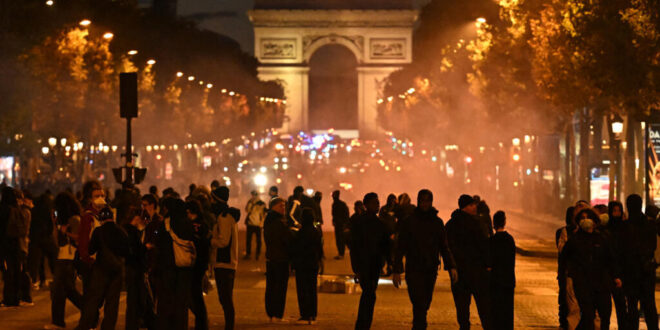
What makes these overlapping political, economic and geopolitical pressures particularly consequential in France is the generation now driving the protests. Its organisation and apparent determination suggest that many younger demonstrators are less interested in the compromises that shaped earlier cycles of French protest. The issue is not simply the intensity of street violence, which some political actors and protest organisers may have struggled to anticipate. It is also the political vision that younger protesters want to advance in response to a set of crises they regard as interconnected and unusually severe.
The protests have taken on a significance that extends beyond individual grievances. They raise broader questions about representation, economic fairness, the legitimacy of established political institutions and the ability of the French Republic to renew its social contract. The challenge for political movements is to translate that anger into a coherent programme capable of winning support beyond the streets.
If protesters are seeking a political transition comparable in some respects to the aftermath of May 1968, they will need to develop a clearer strategy for converting mobilisation into durable political change. The events of 1968 culminated in Charles de Gaulle’s resignation the following year and helped open the way for a political transition in which his former prime minister, Georges Pompidou, played a central role. But the historical lesson is not that street mobilisation automatically produces a new political order. It is that protest acquires lasting significance when it is translated into political organisation, institutional change and a programme capable of attracting broader public support.
That distinction matters because the political energy of the current movement cannot be measured solely by the scale of demonstrations or the intensity of confrontations. Treating violence as an end in itself risks obscuring the substantive economic and political demands that bring people into the streets. It can also make it easier for opponents to shift public debate away from those demands and towards law and order.
The events surrounding the looting and arson reported on 17 October have, in this respect, provided ammunition for a forceful right-wing political and media response. Critics have used the violence to portray the protests as illegitimate, place disproportionate responsibility on immigrants and intensify pressure on La France Insoumise and its allies. The movement has also faced political and security pressure, while its supporters point to the large, peaceful mobilisation reported on 24 October as evidence that the protest movement cannot be reduced to episodes of disorder.
The political struggle is therefore being fought on two fronts: in the streets, where demonstrators seek to make their demands impossible to ignore, and in the public arena, where competing political forces are trying to define what the protests mean. For La France Insoumise, trade unions and other protest networks, the challenge is to sustain a broad coalition without allowing episodes of violence to eclipse their political and social programme. For their opponents, the temptation is to treat disorder as proof that the movement as a whole lacks legitimacy. Neither approach, by itself, resolves the underlying grievances.
There is another historical lesson worth recalling. Periods of left-wing mobilisation at decisive moments in French history have often taken years to translate into electoral victories and lasting policy change. The political consequences of protest are rarely confined to the immediate aftermath of a demonstration or a single election. Ideas that initially appear marginal can gradually gain acceptance as political circumstances change and established governing coalitions lose their ability to respond to public demands.
May 1968 offers a revealing example. Beyond the political figures associated with the French left, including François Mitterrand and Lionel Jospin in later periods, the upheaval stimulated a remarkable body of intellectual and cultural work. Its influence spread from politics into philosophy, critical theory and cinema, reshaping debates about authority, social relations and individual freedom.
Yet the left failed to secure the presidency in the election that followed the events of 1968. Mitterrand was defeated by Valéry Giscard d’Estaing, who was supported by the non-Communist right and the broader political forces that emerged from the Gaullist tradition. The immediate political outcome therefore favoured the right, even as the longer-term cultural and intellectual consequences of 1968 continued to influence French society.
It took further political and social change before the French left secured the presidency, with Mitterrand’s victory in 1981. That outcome cannot be attributed to May 1968 alone. It also reflected economic developments, shifts in public opinion, changes within the political parties and the difficulties faced by successive governments. Nevertheless, the intervening years illustrate how the impact of a protest movement can outlast its immediate political defeats.
The transition required more than the exhaustion of the Gaullist political legacy. It also depended on a growing number of voters coming to believe that the left could offer a credible response to France’s political, economic and social problems. The right’s difficulties in addressing those challenges eventually created opportunities for alternative approaches to gain wider acceptance.
A comparable dynamic may be emerging today, although history offers no guarantee that the present protests will produce the same outcome. France’s current crisis differs from that of 1968 in its economic context, its political institutions and the fragmentation of its party system. The contemporary left also faces the challenge of building a coalition broad enough to unite voters whose concerns range from purchasing power and public services to immigration, security, Europe and France’s international role.
What links the two periods is the possibility that a moment of intense protest can expose weaknesses in the existing political order without immediately producing a viable replacement. The political consequences may emerge gradually, as voters reassess established parties and new ideas move from the margins towards the centre of public debate.
France’s present predicament is therefore about more than the survival of a government or the management of demonstrations. It concerns the capacity of the Fifth Republic to respond to a convergence of pressures that cannot be resolved independently of one another. Political polarisation makes compromise harder; economic constraints narrow the room for manoeuvre; geopolitical commitments generate difficult choices over resources; and a younger generation is questioning whether established institutions can adequately represent its interests.
The decisive question is whether the current protest movement can turn that dissatisfaction into a coherent political alternative—or whether the divisions within French society will allow the established order to endure without addressing the conditions that produced the unrest.
May 1968 reminds us that the immediate outcome of a protest is not always the measure of its historical significance. But it also demonstrates that political transformation requires more than anger. It requires organisation, credible leadership, a programme that addresses everyday concerns, and the ability to persuade a wider public that a different course is both desirable and achievable.
The author is a Syrian writer.