Geostrategic Media Political Commentary, Analysis, Security, Defense

Dr, Shehab Al-Makahleh
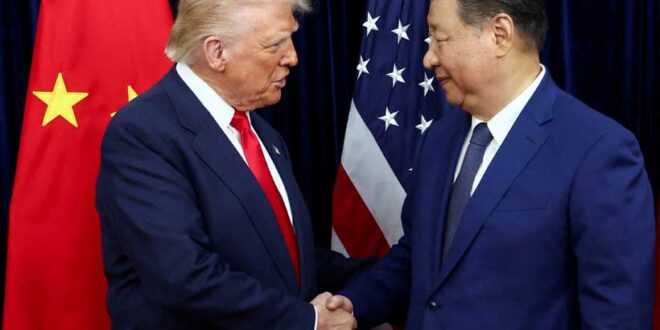
When a U.S. president walks into Beijing and leaves without mentioning Taiwan, the silence speaks louder than any communiqué. The reported visit of Donald Trump to China—culminating in a closed-door meeting with Xi Jinping—is not just another episode in great-power diplomacy. It is a signal that the architecture of global leadership is being quietly renegotiated, not through confrontation, but through calibrated restraint.
For decades, the United States defined global order through what might be called functional leadership: military alliances, economic institutions, and interventionist credibility. What is emerging now is something different—closer to civilizational bargaining, where power centers like China are no longer negotiating within a U.S.-led system, but alongside it. Trump’s posture in Beijing suggests a tacit acknowledgment of this shift. By refusing to engage on Taiwan—a cornerstone of U.S. strategic ambiguity—he effectively deprioritized one of the most volatile flashpoints in U.S.-China relations. This is not necessarily weakness; it may be realism. Washington increasingly understands that a war over Taiwan is not just costly—it is unwinnable in any meaningful strategic sense.
At the same time, Trump’s rhetoric on Iran reveals a different dimension of this recalibration: coercion without escalation. His claims of crippling Iran’s military-industrial capacity and enforcing economic pressure through the Strait of Hormuz fit into a broader doctrine—maximize pressure, avoid full-scale war. Yet such claims should be treated cautiously. Assertions like “85% destruction” of missile capacity are politically powerful but analytically unverifiable. What matters more is the strategy behind them: the United States seeks to contain adversaries economically and technologically while stepping back from prolonged military entanglements.
This duality—restraint in East Asia, pressure in the Middle East—highlights a deeper contradiction. The U.S. is trying to remain globally dominant while simultaneously reducing the costs of that dominance. It is a balancing act that depends heavily on economic leverage. The reported agreement for China to purchase Boeing aircraft—whether fully realized or not—illustrates how interdependence continues to anchor even the most competitive relationships. Trade, not tanks, is becoming the primary stabilizer of great-power rivalry.
The private meeting at Zhongnanhai is perhaps the most telling moment. Behind closed doors, away from the rhetoric of rivalry, both Trump and Xi appear to have explored a model of coexistence rooted in mutual recognition. Xi’s emphasis on national revival and Trump’s invocation of American restoration are not mutually exclusive visions—they are parallel ambitions. The implication is profound: the future global order may not be unipolar or even bipolar, but negotiated among competing civilizational centers that agree, at minimum, on avoiding direct conflict.
This logic extends beyond China. Trump’s reported communication with North Korea’s leadership reinforces a pattern of personalized diplomacy aimed at freezing conflicts rather than resolving them. Similarly, the temporary stabilization of the Strait of Hormuz—framed as a strategic pause—underscores how regional flashpoints are increasingly managed, not solved. The goal is not victory, but equilibrium.
Yet this emerging order is fragile. It relies on informal understandings, economic incentives, and the assumption that all actors prefer stability over escalation. History suggests otherwise. The absence of clear red lines—on Taiwan, Iran, or elsewhere—may reduce immediate tensions but also introduces long-term uncertainty. Ambiguity can deter conflict, but it can also invite miscalculation.
What we are witnessing is not the decline of American power, but its transformation. The United States is moving from enforcer to negotiator, from unilateral actor to reluctant partner in a shared—if uneasy—global leadership structure. China, for its part, is stepping into that space with confidence, but also caution, aware that overt dominance could provoke the very confrontation it seeks to avoid.
The real question is whether this quiet understanding can hold. A world governed by implicit deals and strategic silence may be more stable in the short term, but it lacks the institutional clarity that defined previous eras. If Trump’s visit to China reveals anything, it is this: the future of global order will not be declared—it will be implied, negotiated, and constantly tested.
And in that world, what is left unsaid may matter more than what is proclaimed.