Geostrategic Media Political Commentary, Analysis, Security, Defense

Hadi Elis
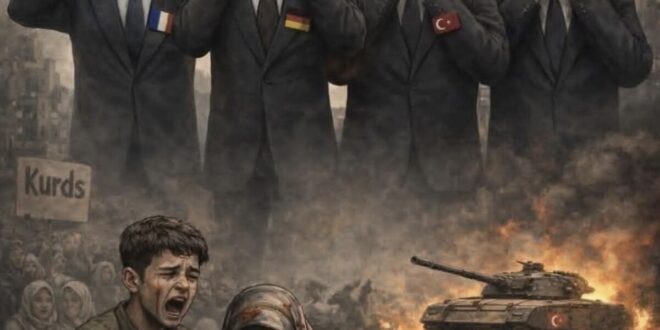
For decades, Turkey has systematically created problems for the Kurdish people. Those problems did not emerge from thin air. They forced the Kurds to form the PKK as a resistance movement against deliberate, state-driven assimilation policies—policies that many would argue amount to an effort to exterminate Kurdish identity. What has come to be known as the “Turkification” policy is, in effect, a slow-burning genocide that has continued since the Republic’s foundation.
In 1922, the new republic was declared as a homeland for both Turks and Kurds. By the following decades, it had become a republic of terror against Kurds. The nationalist slogan “Türkiye Türklerindir” (“Turkey belongs to Turks”) was adopted as the unofficial motto of the state, even appearing as a logo in the national newspaper Hürriyet. That slogan is not a simple expression of patriotism—it is a confession of guilt. It betrays an anxious recognition that non-Turkish nations exist within Turkey, and that their existence must be denied.
Turkey recently changed its international name from “Turkey” to “Türkiye,” hoping to leave behind the bird associated with the old name. But ironically, in Turkish, “Türkiye” can be broken into “Türki” + “ye” — and “ye” means “eat.” So it reads as “Eat the Turks.” Whether intentional or not, the change has not erased the deep problems. God only knows why a leadership that claims to be fighting for survival would exchange one bad name for an even worse one.
Under both the Kemalist regime and the current Turco-Islamist regime of President Erdoğan—who is far more than just a president—the state has consistently labeled Kurds as the most important “internal enemy.” Yet Kurds have never called Turks their enemy. They have condemned the state and successive governments for being enemies of the Kurdish people, not the Turkish people themselves. While Turks proudly declared, “How happy is the one who calls himself a Turk,” Kurds never responded with a mirror slogan. They never said, “How happy is the one who calls himself a Kurd.” That restraint speaks volumes.
Turkey banned the Kurdish language. It prohibited the letters X, Q, and W—letters essential to writing Kurdish. In return, Kurds did not ban Turkish. They learned Turkish to communicate, to share good times and bad, to live as neighbors and even as relatives after generations of intermarriage. They extended a hand. But nothing Kurds have ever done has been enough for the Turkish regime. The regime has instead labeled the simple act of resisting forced assimilation as “terrorism.”
With the backing of NATO member states, the Kurdish struggle endured for decades. But that Western support did not prevent the illegal abduction of PKK leader Abdullah Öcalan in February 1999. That act violated numerous international laws. Yet the Kurdish people did not respond by declaring war on NATO members. Unlike many other armed resistance movements that have since been recognized by Western governments, the Kurds continued to fight for their existence within the boundaries of international law.
International law has long justified the Kurdish armed struggle as a non-international armed conflict. Western governments should have recognized it much earlier and engaged in a peace process between Turkey and the PKK—just as they did with the UK and the IRA. Instead, they remained silent.
The PKK has been declaring peace and ceasefires since 1987. Official records like to begin with the March 1991 declaration in Beirut, made before international media. Since then, it has become an annual ritual: the PKK renews its call for peace. In 2008, there was a response—kept secret until the Oslo peace talks were exposed in 2013. Those talks failed because President Erdoğan refused to sign the agreement, now known as the Dolmabahçe Palace documents.
Turkey returned to war, not only on its own soil and in Iraq, but also in Syria. After a decade of occupation in the Syrian civil war, in December 2024, a Turkish-backed organization—which changed names several times, finally settling on HTS—became the post-Assad government. Then the PKK renewed its peace and ceasefire call, this time from Öcalan himself, who even suggested dissolving the PKK. Remarkably, the most anti-Kurdish party in Turkey, the MHP, and its leader Devlet Bahçeli responded positively. They became the unlikely partners on the other side of a potential peace process.
The process has been given two names: President Erdoğan calls it a “Terror-Free Turkey.” The MHP calls it a “National Solidarity, Brotherhood and Democracy Process.” Kurds call it the second peace process. On May 5, 2026, Bahçeli announced that Öcalan’s status in the process should be “Coordinator for the Peace Process and Politicization.” This marks the first time Turkey has officially recognized Öcalan as part of a peace framework.
So what does Turkey demand? The PKK must dissolve, lay down its arms, and wait for Turkey to produce the necessary laws. And what do the Kurds demand? Laws must be passed by parliament first, so the process begins on solid legal ground.
Here is the problem: Turkey continues to oppress Kurds specifically for speaking and singing in Kurdish in public. It arrests elected pro-Kurdish parliamentarians and removes elected officials, mostly from municipalities. These actions make any observer wonder: Is Turkey serious about peace?
Turkey demands that the PKK lay down its weapons before any real discussion. But it is time to reverse the question: Will Turkey lay down its arms against the Kurdish people? Will Turkey stop using state violence—military and police operations—against those it claims to recognize as citizens, but treats as enemies?
If the PKK lays down its arms and dissolves, then Turkey must reciprocate. It must stop oppressing Kurds under fabricated excuses and false-flag operations. It must make this peace process genuine, not another cynical maneuver.
Otherwise, the world will know: the arms were never the problem. The will for justice was.