 Geostrategic Media Political Commentary, Analysis, Security, Defense

Hemant Adlakha
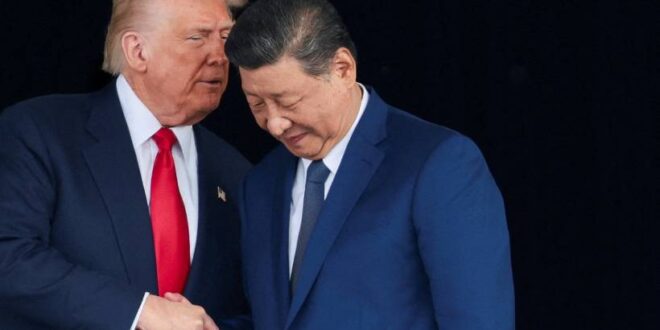
Just a few days before President Trump was to arrive in Beijing as per Trump’s previous itinerary (March 31-April 2), the mood in China—as reflected on social media and in the media commentaries—was not at all in favor of a visit by Trump to the Chinese capital. Citing Chinese analysts, an article in these columns, titled “Beijing’s forever wait for a Trump visit: zero enthusiasm, low expectation,” highlighted the Chinese foreign ministry’s changing stance from “anxiety” to “no confirmation” to “no information” regarding the visit. Some scholars in China even bluntly expressed that China must abandon its illusions, maintain strategic composure, and not be deceived by Trump’s honeyed words and treacherous intentions.
Trump’s China visit-itinerary drama
Remember, on February 20 this year—just a week before initiating war of aggression in Iran—in a unilateral announcement, the White House released the dates (March 31-April 2) of Trump’s China visit. Then again, much to the irritation of Beijing, Trump unilaterally told the Financial Times on March 15 that the war on Iran might prevent him from embarking on a China tour as scheduled. The US leader once again unilaterallyrescheduled his summit talks with his Chinese counterpart in Beijing from late-March/early-April to May 14-15, confident that in four to six weeks he would be “free” from the Iran quagmire.
Confirming that the Iran war was the reason for the postponement of the visit, the White House admitted that “it’s very important for the president to be here throughout these combat operations right now.” But as it were, the war in Iran is going on and is still looming large over the visit. Typically, with Trump known for going back on his words at the drop of a hat, speculations are high that with a fragile ceasefire in the Strait of Hormuz, significant uncertainty clouds whether his China trip will happen at all. (Emphasis added) The buzz in the Chinese official circles and on Weibo was that “it will be Trump’s Beijing tour, not a visit.”
Interestingly, or rather intriguingly, unconcerned with the US president again confirming last Thursday—just a week prior to his much-anticipated summit talks with Xi—his schedule to go ahead with the visit, Beijing has still not officially announced the date of the Trump visit. One plausible explanation to Beijing not officially confirming the visit schedule has come from a former US ambassador to Beijing. Ambassador Nicholas Burns has recently stated in an interview that China is feeling quite uneasy about the visit while the US-Iran war is still unresolved. However, in a move indicating the visit’s certainty, the two countries’ foreign and trade ministers held a series of telephone conversations last week.
Unravelling Chinese diplomatic discourse
As mentioned, quite a few overseas media have been reporting how the Chinese foreign ministry spokespersons repeatedly maintained a “no information” stance when asked to confirm the Trump visit and the visit date. To foreign observers, such an official stance most likely conveys “ignorance” or “neutrality” regarding the issue; however, China’s scholars and analysts would interpret this as conveying a clear value-loaded view. Take, for example, until as recently as May 8, there has been no official confirmation or denial by the Chinese foreign ministry spokespersons on the visit schedule, only a reiteration that China and the US maintain communication at all levels and that China remains willing to engage in dialogue and cooperation with the US on the basis of mutual respect to properly handle differences.
What to make out of the Chinese foreign ministry’s stance? As discussed, the foreign media mostly concluded that 1) the ministry’s spokesperson was not authorized to reveal the official position, and 2) the spokesperson genuinely was unaware of the official position. However, in several Chinese commentaries it was pointed out that the spokesperson’s so-called “neutral” stance was actually to be read as the Chinese government’s “not so positive” response to the arbitrary manner in which Trump or the White House had been unilaterally announcing the visit and the visit itinerary. Some Chinese scholars even claim the spokesperson’s “neutral” stance is indicative of China having not officially invited a foreign visitor. Meaning it was Trump who wanted to visit, and the Chinese government simply did not say no to him.
At another level, following China’s rapid rise and the US feeling threatened due to its “failed” China containment policy since 2017, the US-China bilateral relationship has fast degraded from being hailed as the “most important bilateral relationship” in the world into the “most dangerous bilateral relationship.” A recent study by two Chinese scholars has claimed, out of enormous fear over the growing China, particularly in the past two decades, the US has been trying to portray the People’s Republic of China (PRC) as a “public enemy” or even “common enemy” of the international community. To counter this US propaganda, China too has been shifting to cooperative and proactive gestures in its diplomatic moves and subtly altering its previous soft and modest practices into tougher ones and striving for its “power to discourse.”
‘Diplomacy’ in Chinese is distinct from the West.
While it is mostly true that today diplomacy everywhere is regarded as the main instrument of foreign policy. Yet it is of import to remember how the word “diplomacy” is fundamentally different—both conceptually and in practice, respectively, in China and in the West. In its brief etymology, in the Western discourse and practice, “diplomacy” in its current, modern form is attributed to 18th-century France and is based on the ancient Greek word “diplōma” (meaning “an object folded in two”).
In China today, on the other hand, the word “diplomacy” is understood by the Chinese word 外交 (a compound word combining two Chinese characters, 外 and 交, pronounced wài and jiāo, respectively). The meaning of the two characters separately is “foreign” and “exchange,” but the usual caveat is that typically the two characters have various other multiple meanings. In the Chinese Encyclopedia, the meaning of the term “diplomacy,” or wàijiāo, in the modern sense is defined in the context of treaty ports and with the increasing frequency of Sino-Western exchanges. However, in ancient China, in its more nuanced sense, the term referred to officials representing their state in other countries.
It’s its ancient, nuanced connotation that has a continuing impact on the use of the term today, both as an idea and in practice. Let us look at an ancient Chinese tale that best captures the nuanced diplomacy between officials (ambassadors in today’s nomenclature) from two states. The tale is from the 8th century BC, “Yanzi’s Diplomatic Mission to Chu,” in which Yanzi is a famous politician and diplomat from the Qi state. Unfortunately, God didn’t give him a good appearance to match his wisdom and resources. Yanzi was tiny and ugly. One day, the king of Qi, King Jing, wanted to get help from the Chu state in South China, so he sent Yanzi on a diplomatic mission to Chu. King Ling, the king of Chu, was not satisfied with the emissary because of Yanzi’s tiny stature and ugly appearance. He asked his guards to close the main gate of his city, and they told Yanzi, “There is a hole dug in the wall by dogs. King Ling thinks the hole is big enough for you.” Yanzi replied, “People go through a great gate when they visit a great kingdom. People go through a dog’s hole when they visit a dog’s kingdom.” After King Ling heard this answer, he asked his guards to open the biggest gate for Yanzi.
To conclude, the moral of the above story has become relevant today in the context of the Trump visit and is gaining popularity on the Chinese social media. The moral of the story centers on relying on one’s wisdom to counter insult and disrespect. It further means that arrogance and bullying are forms of self-humiliation and that intelligence, calm, and witty eloquence are superior to brute force. No wonder a recent Chinese commentary observed that the arbitrary and unilateral manner in which Trump has been clamoring for a China visit has made the Chinese people ridicule him by saying, “This may be the first time in 100 years that the world (especially China and the US) has such low expectations for a US president’s visits to major countries.”
About the Author:
Hemant Adlakha is professor of Chinese, Jawaharlal Nehru University in New Delhi. He is also vice chairperson and an Honorary Fellow, Institute of Chinese Studies (ICS), Delhi.