 Geostrategic Media Political Commentary, Analysis, Security, Defense

Carla Davies
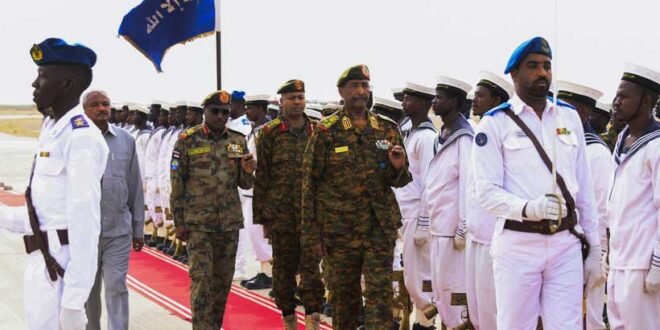
Sudan’s self-appointed leader Abdel Fattah al-Burhan is finding that his co-dependent relationship with the country’s Islamist-Muslim Brotherhood elite is beginning to run interference on his relations with the Gulf States and his ability to restock his arsenal.
He is, as Africa Intelligence recently reported, struggling to close the deal on various military aid projects initiated with his Gulf partners. In an incisive analysis, AI references several diplomatic sources who say the draft military supply contract for the Sudanese Armed Forces (SAF) with Pakistan, facilitated by Saudi Arabia, has been brought to a halt. This $1.5bn agreement, intended to supply the Sudanese regular army with weapons, including JF-17 fighter jets, drones, and air defence systems, had been in the pipeline for several months.
Moreover, the US-Israeli war against Iran has doubtless also reprioritized the distribution of weapons-flow across the region as Iran and the Gulf states seek to replenish stocks depleted by the conflict, leaving Burhan’s Sudanese Armed Forces scrambling for resupply.
Burhan’s struggle to secure external backing is, at root, a crisis of Islamism management rather than of arms procurement or diplomatic tactics. His inability to decisively marginalise Sudan’s Islamist networks is steadily eroding his credibility with the very actors he needs most, even as those same networks remain central to his wartime coalition and personal power.
From the perspective of Gulf and Western capitals, the Pakistan arms package is not an isolated transaction but a test of whether Burhan can be trusted to anchor a post‑Islamist security order. The emerging regional consensus, reflected in Quartet statements over the past year, is that any sustainable settlement in Sudan will have to exclude radical Islamist currents from both the army and civilian politics. Yet the SAF has had to lean heavily on cadres from the old National Congress Party and affiliated militias, who supply both ideological framing and war-fighting capability. Burhan’s dependence on these actors is not incidental; it has been the operating system of his rule since 2021.
This is why external messaging has grown more openly impatient. When U.S., Saudi, Emirati and Egyptian officials have talked about “limiting Islamist influence” and “curtailing Iran’s regional activities,” they have been, in practice, talking about reshaping the very coalition that keeps Burhan in power. The recent rounds of sanctions targeting army‑aligned Islamist figures, as well as Western insistence that any ceasefire or transition blueprint ring‑fence security institutions from Brotherhood‑linked currents, are signals that the old bargain – tolerating Islamists as the price of engaging with the army – is no longer acceptable. For Riyadh in particular, fresh memories of the Muslim Brotherhood era, concerns about Iranian inroads via Sudanese airspace and ports, and domestic red lines on Islamist resurgence, all feed into a narrowing tolerance for Khartoum’s ambiguity.
Burhan has responded to this pressure with a series of calibrated, and often contradictory, gestures. On the one hand, he has presented selective arrests of hardline militia leaders and the occasional public disciplining of Islamist firebrands as proof that he is capable of policing his own flank. These moves are carefully choreographed to be read by foreign diplomats as “good faith,” while minimising damage to the networks that sustain his war effort. On the other hand, his rhetoric – the insistence on “victory only,” the refusal to seriously entertain power‑sharing or security sector reform that would dilute the Islamist presence – reassures his base that the core project remains intact. The result is a politics of performance: enough Islamist signalling to keep the movement mobilised, enough cosmetic pruning to keep the cheques from Riyadh and Abu Dhabi at least ‘in the mail’.
But this balancing act is becoming wobbly. As the war grinds on, the Islamists’ leverage has grown rather than shrunk. It supplies motivated fighters and ideological coherence at a time when the army is exhausted and fragmented. It offers ready‑made narratives tying the conflict to wider struggles against Western intervention, Zionism and regional rivals, narratives that resonate with constituencies far beyond Sudan’s borders. In a scenario where Burhan’s personal authority rests more on being the acceptable face of this ecosystem than on commanding a disciplined national army, any meaningful purge would amount to self‑sabotage.
External actors, meanwhile, are recalibrating. For the Gulf monarchies and Egypt, the fear is not only that Sudan’s Islamists might re‑embed themselves in state institutions, but that an increasingly desperate, Islamist‑tinged military regime could become a logistical and political bridge for Iran, however that besieged nation reconstitutes itself after this war. In their reading, drones and air defence systems delivered today could be repurposed tomorrow in ways that cut against their own security interests if the ideological balance inside the SAF tips further toward hardline currents. That logic helps explain why deals that looked technically advanced a few months ago are now enveloped in hesitation, and why diplomatic communiqués from the same capitals mix calls for support to “state institutions” with unusually explicit conditions on who can and cannot be part of those institutions.
Seen through this prism, Burhan’s legitimacy crisis is not so much about his military performance as about trust. Can he credibly promise to deliver an army and a political order no longer hostage to Islamist veto players when his own survival has become intertwined with their fortunes? For now, the evidence points the other way. Each new gesture against a prominent Islamist is offset by continued reliance on Islamist mobilisation and discourse. Each round of external pressure deepens his structural dependence on those actors willing to fight an existential war alongside him, who are overwhelmingly drawn from the Islamist milieu.
This is the paradox at the heart of his position. The very forces that enable Burhan to sustain the war are those that make him unacceptable as a long‑term partner to the coalition of states that could actually stabilise Sudan. Until he resolves that contradiction – by choosing either to fundamentally reconfigure his coalition or to embrace an openly Islamist project – his relationships with Gulf and Western backers will remain stuck in a pattern of tactical cooperation and strategic mistrust, and every prospective arms deal or diplomatic initiative will be haunted by the same question: who, in the end, is Burhan really governing for?
About the Author:
Carla Davies is a Brussels-based journalist. She writes on foreign affairs for EU Political Report and has an interest in the Middle East and Africa.