Geostrategic Media Political Commentary, Analysis, Security, Defense
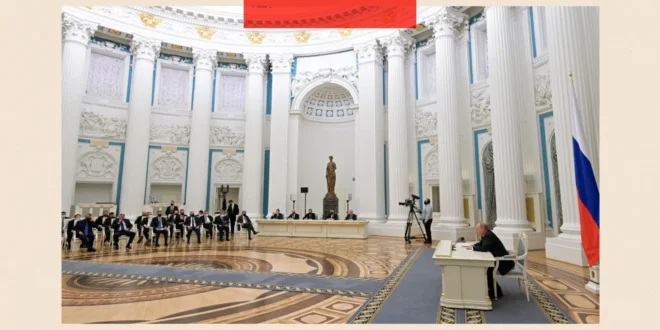

In March 1985, Konstantin Chernenko became the third Soviet leader to die in 28 months. Leonid Brezhnev went in November 1982, Yuri Andropov in February 1984. Each funeral was a rehearsal for the next, and the Politburo’s real work was finding someone young enough to outlive the transition. They chose Mikhail Gorbachev, and six years later the country he inherited was gone.
Russia’s history of succession suggests a pattern. Leaders matter enormously to how the system runs, but surprisingly little to whether the state endures. It also suggests that endurance is not the same as health.
The state that outlasts its rulers
When the Rurikid line died out in 1598, Russia entered the Time of Troubles: pretenders, foreign garrisons in the Kremlin, a state that nearly ceased to exist. It was rebuilt in 1613 around a new dynasty and much of the old machinery. When Joseph Stalin died in March 1953, his security chief Lavrentiy Beria was arrested within four months, on June 26, 1953, and shot by year’s end, on December 23, 1953; removed by colleagues who feared him more than they feared each other. On October 15, 1964, it was Nikita Khrushchev’s own Presidium that retired him, with no street protest involved.
In each case the apparatus survived the person. What changed, sometimes sharply, was what the apparatus did next. Nicholas I died in February 1855 with Sevastopol under siege. His son Alexander II sued for peace and then abolishedserfdom in March 1861, a reform that defeat had made thinkable. Succession followed by defeat can be a hinge.
So the question to ask of today’s Russia is not whether it holds. It is what holding is costing, and who is being asked to pay.
The ledger
The costs are visible in the numbers. Chatham House reports that growth was about 1% last year against 6% in 2021, and the 2026 budget deficit had already overshot its annual target by half. The Kiel Institute puts the damage in starker terms: liquid sovereign wealth fund assets fell from 6.5% of GDP at the start of the war to 1.8% by April 2026, and oil and gas revenues dropped 45% year on year in the first quarter of 2026. One account has the finance minister warning the prime minister in April that the government might lack the money to make all scheduled payments on time. A Polish analysis of the first quarter notes GDP fell 0.3% year-on-year, the first contraction in three years.
Ukrainian long-range strikes have made the cost tangible. They are producing petrol shortages and videos of blasts at warehouses that reach regions the drones themselves never touch.
Yet Russia is not collapsing, and the reasons are instructive. A temporary oil windfall from the Iran war cushioned the budget. One economic analysis concedes that the state keeps forcing money into the war economy. Dissent is also expensive. A senior state-bank economist who publicly called the war a failure lost his job, though not his life. That is both a sign of how things stand and an indicator of the regime’s remaining margin.
The sleepers
What of ordinary Russians? Many Western observers imagine a population quietly counting the regime’s weaknesses. The best recent evidence paints a stranger picture.
Researchers working with Levada-Center ran 14 focus groups in four cities between April and August 2026 and concluded that people treat the war as a fact of life they cannot change. They report no sign of readiness to confront the Kremlin. Polling they cite shows 61% think it is time for peace talks, while 59% would intensify attacks rather than concede more if peace cannot be had. These views coexist easily, because “end the war” and “end it on our terms” are compatible wishes.
Some details are strikingly human. Participants complained bitterly about inflation but did not blame the war for it. Asked whether they would fight, many men said never, then added that they would consider it their duty if mobilisation were announced. There is little warmth for the men at the front. People dread veterans coming home and compare them to Afghanistan’s veterans, the cohort Soviet society preferred to forget. The state calls them a new elite, and the public does not appear to agree.
The researchers’ term for this is a “bewitched sleep”, and they stress that Putin’s approval has never fallen below 59% in Levada’s tracking. Sleep is not consent, but neither is it a revolution in waiting.
Where the system could eventually crack
If the street is quiet, the corridor is not. Elites have always been the audience that matters in Russian politics. Khrushchev fell to the Presidium, not to crowds.
Chatham House describes business and political leaders bearing growing burdens as the war’s costs rise, with high-level dissent stamped out. Putin reportedly asked business owners at a closed meeting in March to donate directly to the war effort, after raising taxes earlier in the year. A Polish think tank notes that the FSB has been given near-total freedom to discipline members of the elite at other groups’ expense. The Estonian foreign intelligence service records that at an economic forum, the head of Sberbank spoke of “technical stagnation”, which Putin then denied.
The brake, for now, is the coercive apparatus. CNAS finds no significant sign of weakening security-service loyalty, and no autonomous military constituency has emerged from four years of war. Without a faction that has guns and a grievance, elite discontent tends to stay private. The Soviet case is a caution in both directions. Nobody saw 1991 coming, and nobody needed to for it to happen.
Three doors out
A Russia without Putin could take several routes, and history supplies precedents for each.
The relay: An insider is anointed, as Putin himself was in 1999. The faces change, and the structure and the beneficiaries stay. The new leader may end the war and keep the system.
The committee: After Stalin, collective leadership held for a few years before one man emerged from it. Such arrangements are stable only until someone wins.
The scramble: Without a clear heir, rival security and business networks compete. This is the Time of Troubles in miniature, and it could produce harder lines as easily as softer ones.
None of these routes leads automatically to liberalisation. The people best placed to inherit have thrived under the current order. Even the Russians in the ECFR focus groups expect only a limited thaw, one in which relations with Europe improve on pragmatic terms after Putin leaves, though no one expects Russia to see Europe as a model again.
Europe’s long game
Brussels has read the same ledger. The EU approved a record payment to Kyiv on November 16: just under €8 billion, about €5 billion of it from the Ukraine Support Loan, released after Ukraine completed more than 20 reform steps. The message is that Europe intends to outlast Russia’s endurance.
The sounder strategy runs on two tracks at once. One is firmness, because a Russia that is under strain is not a Russia that is about to concede. The other is keeping open the idea that the country can change. The ECFR authors urge Europeans to keep indirect lines to Russian society open because Russia will remain Europe’s neighbour whoever governs it.
The Alexander question
The best test of any succession is what the successor does with defeat, or with something that feels like it. Alexander II read Sevastopol as proof that the old order had failed and reformed. Others, in other eras, read their failures as proof that they needed to be harder and more closed.
Putin’s Russia will eventually face that choice, whether on his watch or the next man’s. The state will survive. What it concludes about its own wars, and who gets to draw that conclusion, will be decided in rooms most Russians will never see.
Author’s Bio:
Dr. Yashwant Singh is an Indian sociologist working at the intersection of urban studies, development, nature and geopolitics. He holds an M.Phil. in Sociology from the University of Delhi and a Ph.D. from the University of Hyderabad, and recently served as Assistant Professor of Sociology at GITAM (Deemed to be) University, Bengaluru. His essays and analyses have been published across several international platforms, including Across Voices, Modern Diplomacy, Eurasia Review, Jerusalem Strategic Tribune, Geostrategic Media, South Asia Journal, World Geostrategic Insights, and IA-Forum.