Geostrategic Media Political Commentary, Analysis, Security, Defense

By James Whyatt
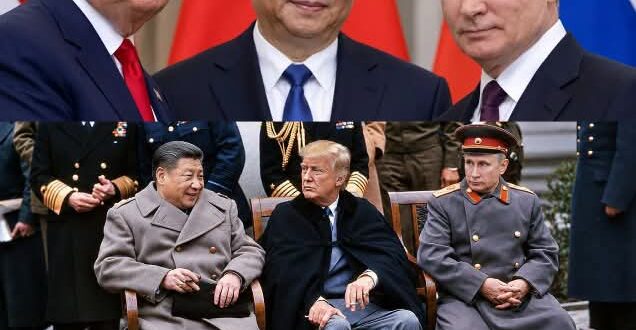
The gathering of Donald Trump, Xi Jinping and Vladimir Putin in Shenzhen on 19 November is more than an extraordinary diplomatic photograph. It is a demonstration of how international politics is increasingly being conducted: through personal relationships between powerful leaders, transactional diplomacy and the pursuit of national advantage in a world where established institutions are struggling to maintain their authority.
The comparison with the 1945 Yalta Conference is tempting. Then, the leaders of the United States, Britain and the Soviet Union negotiated the political architecture of post-war Europe. Today, the leaders of three nuclear powers are preparing to discuss questions that could influence the future of international security, trade and strategic competition. But there is an important difference. The three countries do not share a common vision of the international order, and their interests remain fundamentally competitive. Shenzhen is not Yalta, even if the symbolism of three powerful men sitting around one table invites uncomfortable historical comparisons.
For Xi Jinping, the meeting represents an opportunity to reinforce China’s international standing. Beijing wants to present itself as a responsible global power committed to economic cooperation, open trade and a more representative international system. Hosting the Asia-Pacific Economic Cooperation summit provides an appropriate diplomatic setting for that ambition. China is also seeking to demonstrate that its relationship with Moscow remains strategically important while preserving room for negotiations with Washington.
Putin has a different calculation. Russia’s international position has been constrained by Western sanctions, the continuing war in Ukraine and its increasing economic dependence on China. Yet an invitation to participate in a trilateral meeting with the American and Chinese presidents allows the Kremlin to project an image of continued great-power status. For Putin, diplomatic recognition is itself a political achievement. It helps counter the narrative that Russia has become internationally isolated and reinforces his domestic argument that Moscow remains indispensable to global security discussions.
Trump, meanwhile, approaches the summit through a transactional understanding of diplomacy. His interest in nuclear arms negotiations, the war involving Iran and the broader relationship with Beijing reflects an ambition to secure visible agreements with major international consequences. Yet the difficulty is that the three leaders do not necessarily define success in the same way. Washington wants strategic concessions, Beijing wants recognition of its growing influence and Moscow wants relief from international pressure and a more favourable diplomatic environment.
The nuclear question illustrates the problem. The expiration of the New START agreement in February 2026 removed the last major treaty framework limiting American and Russian strategic nuclear arsenals. Washington wants China involved in future arms-control discussions, but Beijing has little incentive to accept restrictions designed around arsenals that remain considerably larger than its own. A trilateral photograph cannot resolve this fundamental disagreement. Any credible agreement would require verification, transparency, reciprocal commitments and a recognition of the different strategic positions of the three countries.
The same difficulties apply to Ukraine and Iran. Russia wants its war against Ukraine addressed on terms favourable to Moscow. Washington has indicated that Ukraine may not be central to the planned trilateral agenda, while China has its own reasons for avoiding a discussion that could expose disagreements with Russia. Iran presents another challenge. Trump has expressed an interest in discussing the war, while Beijing and Moscow maintain relationships with Tehran that give them diplomatic access but do not necessarily translate into control over Iranian decisions.
There is a wider danger here. When great powers conduct diplomacy primarily through bilateral understandings and personal relationships, smaller countries can become subjects of negotiation rather than participants in decisions affecting their security. European governments, Ukraine, Gulf states and other regional actors have legitimate reasons to be concerned about the possibility that their interests could be subordinated to broader bargains.
APEC itself provides an important contrast. Its 21 member economies represent a substantial share of global economic activity, and its purpose is to encourage regional trade, investment and cooperation. The summit should not become merely a backdrop for a diplomatic spectacle involving three presidents. The economic and political interests of the wider Asia-Pacific cannot be reduced to the ambitions of Washington, Beijing and Moscow.
The real test of Shenzhen will therefore not be whether the three leaders appear cordial or whether they issue carefully negotiated statements. It will be whether their discussions produce measurable progress on nuclear stability, conflict prevention and international economic cooperation. If they fail, the summit may become another example of diplomacy in which symbolism substitutes for substance.
The world does not need a new Yalta. It needs an international system in which powerful countries accept that their security cannot be built by disregarding the sovereignty and interests of others. Shenzhen offers an opportunity to demonstrate that principle. Whether the three leaders recognise it is another matter.