Geostrategic Media Political Commentary, Analysis, Security, Defense

GEOSTRATEGIC MEDIA | SECURITY ANALYSIS | 30 OCTOBER 2026
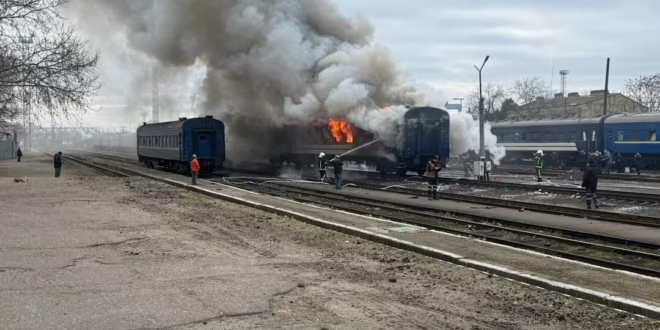
A Russian drone strike on a crowded railway platform in the Ukrainian city of Dnipro killed at least 14 people, according to Ukrainian officials cited by Reuters. The attack came amid further strikes in other Ukrainian cities and at a moment when a limited local ceasefire in the Kherson region had raised cautious hopes for renewed diplomatic contacts. The contrast is stark: even as channels for negotiation remain possible, the war continues to expose civilians and essential infrastructure to lethal risk.
Railways are central to Ukraine’s ability to sustain daily life and national resilience. They move civilians, workers, humanitarian supplies and goods across a country whose road and energy networks have repeatedly been damaged. Attacks on stations and transport nodes therefore have consequences beyond the immediate casualty count: they disrupt mobility, undermine public confidence and place additional pressure on emergency services.
The operational logic of infrastructure pressure
Strikes against transport infrastructure can serve several military purposes, including disrupting logistics, complicating movement and imposing psychological pressure on the population. But when civilian facilities are struck, the legal and moral questions are unavoidable. International humanitarian law requires parties to distinguish civilians and civilian objects from military objectives, and to take precautions to avoid or minimize civilian harm. The precise circumstances and target selection in Dnipro require investigation; the reported death toll alone should not be used to speculate about the intended target.
The wider pattern also matters. Reuters reported that the Dnipro attack occurred alongside deadly strikes in Chernihiv and Kremenchuk. The accumulation of incidents makes it harder for Ukrainians to treat local pauses as evidence of a broader reduction in hostilities. A ceasefire confined to one area may save lives, but it does not change the strategic character of a war being fought across multiple fronts.
Diplomacy under the shadow of violence
Efforts to restart talks involving Ukrainian and Russian representatives and US envoys face a familiar problem: the parties are negotiating not only over territory and security guarantees, but over the political meaning of any pause. Kyiv wants an arrangement that does not simply give Moscow time to regroup. Moscow seeks terms that consolidate its battlefield and political objectives. External mediators can create opportunities for contact, but they cannot substitute for agreement on enforcement, monitoring and the consequences of violations.
For Ukraine’s partners, the attack reinforces the need to connect diplomatic engagement with practical civilian protection. Air defence, early-warning systems, resilient transport networks and support for emergency response are not alternatives to diplomacy; they help preserve the conditions under which a country can negotiate without being coerced by attacks on its population.
A test of resilience
The Dnipro strike is a reminder that the human cost of the war is not measured only by changes on the front line. Railway stations, residential districts and public services are part of the infrastructure that allows society to function during conflict. Any credible settlement will need more than a cessation of major offensives: it will require monitoring arrangements and meaningful protections for civilians. Until then, every local truce will remain fragile, and every attack on civilian life will deepen the distrust that makes a political settlement harder to achieve.