Geostrategic Media Political Commentary, Analysis, Security, Defense

Geostrategic Media Desk Team
Key Features
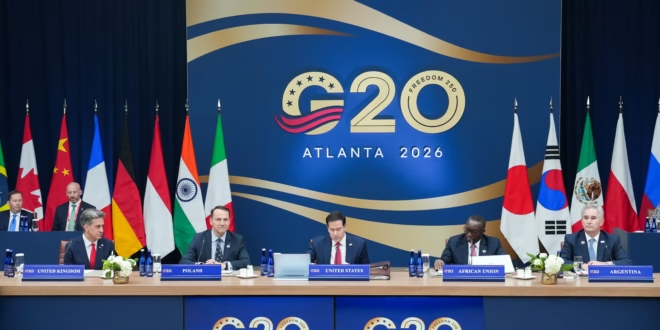
- The G20 foreign ministers’ meeting in Atlanta ended on Saturday with no joint communique; Secretary of State Marco Rubio will issue a chairman’s statement instead.
- The traditional group photo was canceled after European diplomats objected to standing alongside Russia’s Sergei Lavrov.
- The Ukraine and Iran wars, and the prospect of new US strikes on Iran, dominated the corridors.
- The US midterms on 3 November, an unresolved Israeli election and Christine Lagarde’s coming exit from the ECB add to a week of political uncertainty.
The world’s top diplomats met in Atlanta this week hoping to show that the Group of 20 can still work together. They left without agreeing on the issues that matter most, a result that says as much about the state of world politics as any single communique could have.
A meeting overshadowed by two wars
Rubio opened the talks on Friday with an appeal for unity, warning of interconnected economic and geopolitical crises that threaten the global economy, including strains on energy and food supplies and on freedom of navigation. He then canceled the customary group photo after European diplomats objected to including Lavrov and threatened to boycott or walk out. EU foreign policy chief Kaja Kallas accused the Russian minister of presenting lies and false narratives. Diplomats described the opening session as cordial but said Russia’s position on Ukraine was unyielding, as was its opposition to Poland’s membership in the G20. Lavrov said Moscow would not accept a situation in which Ukraine posed a military threat to Russia’s legitimate security interests.
Some members had questioned why Washington invited Russia at a time of heightened attacks on Ukraine, especially after President Trump pushed relations with Kyiv to new lows by waiving fresh sanctions on Moscow and temporarily limiting logistical and intelligence assistance, according to AP. Rubio told reporters he would not pretend the group was close to universally accepted solutions, though he called the first day productive.
Iran in the background
The possibility of renewed US military action against Iran also hung over the gathering and has put the Gulf, including G20 member Saudi Arabia, on edge. Rubio met Saudi Foreign Minister Prince Faisal bin Farhan and Turkey’s Hakan Fidan, whose country has been a key mediator. On the sidelines, Rubio also hosted Quad counterparts from Japan, India and Australia. Rubio said pressure on NATO allies to spend more on defense is not hostile, a message aimed at European partners already unsettled by US policy.
Other political fault lines
United States. Voters decide on 3 November whether to hand Democrats the House. Forecasters and prediction markets give them roughly an 80% to 94% chance, and a divided Congress would gain new leverage over war powers, spending and nominations, though foreign policy would remain largely in the president’s hands.
Israel. The 28 October election produced no clear winner. CBS News reports that Prime Minister Benjamin Netanyahu’s Likud party is claiming the vote was stolen, which raises the stakes of coalition talks at a moment when Israel is a party to the war with Iran.
Europe. ECB President Christine Lagarde will leave on 7 February, ahead of France’s presidential election in April, where polls show Marine Le Pen or Jordan Bardella could win. The choice of her successor is therefore both a financial and a political decision.
Latin America. Luiz Inácio Lula da Silva won a fourth term in Brazil on 25 October, with about 51.8% of the vote.
What to watch
The chairman’s statement from Atlanta, the 3 November US vote and the December G20 leaders’ summit, which Trump plans to host in Miami at his Doral resort. As one Atlantic Council analyst put it to AFP, this was the group’s last test under the US presidency before Miami, and the result suggests the leaders’ meeting will be hard.