Geostrategic Media Political Commentary, Analysis, Security, Defense

By Rami Al-Shaer
Key Points
- Preparations have reportedly begun for a potential trilateral meeting between the Russian, Chinese and American presidents, possibly on the sidelines of the APEC summit in China on 18–19 November.
- Direct contacts between Russia and European leaders, alongside diplomatic initiatives concerning Ukraine, Iran and Gulf security, suggest renewed efforts to reopen channels of dialogue.
- Saudi Arabia, Türkiye and Pakistan are pursuing regional diplomatic engagement with Iran, while Qatar is reportedly facilitating discussions on a possible US-Iran settlement.
- The central principle underpinning these initiatives is indivisible security: addressing the security concerns of all parties without undermining the security of others.
- The return of diplomacy does not guarantee success. The real test will be whether these contacts produce enforceable agreements, reciprocal concessions and a sustainable reduction in conflict.
The Op-Ed
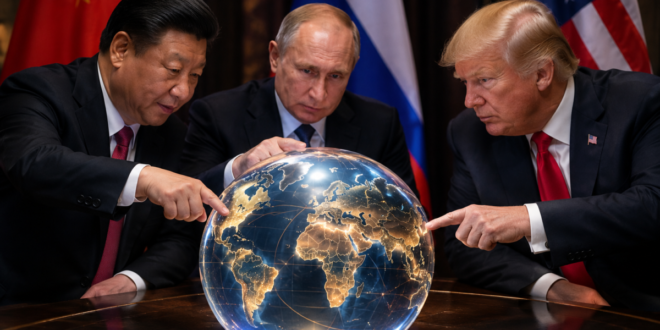
On 25 October, Yuri Ushakov, an aide to the Russian president responsible for foreign policy, announced that preparations had begun for a trilateral meeting between the Russian, Chinese and American presidents.
Ushakov did not specify a date or agenda. He said, however, that all three parties were, in principle, prepared to meet. The proposal under consideration is to hold the meeting on the sidelines of the APEC summit in China on 18–19 November.
In a notable development, Finnish President Alexander Stubb and Norwegian Prime Minister Jonas Gahr Støre held a telephone conversation with Russian President Vladimir Putin on 27 October. According to Reuters, the conversation lasted 90 minutes and was initiated by the Finnish and Norwegian leaders in consultation with Ukraine. The discussion focused on the war in Ukraine and diplomatic efforts to end it, against the backdrop of preparations to resume trilateral negotiations between Russia, the United States and Ukraine in Abu Dhabi, also scheduled for November.
While Stubb and Støre stressed the “need to end the war and de-escalate,” Moscow reiterated its longstanding position that any lasting peace must address the root causes of the crisis and take Russian security interests into account.
The Qatar News Agency also published a statement on the meeting between Qatar’s Emir, Sheikh Tamim bin Hamad Al Thani, and President Putin in Moscow on 27 October. According to the statement, the two leaders discussed developments in the Middle East and ways to strengthen security and stability, as well as energy supply chains and the Strait of Hormuz. They also affirmed that regional security requires the establishment of an independent Palestinian state.
At the same time, Saudi Arabia, Türkiye and Pakistan—the three countries identified in the article as signatories to the Mecca mutual defence agreement—undertook a joint diplomatic initiative to hold direct security talks with Iran amid escalating regional tensions. Saudi Defence Minister Prince Khalid bin Salman, Pakistani Army Chief Field Marshal Asim Munir, and Türkiye’s National Intelligence Organization chief, Ibrahim Kalin, travelled to Tehran on 26 October. The delegation was received by Iranian President Masoud Pezeshkian and Mohsen Rezaei, identified in the article as secretary of Iran’s Supreme National Security Council.
The delegation discussed the possibility of opening a negotiating track between the United States and Iran, as well as establishing a regional framework of understandings to prevent countries in the region from being drawn into direct military confrontation. Such a framework would also provide mechanisms for addressing disputes through regional security arrangements.
The discussions naturally included freedom of navigation and the security of maritime corridors. Tehran presented its position linking negotiations over its nuclear programme to demands for an end to the US blockade of its ports and the lifting of restrictions on Iranian oil exports. The meetings also addressed Palestine, Lebanon and the repercussions of the US-Israeli war against Iran.
Reuters also reported that Qatar had put forward a draft proposal for a new agreement aimed at resolving the dispute with the United States during bilateral discussions held in Tehran on 25 October through Qatari mediators. Tehran is currently reviewing the proposal and is expected to respond by the end of the week.
What connects these initiatives, despite their different participants and geographical settings, is an effort to reopen direct channels of communication at a moment when the risks of escalation are increasing. From a potential trilateral summit involving Vladimir Putin, Xi Jinping and Donald Trump, to direct contacts between Putin, Stubb and Støre over Ukraine, and regional mediation efforts concerning Iran, Yemen and Gulf security, multiple diplomatic tracks are searching for a genuine and realistic political way out of the existing crises.
That way forward rests on a central principle: indivisible security.
This means security for everyone without diminishing the security of anyone else. It requires recognising the concerns and rights of all parties, above all the rights of Palestinians to their land and return, and the need to end the Israeli occupation in the Middle East. It also requires acknowledging the failure, as the author sees it, of the Western strategy to contain, fragment and weaken Russia and to achieve its “strategic defeat” in Europe.
It is equally important, however, not to confuse the resumption of diplomacy with its success. Communication does not mean that disagreements have disappeared, proposals do not mean that the parties have accepted them, and meetings alone cannot guarantee de-escalation or a ceasefire.
The parties remain far apart on Ukraine and Iran’s nuclear programme, not to mention the Arab-Israeli conflict. Their visions for future regional arrangements also remain divergent, and some of the underlying disputes are too deep to be resolved through a handful of diplomatic initiatives.
Nevertheless, Saudi Defence Minister Prince Khalid bin Salman’s visit to Tehran under the current circumstances underscores, in the author’s assessment, the important responsibility Saudi Arabia is assuming amid rising tensions in the Middle East. It also signals a diplomatic direction in which all parties to the crisis should engage.
The convergence of these initiatives raises questions worthy of serious reflection. Are the parties beginning to recognise that the world is approaching a series of potentially catastrophic crises whose consequences would affect everyone? Are they acknowledging that continued escalation raises the cost of conflict for all sides, and that security cannot rest on mutual threats alone? Can regional powers build mechanisms for dialogue and understanding that reduce their dependence on intervention by major powers and prevent the region from becoming an open arena for settling geopolitical scores?
Perhaps reason has not yet prevailed over escalation. Nevertheless, these contacts, initiatives and commendable efforts to contain a crisis that could ignite at any moment offer grounds for cautious attention. The multiplication of dialogue channels, the widening scope of mediation and the resumption of direct communication between adversaries all suggest that diplomacy has not lost its place in the management of international crises.
The real test remains whether these initiatives can move beyond statements, meetings, press conferences and commemorative photographs to produce agreements that can actually be implemented. Such agreements will require reciprocal concessions and difficult, sometimes painful, compromises, with the overriding objective of protecting lives and property, bringing wars to a genuine end, and establishing a more stable and sustainable security order.
Rami Al-Shaer is a Palestinian writer and political analyst based in Moscow.