Geostrategic Media Political Commentary, Analysis, Security, Defense

Dr. Nessrine Mesto-Assaad
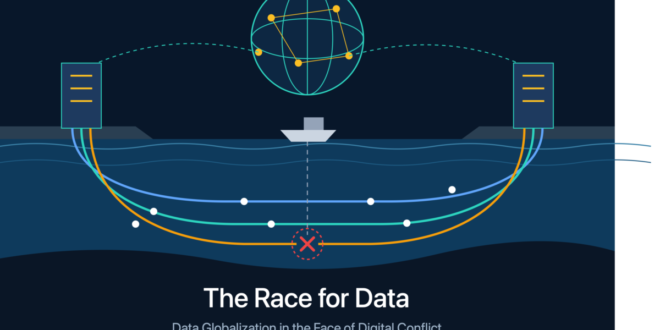
Imagine you are taking a picture in a small café in Egypt overlooking the Nile River. You keep the picture on your cloud server, and say to yourself, “I will not share it with anyone; I will keep it to myself.” This personal, spontaneous image of yourself has become universal. When you upload your image to the cloud, you are sending it as light signals through fiber-optic cables that cross the oceans to another continent or country, where it settles in one of the global data centers. Your image has become a digital expatriate sleeping on a physical server (data center) located on another continent and subject to the data and information protection laws in force in the country where you are located. This image has become part of this cross-border world governed by technology.
Now imagine with me that you are in a European country, such as France, and you are interacting with generative artificial intelligence platforms, for example, ChatGPT, Google Gemini, Alexa, Siri, or any other smart chatbot. You’re not just talking to yourself or through your device; you’re embarking on an amazing exploratory cognitive data journey about yourself, your thoughts, tendencies, beliefs, and orientations. These conversations, inquiries, and ideas exchanged between you and the chatbot cross borders and continents and reside on a physical server in another country, which may be an American state or a Chinese city. These conversations are the optimal digital environment that AI uses to develop itself by mimicking human behaviors and interactions.
Now imagine with me that you are a consumer living in Australia and buying goods online, for example, on Amazon, Shein, Temu, or any other global trading company. When you press the buy button, you send complex digital streams that cross continents to global technical processors that process your data. First, you call logistics algorithms in a country to process and ship the order for the purchase you made. Second, you issue an encrypted financial order to global bank servers to pay the amount for the purchase. Third, marketing algorithms collect your digital footprint and send neural signals through the cloud to analyze your purchasing behavior, predict your needs, and send targeted ads. Fourth, your personal information, including your name, address, phone number, the bank or financial company you deal with, the times you are online, and the purchases that appeal to you, is all kept and matched with similar data on a physical server (data center) on another continent. All this is done in less than a second.
This is not a fantasy; this is a reality we all live in.
Welcome all to the globalization of data!
Data globalization is the most attractive term for AI companies and one of the most important terms attracting the attention of governments seeking to develop AI. This term is considered the most important in the world today and is ranked among the priorities of the largest digital technology countries, such as China and the United States. In the era of generative AI, data globalization is the primary source for generating and training AI in data centers around the world.
What is data globalization?
To understand this term well, we must first define data and its uses.
Data is the information, behaviors, and patterns that AI collects about users. For example, people who use a generative chatbot directly contribute free information and data to AI. No phone or laptop is without apps and features for virtual websites or digital platforms. Whenever you browse websites, interact with a particular post, or purchase a product online, you contribute to the collection and storage of your personal data in the cloud. In addition to individual data, your most frequently used behaviors, preferences, and browsing times, your purchases, your purchasing cycle, your interests, your circle of acquaintances, your thoughts, your concerns, your whereabouts, and even your personal life have become important data for governments and major commercial companies around the world. Businesses benefit from this data by reselling it for trade and marketing purposes. In many cases, this data is compiled and shared with governments and AI companies to help generate a new generation of AI.
Data globalization is the process of collecting, transmitting, processing, and storing data through close interconnectedness among businesses, governments, and digital platforms around the world. Major global companies such as Microsoft, Meta, Google, Alibaba, TikTok, YouTube, Facebook, and Huawei… are among the most important contributors to the globalization of data. For example, Microsoft provides cloud computing and artificial intelligence services to many companies, governments, and countries around the world. This data is stored on cloud infrastructure (data centers) and, depending on the hosting location, may be processed in the host country or transferred to other geographic areas where it is processed and utilized. In addition to cloud services, Microsoft offers the Windows operating system, which is widely used on most personal laptops and devices and in most companies around the world. In addition to providing cloud computing services, Huawei is a leader in telecommunications networks and equipment, particularly fifth-generation service providers. Both companies contribute to the globalization of user data and its transfer from one geographic region to another.
Another example is YouTube and TikTok, two of the most popular platforms among users. These platforms are no longer just for entertainment but have become an integrated economy that provides financial returns to content creators and encourages them to continue uploading videos, photos, opinions, and engaging in continuous interactions around the clock. These ongoing interactions across these platforms are not just instant entertainment or social communication, but rather an ongoing process of securing food (user behaviors) that algorithms devour and send to data centers.
Digital conflict and the importance of data globalization
The globalization of data is one of the most important sources used to train and update the new generation of artificial intelligence. The training and development of an artificial mind depend on huge amounts of data on which the machine feeds and learns. Developers feed the machine millions of images, conversations, interactions, invoices, texts, and videos that describe a specific topic. The machine analyzes these inputs using advanced technologies such as Deep Learning, Machine Learning, and Natural Language Processing. During this process, the machine converts the inputs into a digital language using mathematical matrices capable of analyzing multiple patterns and finding commonalities among the inputs. This process is repeated millions of times, with external interventions from developers when necessary to correct the learning process and avoid incorrect outputs.
This massive hunger for data is accompanied by a dual political drive from China and the United States to secure data and ensure the continuity of the existing learning and development process to create an artificial mind identical to the human mind. China and the United States are competing in global markets through companies from both countries to collect and purify user data worldwide.
Commercial companies selling goods and products, global banking companies, social networking sites such as TikTok, Facebook, and U-Top, global digital magazines, search engines, chatbots, virtual gaming sites, global news stations, and digital television networks are all Chinese American tools that collect user data and transfer it to giant servers for processing, purification, and machine training.
With the rapid increase in data production, keeping this artery of training data flowing has become extremely important and requires intelligence and influence. The issue is no longer who gets the data; it is who gets to the data faster and who monopolizes it. The conflict has become a global takeover conflict, with Chinese and American companies as the leaders in collecting data and ordinary users (us) as the tools for generating data.
The more data and interactions we have across the platforms mentioned above, the closer we will get to a super-intelligent industrial mind. The excessive modernity of current technology, imposed on our lifestyle, is not free in the full sense. It targets our data and behaviors, steals our privacy, and shares it with controlling data rulers around the world. If you are one of those who rely on this technology continuously, do not be surprised that huge amounts of your data, behaviors, and characteristics are collected, packaged, and resold in the data market every second.
In the near future, when you ask a simple question of a generative chatbot, such as ChatGPT, always remember that its correct answer emerged from a digital neural network after millions of attempts and exercises on inputs of which you yourself are a part.
Author’s Bio:
Dr. Nessrine Mesto-Assaad is a Doctor of Business Administration and a researcher specializing in e-government, e-file, and Generative Artificial Intelligence (ChatGPT applications) research. Her work focuses on taxpayers’ behavioral intentions to use e-government, the electronic filing system, and the adoption of AI conversational tools when e-filing income tax returns. Currently, she focuses on the intersection between digital technology and its influence on global supremacy.