Geostrategic Media Political Commentary, Analysis, Security, Defense

Dana Ennab
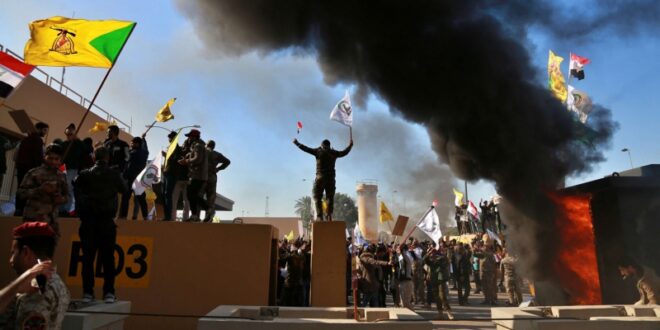
Washington’s renewed warning against travel to Iraq is more than a routine security advisory. It comes amid a regional crisis in which confrontation with Iran, attacks affecting Gulf states and concerns over threats to American personnel and interests are becoming increasingly interconnected. For Baghdad, the message carries implications that extend beyond the safety of American citizens: it raises renewed questions about the Iraqi government’s ability to exercise sovereign control over armed groups operating within its borders.
The US State Department has retained Iraq at Level 4, its highest travel advisory category. The latest update, as described in the *Arab Newspaper* report, broadens the security context by referring to the risk of further attacks, including Houthi activity affecting Saudi Arabia and alleged Iranian efforts to target American officials in the region. The distinction is important. Washington has not necessarily introduced a new classification for Iraq; rather, it has placed the existing warning within a wider regional security framework.
The question, therefore, is not simply whether Iraq has become more dangerous for American visitors. It is whether Washington is also signalling that Baghdad’s ability to manage security threats will increasingly shape its political and strategic relationship with the United States.
Iraq Is No Longer an Isolated Security Theatre
The confrontation between Washington and Tehran has consequences that extend well beyond their immediate bilateral relationship. Iraq sits at the intersection of competing interests, with close political and economic ties to Iran, a longstanding security partnership with the United States, and relationships with Gulf countries that are increasingly concerned about cross-border threats.
Any escalation between Washington and Tehran could expose Iraq to pressure from multiple directions. American facilities and personnel could face attacks by armed groups, while operations launched from Iraqi territory could provoke diplomatic disputes with neighbouring states. Even if Baghdad does not participate directly in a conflict, its geography and internal political dynamics could make it difficult to remain insulated from its consequences.
This is the strategic vulnerability at the heart of Iraq’s position. The country has spent years attempting to rebuild its institutions and restore its international standing after decades of war, sanctions and internal conflict. Yet the persistence of armed actors with varying degrees of independence from central government authority continues to complicate those efforts.
Washington’s warning should be understood against this background. The United States is signalling that it views security risks in Iraq not as an entirely domestic matter, but as part of a broader regional challenge involving Iran, its partners and the protection of American interests.
That interpretation does not establish that the advisory is a deliberate instrument of political coercion. Governments issue travel warnings in response to security assessments, and the protection of citizens is a legitimate responsibility. Nevertheless, such warnings can carry diplomatic weight, particularly when they question whether a host government can guarantee the safety of foreign nationals.
The Limits of Baghdad’s Authority
The most consequential language in the advisory, according to the report, concerns the Iraqi government’s inability to guarantee the safety of American citizens during a sudden outbreak of violence or armed conflict. The statement raises a fundamental question about state authority: can Baghdad ensure that decisions concerning the use of force remain under the control of legitimate national institutions?
Iraq’s security structure is complex. The Popular Mobilization Forces, or PMF, were formally incorporated into the country’s security architecture, but the relationship between state institutions and the various factions within the broader network remains politically sensitive. These groups differ in their organisational structures, political affiliations and relationships with Iran. They should not be treated as a single, uniform actor.
Some factions maintain considerable military capabilities and political influence, complicating efforts to establish a unified chain of command. The Iraqi government must navigate this reality while balancing domestic political considerations, its obligations to international partners and the need to prevent Iraqi territory from being used for attacks against neighbouring countries.
This is not simply a question of satisfying Washington. It goes to the heart of Iraqi sovereignty. A state’s authority is weakened when armed organisations can independently determine whether, when and against whom force is used. The consequences can include retaliation against Iraqi territory, deterioration in diplomatic relations and damage to investor confidence.
At the same time, efforts to bring armed factions under effective state control cannot be reduced to a demand for immediate confrontation. Abrupt measures could trigger domestic instability, deepen political divisions or provoke resistance from actors with entrenched interests. The challenge for Baghdad is to strengthen the authority of national institutions through a credible, lawful and sustainable process.
The Gulf Dimension
Iraq’s security predicament has become more consequential as Gulf governments confront a wider range of threats to their territory and critical infrastructure. Saudi Arabia, in particular, has reason to be concerned about missile and drone attacks, whether originating from Yemen or associated with other regional actors.
The report cites analysis from the American Enterprise Institute’s Critical Threats Project suggesting that Iraqi groups aligned with Iran may have launched drones toward Saudi Arabia in recent weeks. However, responsibility for individual incidents requires careful verification, and allegations concerning the launch of attacks from Iraqi territory should not be treated as conclusively established without supporting evidence.
That distinction matters. If armed groups operating from Iraq are shown to be responsible for cross-border attacks, Baghdad will face increased pressure to demonstrate that it can secure its territory and prevent it from becoming a platform for operations against neighbouring states.
The diplomatic consequences could be substantial. Gulf governments may demand stronger assurances from Baghdad, while Washington could press for more effective protection of American personnel and facilities. Depending on the circumstances, further incidents could also affect security cooperation, economic engagement and regional efforts to improve relations with Iraq.
For Baghdad, the objective should be to prevent allegations and security incidents from becoming a permanent obstacle to regional integration. Iraq has a strategic interest in maintaining constructive relations with Saudi Arabia and other Gulf states, expanding economic cooperation and avoiding a return to the role of a battleground for competing regional powers.
Is Washington Applying Political Pressure?
There is a distinction between the security purpose of a travel advisory and its possible political consequences. The warning alone does not prove that Washington has decided to impose new measures against the Iraqi government or fundamentally change its policy toward Baghdad. Nor does it establish that the United States is preparing sanctions or other punitive steps.
Yet security assessments can become part of a wider diplomatic message. By emphasising the risks posed by armed groups and the limitations of the Iraqi government’s ability to guarantee safety, Washington places responsibility on Baghdad to demonstrate greater control over the security environment.
Such a message could serve several purposes. It could justify additional precautions for American personnel, support demands for stronger protection of diplomatic facilities, or encourage Iraqi leaders to take more visible action against groups accused of threatening US interests. It may also communicate to Tehran that Washington is monitoring the regional activities of Iran-aligned actors and views attacks against its personnel and partners as part of a wider security challenge.
Whether these signals will translate into concrete political action remains uncertain. A travel warning is not, by itself, evidence of an impending sanctions package, a withdrawal of diplomatic engagement or a decision to punish Baghdad. Those conclusions would require separate indicators, such as formal policy announcements, specific demands, new restrictions or documented changes in bilateral cooperation.
Washington also faces a strategic calculation of its own. Excessive pressure on Baghdad could weaken the very government it wants to see exercise greater control over security. A destabilised Iraq would create additional opportunities for armed groups to expand their influence and could undermine American and regional interests alike.
The effectiveness of US policy will therefore depend partly on whether Washington combines pressure with practical support for Iraqi institutions, intelligence cooperation and diplomatic engagement.
Sovereignty Must Be More Than a Political Slogan
For Iraq, the central issue is not whether to comply with every American demand. It is how to establish a security system in which the use of force is governed by national law and accountable institutions.
That requires more than statements affirming the government’s authority. It calls for stronger command structures, effective border controls, credible investigations into attacks, and consistent enforcement of the law against those who threaten civilians, foreign personnel or neighbouring countries. It also requires political arrangements that reduce the incentives for armed factions to operate independently of the state.
Such reforms should serve Iraq’s national interests rather than be presented merely as concessions to Washington. The ability to prevent attacks launched from Iraqi territory would strengthen Baghdad’s standing with Gulf neighbours, reduce the risk of retaliation and create a more stable environment for investment and reconstruction.
The government must also preserve a careful balance in its relations with the United States and Iran. Both countries possess influence in Iraq, but neither should determine Iraq’s security priorities at the expense of Iraqi national interests. Baghdad’s long-term objective should be to avoid becoming an operational arena in which external powers settle their disputes through local partners.
This will be difficult. Iraq’s political system reflects competing domestic constituencies, some of which maintain close ties with Tehran, while the security partnership with Washington remains important to other national priorities. Managing these relationships requires political negotiation, institutional reform and a consistent commitment to preventing Iraqi territory from being used to threaten others.
The Real Test Lies Ahead
Washington’s decision to retain Iraq at the highest travel advisory level while expanding the surrounding security narrative highlights the growing connection between Iraq’s internal security challenges and the wider confrontation involving Iran and the Gulf.
The immediate message to Baghdad is that its partnership with the United States does not remove its responsibility to protect foreign personnel and prevent attacks from being launched from its territory. The broader message to Tehran is that Washington is treating potential threats to its interests and regional partners as part of a connected strategic challenge.
But the decisive test will not be the language of travel advisories. It will be whether Baghdad can prevent armed groups from drawing the country into a wider conflict, whether Washington can protect its interests without undermining Iraqi stability, and whether regional governments can contain their disputes before they produce another cycle of proxy confrontation.
Iraq cannot eliminate the strategic competition surrounding it. It can, however, work to ensure that its institutions, territory and population are not once again made instruments of that competition.
The choice facing Baghdad is therefore larger than the question of whether Washington is warning or pressuring it. It is whether Iraq can turn the