Geostrategic Media Political Commentary, Analysis, Security, Defense

In the Gulf, water is not a given. It is engineered.
Across a region where vast oil wealth meets extreme natural scarcity, life depends on a technological miracle: turning seawater into drinking water. Today, Gulf states produce nearly 40 percent of the world’s desalinated water—an achievement that has sustained rapid urban growth, industrial expansion, and modern life.
But in a time of war, that same lifeline reveals a dangerous truth: what sustains the Gulf can also be targeted. And increasingly, it is.
As tensions escalate with Iran and spill toward coastal zones, recent incidents have exposed a critical vulnerability. Desalination plants—long viewed as infrastructure—are now emerging as strategic assets, no less important than oil terminals or military bases.
How the Gulf Manufactures Water
The Gulf’s natural water resources are among the lowest in the world. Renewable water availability per person ranges from just 286 cubic meters annually in Oman to as little as 4–20 cubic meters in Kuwait and Qatar. In practical terms, this means that without desalination, modern life in the region would be impossible.
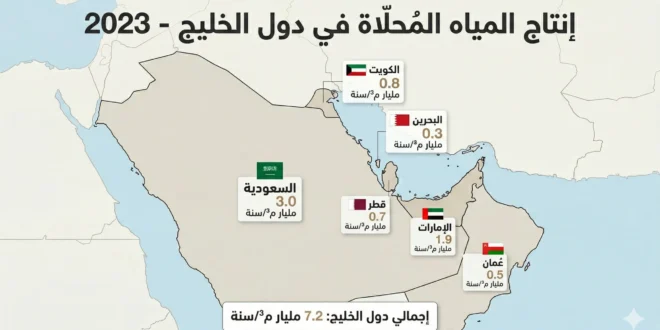
According to 2023 data, the six Gulf Cooperation Council states collectively produced around 7.2 billion cubic meters of desalinated water annually. Leading the way is Saudi Arabia, followed by United Arab Emirates, with the rest distributed among Kuwait, Qatar, Oman, and Bahrain.
This water is produced through two main methods:
- Thermal desalination, which uses heat to evaporate and condense water
- Reverse osmosis, which filters salt through high-pressure membranes
The shift in recent years has been toward reverse osmosis, which consumes far less energy. Facilities such as Al-Ghubrah and Qurayyat in Oman, and Al-Marfa in the UAE, reflect this transition.
Yet behind every cubic meter of water lies a complex chain: intake systems, energy-intensive processing, pipelines, storage tanks, and distribution networks. Most desalination plants are also co-located with power stations. This creates a critical dependency—if electricity fails, water production stops.
Major coastal complexes such as Jubail in Saudi Arabia, Fujairah in the UAE, and Doha West in Kuwait supply entire metropolitan regions. These are not just utilities; they are strategic nodes.
Building Resilience—But Not Enough
Gulf governments have long understood the fragility of this system and have invested heavily in resilience.
Qatar has built massive strategic reservoirs capable of storing millions of cubic meters of water—enough for roughly a week of full national supply, with plans for expansion.
The United Arab Emirates has gone further, constructing a vast underground reserve in Liwa capable of sustaining Abu Dhabi for up to 90 days, alongside a national water security strategy targeting 45 days of storage across all emirates.
In Saudi Arabia, large-scale storage projects such as the Juranah reservoir near Mecca and integrated systems linking production and storage reflect a similar approach.
Other states, including Bahrain and Kuwait, rely on smaller facilities, temporary storage, and regional الكهرباء interconnections, though their запас remains limited.
Efforts have also been made to diversify energy sources powering desalination, incorporating solar and nuclear energy, and to build inland facilities and redundant pipeline networks to reduce exposure.
Yet despite these measures, a fundamental vulnerability remains: concentration.
Nearly 90 percent of the Gulf’s desalinated water is produced by just a few dozen large plants, most located along exposed coastlines.
Where the System Breaks in Wartime
As conflict intensifies in 2026, several weaknesses have become increasingly visible.
1. Coastal Concentration
The clustering of production in large coastal plants creates single points of failure. Even limited incidents—such as debris near the Doha West facility or reported strikes near Muharraq in Bahrain—highlight how fragile the system can be under repeated pressure.
2. Power-Water Interdependence
Because most plants are integrated with power generation, targeting electricity infrastructure can halt water production entirely. This interdependence magnifies the impact of any disruption.
3. Environmental and Hybrid Threats
Desalination is not only vulnerable to missiles. Contamination—whether accidental or deliberate—can disable intake systems. Past events, from toxic algal blooms in 2008–2009 to oil pollution during the 1991 Gulf War, demonstrate how quickly water systems can collapse.
4. Limited Storage Windows
Storage capacity varies widely:
- UAE: up to ~45 days
- Qatar: ~7 days
- Bahrain & Kuwait: only a few days
This means that if even a small number of facilities are disabled simultaneously, major cities could face water shortages within days. In extreme scenarios, evacuation becomes a real possibility.
5. Legal Protection Without Enforcement
International law, including the Geneva Conventions, prohibits targeting civilian water infrastructure. Yet repeated incidents across the region—from attacks on Saudi facilities in 2019 to more recent strikes—suggest that such protections offer limited practical deterrence.
The Real Strategic Shift
For decades, oil was seen as the Gulf’s most critical vulnerability. Today, water may be more immediate.
Oil disruptions shake markets. Water disruptions threaten survival.
The emerging reality is stark: desalination has allowed the Gulf to overcome geography, but it has also created a new form of dependence—one that is highly centralized, energy-intensive, and exposed.
If conflict remains limited, the system can absorb shocks. But if war becomes prolonged, or if infrastructure targeting becomes systematic, the consequences could escalate rapidly into a humanitarian crisis.
Conclusion: A New Kind of Security
The Gulf’s water system is a triumph of engineering. But it is also a reminder that modern security is no longer defined only by borders or armies.
It is defined by systems—fragile, interconnected, and often hidden in plain sight.
In a region where every drop is manufactured, the question is no longer just how water is produced.
It is how long it can keep flowing when war arrives.