Latest developments: Atlanta meeting, 30 October 2026
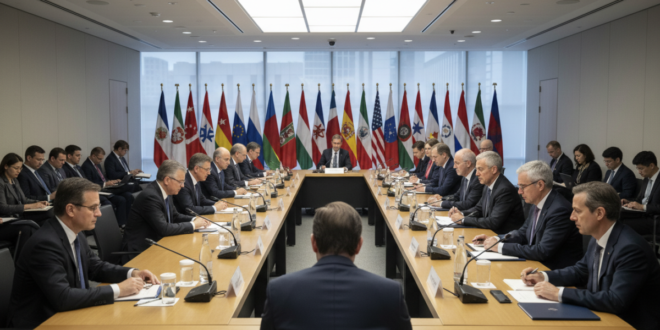
The G20 foreign ministers’ meeting in Atlanta has exposed the limits of diplomatic coordination among the world’s major economies. US Secretary of State Marco Rubio urged ministers to cooperate on geopolitical stability and economic prosperity, but the participation of Russian Foreign Minister Sergei Lavrov deepened divisions over Ukraine and the Middle East. European objections led Washington to drop the traditional group photograph; Reuters reported that roughly one-third of members objected to appearing alongside Lavrov, including Australia and Canada.
The meeting is expected to end without a joint declaration, reflecting the difficulty of reaching consensus on Russia’s war in Ukraine, the Iran conflict, trade and the wider US-China rivalry. Ministers are also confronting the economic consequences of the Middle East war, particularly the risk that renewed US strikes on Iran could push oil prices higher. Ukraine was not invited to the gathering, although Washington announced a multibillion-dollar sale of Patriot interceptors to Kyiv and EU foreign policy chief Kaja Kallas called for stronger support and accountability measures.
The next test will be whether governments can make progress on narrower areas of shared interest. Critical-mineral supply chains and economic security are on the agenda, while Rubio has promoted the US-led Pax Silica initiative as a way to reduce dependence on concentrated sources of rare earths and other strategic materials. The G20 leaders’ summit is scheduled for Miami from 14 to 16 December. The Atlanta meeting suggests that practical coalitions may be easier to assemble than a common position endorsed by all members.
Original analysis
Geostrategic Media Desk Team
Key Points
- The G20 remains an important forum, but deep political divisions are limiting its ability to produce consensus.
- Ukraine, the Middle East, trade disputes and competition over critical minerals are complicating international cooperation.
- Washington’s leadership is being tested by disagreements among major powers and traditional partners.
- Smaller diplomatic coalitions may increasingly deliver practical agreements where global consensus fails.
The G20 Divide: Why Global Diplomacy Is Struggling to Keep Pace with Geopolitical Rivalry
The G20 was created to provide a platform where the world’s major economies could coordinate responses to shared challenges. Its importance has grown as financial instability, trade disruption, climate pressures and geopolitical competition have become increasingly interconnected. Yet the forum now faces a serious credibility test. The divisions surrounding the wars in Ukraine and the Middle East, disagreements over sanctions and trade, and strategic competition between Washington and Beijing have made it increasingly difficult to reach common positions on international crises.
The foreign ministers’ meeting in Atlanta on 30–31 October 2026 illustrates the problem. The gathering is taking place amid disagreements over the war in Ukraine, the confrontation involving the United States, Israel and Iran, Russia’s participation, and the exclusion of South Africa from the meeting. Washington has sought to focus attention on trade imbalances, energy security, supply chains and critical minerals, but these economic priorities cannot easily be separated from the political conflicts dominating the international agenda. The divisions also reflect broader uncertainty about the future of US leadership and the ability of major powers to cooperate despite their strategic differences.
The Ukraine conflict remains a major obstacle to consensus. Western governments continue to disagree with Moscow over territorial claims, sanctions and the conditions for a political settlement. European governments are particularly concerned that negotiations between Washington and Moscow could reshape the continent’s security environment without adequate European participation. Russia, meanwhile, seeks to use diplomatic engagement to weaken its isolation and challenge the political foundations of Western policy. These competing objectives make a unified G20 position difficult.
The Middle East adds another layer of complexity. The confrontation involving Iran, Israel and the United States has direct consequences for maritime security, energy supplies and international trade. The Strait of Hormuz has become a focal point of diplomatic concern because disruption to shipping can affect economies far beyond the region. Governments that disagree on the causes and responsibilities of the conflict nevertheless share an interest in preventing further disruption to energy and commercial routes.
The wider problem is institutional. Global challenges increasingly require cooperation, but the international system is becoming more divided into competing strategic and economic blocs. The G20 cannot replace the United Nations or resolve every security crisis, but it can provide a mechanism for dialogue between states that otherwise have few opportunities to coordinate. Its practical value may increasingly lie in narrower agreements on financial stability, food security, energy resilience, maritime safety and supply chains.
The future of global diplomacy will depend on whether governments can separate areas of common interest from disputes that remain unresolved. A world in which every international issue becomes a test of political loyalty will struggle to address shared risks. The G20’s relevance will therefore be measured not by the strength of its declarations, but by its ability to preserve communication and deliver practical cooperation in an increasingly divided international environment.


 Geostrategic Media Political Commentary, Analysis, Security, Defense