Geostrategic Media Political Commentary, Analysis, Security, Defense

Geostrategic Media Desk | Europe and Global Trade | 30 October 2026
Key Points
- Dockworkers and seafarers staged coordinated action across 113 ports in 22 countries on 30 October, backed by more than 25 unions.
- The protests targeted arms shipments through commercial ports and the dangers faced by crews working in conflict-affected waters.
- The action coincided with a nationwide general strike in Italy, where tens of thousands demonstrated in more than 40 cities over wages, public services, living costs and military spending.
- The movement highlights how war is reaching beyond battlefields into shipping, labour relations and the political legitimacy of trade infrastructure.
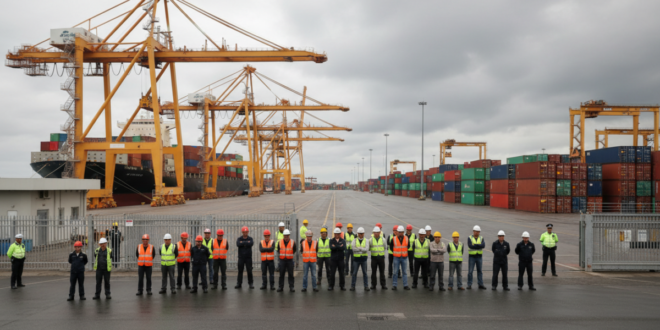
The world’s ports are becoming more than gateways for commerce. They are increasingly contested spaces in which the consequences of war, the politics of arms transfers and the vulnerability of civilian workers converge. On Friday, 30 October, dockworkers and seafarers took coordinated strike action across 113 ports in 22 countries, disrupting cargo operations and ferry services while demanding better protection for crews and opposing the use of port facilities for arms shipments to conflict zones.
A coordinated strike across the maritime network
The action, supported by more than 25 unions, extended from major European shipping hubs to ports in North Africa and South Asia. Reuters identified participation in Piraeus, Valencia, Le Havre, Algeciras, Genoa, Tangier Med and India’s Nhava Sheva. The strike was initially called by unions in Italy, France, Greece, Spain’s Basque Country, Türkiye and Morocco, before gaining wider support.
In Greece, around 3,000 dockworkers, seafarers and engineers joined the walkout in Piraeus, disrupting cargo operations and suspending ferry services to the islands. In Genoa, about 15,000 port workers, students and other demonstrators entered the port as part of wider protests. The movement’s demands extended beyond opposition to military cargo: unions also called for higher pay, safer working conditions and access to doctors on vessels operating in war zones.
The human cost of maritime insecurity
The unions say the danger to civilian crews has become impossible to separate from the wars around them. Greece’s seafarers’ union PENEN cited 28 attacks on vessels in the Gulf during the first 21 days of October and 570 confirmed attacks in the Black Sea so far this year, which it said had killed 40 seafarers and wounded hundreds. Those figures are union-supplied claims and should be read as such; they nevertheless reflect the growing concern among maritime workers that commercial crews are being exposed to risks they cannot control.
Representatives of an Indian maritime union said about 15 Indian seafarers had died as a result of the Iran war, with others stranded at sea as routes were disrupted. The broader issue is that commercial shipping depends on predictable passage, reliable insurance and a minimum level of protection for civilian crews. When these conditions disappear, the costs are transferred to shipowners, importers, consumers and the workers who keep the system operating.
Italy’s street protests widen the political message
The maritime strike coincided with a 24-hour general strike called by Italy’s grassroots USB union. Reuters reported that tens of thousands of students and workers demonstrated across more than 40 cities, demanding higher wages and stronger public services, opposing the rising cost of living and challenging increased military spending. Most demonstrations were peaceful, although clashes occurred in several cities, including Turin and Rome. In Genoa, port workers and demonstrators linked the domestic protest to the wider international campaign over arms shipments and the deaths of seafarers.
The overlap matters. The port strike was not only a dispute over workplace conditions; it became a vehicle for expressing broader social concerns about the economic consequences of war and the priorities of national budgets. The protests show how external conflicts can become domestic political issues when energy prices, transport costs, public spending and the safety of workers are affected.
Ports as strategic infrastructure
Governments increasingly treat ports as strategic assets because they move energy, food, industrial inputs and military equipment. That makes them indispensable to both civilian economies and national security. It also creates a dilemma for port authorities and workers: refusing to handle certain cargoes may become a political act, while accepting them can expose employees and companies to legal, ethical and security disputes.
The organisers of one campaign, No Harbour for Genocide, claimed the action could halt 52,000 containers and disrupt cargo worth $2.8 billion. Reuters said it could not independently verify that estimate, so it should not be treated as a confirmed measure of the strike’s economic impact. The verified disruption in Piraeus and the participation of major ports are sufficient to demonstrate the campaign’s reach without relying on unconfirmed projections.
A warning for governments and shipping companies
The strike is unlikely, by itself, to halt the global arms trade or reshape maritime policy. Its significance lies in the coalition it has brought together and the questions it has pushed into public debate: who bears the risks of shipping through conflict zones, what obligations employers have to civilian crews, and how ports should respond when commercial logistics become entangled with military operations.
For governments, the message is that maritime security cannot be measured solely by the number of ships that pass through a strait or the volume of cargo that reaches a terminal. It must also include the protection of crews, the resilience of supply chains and the social consequences of prolonged conflict. For shipping companies, the pressure to demonstrate that safety procedures are adequate will only grow as workers become more organised across national borders.
Geostrategic Media assessment: The strike reveals a new political geography of conflict: ports, shipping lanes and logistics workers are becoming part of the debate over war itself. If insecurity persists in the Gulf and Black Sea, the contest over commercial infrastructure will intensify. Governments that want uninterrupted trade will need to address not only naval protection but also the labour, insurance and ethical questions that now surround the movement of goods.
Sources and further reading
- Reuters, 30 October 2026: Dockworkers strike across 113 ports in 22 countries
- Reuters, 30 October 2026: Mass protests sweep Italy during nationwide strike
Editorial note: Union casualty and attack figures are attributed to the organisations that supplied them. Estimates of cargo disruption that Reuters could not independently verify are not presented as established facts.