Geostrategic Media Political Commentary, Analysis, Security, Defense
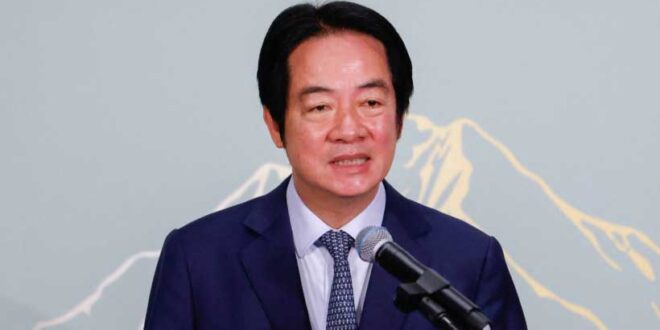

Lai Ching-te stepped before foreign correspondents in Taipei this week. Speaking to foreign correspondents, he said something that should not need to be said but apparently does: Taiwan defending itself is not a provocation. China’s near-daily military flights over the median line, the naval drills encircling the island, the diplomatic coercion campaign that has blocked Taiwan from the World Health Assembly and pressured African countries to close their airspace to Lai’s state visits, none of that, in Beijing’s framing, counts as provocation. Taiwan buys weapons to survive.
Lai has been saying versions of this since taking office in 2024. The audience has shifted. He is no longer primarily talking to Beijing, which has made clear it does not intend to listen. He is talking to Washington, where a $14 billion arms package approved by senior lawmakers in January is sitting unsigned on Trump’s desk, described by the president himself as “a very good negotiating chip” in dealings with China. That phrase — negotiating chip — is the one that has been reverberating through Taipei ever since Trump said it on his way back from Beijing in May, and it explains why Lai is holding press conferences to explain that Taiwan’s right to self-defense is not subject to negotiation.
The Arms Deal That Became a Bargaining Counter
Two arms packages are currently stuck in various stages of US bureaucratic and political limbo. The first, worth $11 billion and approved in December, includes rocket systems and artillery equipment. It has not moved forward. The second, worth $14 billion, was approved by senior lawmakers in January but cannot proceed until Trump formally submits it to Congress. It has not moved forward either.
The stated reason for the delay is concern over US weapons stockpiles following the Iran war. That is a legitimate concern, the conflict consumed roughly 80% of America’s JASSM-ER cruise missile inventory and significantly depleted Patriot and THAAD interceptors. Resupplying Taiwan while simultaneously replenishing depleted US stockpiles and fulfilling existing commitments to Ukraine is a real industrial capacity problem, not an invented one.
But Trump’s “negotiating chip” comment introduced a different explanation that sits alongside the logistics rationale and is considerably more alarming for Taipei. When Xi told Trump at the Beijing summit that the Taiwan question is the most important issue in US-China relations and that the two nations could “have clashes and even conflicts” if it is not handled properly, he was sending a message about the price of continued arms sales. Trump’s subsequent comment suggests he received that message and is at minimum considering it.
Taiwan’s presidential spokesperson confirmed there has been no notification of any pause to the planned arms sales. Rubio has said Washington’s Taiwan policy remains unchanged and that arms deals are not negotiated with China. These are the correct official positions. The gap between the official positions and Trump’s stated thinking is the thing keeping Taipei awake at night.
Lai’s Domestic Problem Is as Serious as the External One
The story of Taiwan’s defense posture in 2026 has two pressure points, and the external one from Beijing gets most of the coverage. The internal one is less visible and in some ways more immediately consequential.
Lai proposed a T$1.1 trillion supplementary defense budget, roughly $40 billion, for 2026. Taiwan’s opposition-dominated parliament approved two-thirds of it and cut the rest. The parts that got cut were the drone program and domestically produced weapons, which happen to be the asymmetric capabilities that defense analysts consistently identify as the most important investments Taiwan can make given its geography and the nature of the threat it faces. The opposition Kuomintang, whose media aligned outlets have been running stories suggesting Trump suspended the arms sale due to Chinese pressure, has a political incentive to make the defense situation look as uncertain as possible. A Taiwan that feels abandoned by Washington is a Taiwan more likely to consider the KMT’s preferred approach of engaging Beijing on terms closer to Beijing’s own.
Lai is now proposing another special defense package worth T$210 billion, focused on surveillance systems, coastal strike capabilities, and unmanned maritime drones, precisely the asymmetric capabilities the opposition cut from the previous budget. Whether that package clears the same parliament that cut the last one is an open question with significant implications for how seriously China takes Taiwan’s stated commitment to self-defense.
Taiwan’s top envoy in Washington, Alexander Yui, put the island’s position plainly in an interview this week. “This is our responsibility, so we will not wait and depend on the US cavalry to come and save us.” That statement is significant not as a rhetorical flourish but as a genuine description of strategic necessity. Taiwan cannot rely on the assumption that American military intervention will materialize in time or at sufficient scale to be decisive. The porcupine strategy, making Taiwan costly enough to attack the cost-benefit calculation tips against invasion, depends on Taiwan building the capabilities itself, which requires both the defense budget and the US arms transfers that are currently stalled.
The Semiconductor Card Taiwan Is Playing
Lai has been more explicit than his predecessors about invoking Taiwan’s semiconductor position as a geopolitical argument. At the Foreign Correspondents’ Club this morning he framed it directly: “Taiwan is a core global interest, and any act that undermines peace and stability across the Taiwan Strait is not only a blatant provocation against international rules and order but will also have a significant impact on Indo-Pacific security, global supply chains and the world economy.”
The semiconductor argument has two dimensions that are worth separating. The first is deterrence, the idea that the global economic cost of a Taiwan Strait conflict is so enormous that it creates a deterrent effect independent of military considerations. If the world’s most advanced chip manufacturing capacity were destroyed or captured in a Chinese invasion, the disruption to every industry that depends on advanced semiconductors would be catastrophic and would last years. That gives every major economy a stake in Taiwan’s security that goes beyond geopolitical alignment.
The second dimension is leverage, the idea that Taiwan’s semiconductor position gives it bargaining power in its relationship with Washington that it would not otherwise have. The US needs TSMC’s chips for its own defense industrial base, its AI ambitions, and its technology sector. That dependency creates an American interest in Taiwan’s security that is partly independent of treaty commitments, alliance politics, and whatever Trump says about negotiating chips. The CHIPS Act was designed in part to reduce that dependency over time, but the timeline for American semiconductor self-sufficiency is measured in decades, not years. For the foreseeable future, the US needs what Taiwan makes.
Lai is using both dimensions simultaneously, arguing that the world cannot afford a Taiwan Strait conflict while also signaling that Taiwan’s strategic value makes abandonment economically irrational for Washington. It is a sophisticated argument that has the advantage of being accurate.
The SASC Bill and What Congress Is Saying
While the executive branch has been ambiguous about Taiwan arms sales, the legislative branch has been considerably clearer. The Senate Armed Services Committee’s bill authorizes $1.5 billion in security assistance for Taiwan and the Philippines. That authorization reflects the consistent position of the defense establishment and most of Congress — that Taiwan’s security is a vital American interest that should not be subordinated to trade negotiations or bilateral deal-making with Beijing.
The gap between congressional intent and executive action on Taiwan is one of the defining tensions in current US foreign policy. The Taiwan Relations Act requires Washington to provide Taiwan with sufficient defensive equipment to deter aggression. Trump’s treatment of arms sales as a negotiating chip sits uncomfortably alongside that statutory requirement, and it creates legal as well as political complications for an administration that has generally preferred to assert executive prerogatives rather than accommodate congressional constraints.
The Philippines dimension in the SASC bill is also worth noting. Manila has been the most assertive of any Southeast Asian government in contesting Chinese territorial claims in the South China Sea, has expanded its security relationships with Japan and Australia, and has been watching the Taiwan arms situation with its own concerns about what US reliability means for its own security. The SASC bill treating Taiwan and the Philippines together is a signal that Congress sees the two situations as connected, both are frontline states in the US-China competition, both face Chinese pressure, and both need American support that the current administration has been inconsistent about providing.
How China Wins Without Pulling the Trigger
China’s military pressure on Taiwan in 2026 is in line with the pattern it has maintained since Lai came to power: consistent, calibrated, and designed to normalize, not trigger. Nearly daily crossings of the median, regular strait patrols, large scale exercises timed to political events all put pressure on without reaching the point of action.
The diplomatic coercion has been equally systematic. Blocking Taiwan from international organizations, pressuring countries to downgrade Taiwan’s participation, financially coercing African countries to close their airspace during Lai’s state visits. China closed official communication channels with Taiwan in 2016 and has not reopened them, while simultaneously insisting that Lai engage on terms that accept Beijing’s framing of the relationship.
What Beijing is calculating is that sustained pressure combined with uncertainty about American support will eventually shift Taiwan’s domestic politics in a direction more favorable to accommodation. The KMT’s gains in the parliamentary elections that produced the divided legislature Lai is now governing against, the cuts to the drone budget, the opposition media’s amplification of every signal of American ambiguity, all of it serves a Chinese interest even when it is driven by genuine domestic political disagreement rather than coordinated intent.
Whether that calculation is correct depends substantially on what happens with the arms packages in Washington and whether Lai can build enough domestic consensus around the defense budget to sustain the porcupine strategy through the political headwinds he is currently facing. The press conference this morning was partly aimed at that domestic audience as much as the international one.