Geostrategic Media Political Commentary, Analysis, Security, Defense

By Engineer Saleem Al-Batayneh
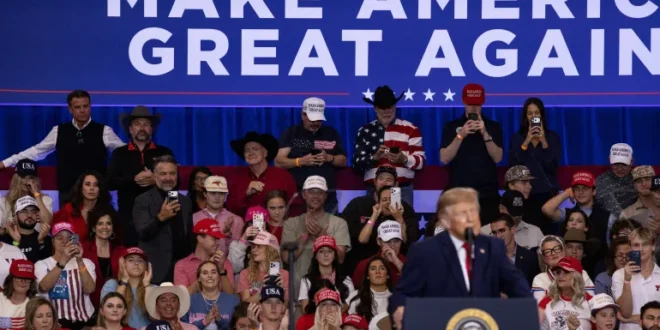
The American midterm elections of November 4 delivered a political earthquake to Washington. With Democrats taking control of both chambers of Congress, the result became a direct referendum on President Donald Trump’s leadership, particularly his handling of the economy, the war, government spending and allegations of corruption. More than a partisan setback, the outcome reflected a growing public rejection of a governing approach that many Americans increasingly associate with economic insecurity, political confrontation and a rising cost of living.
In the end, the decisive arguments were not necessarily made at campaign rallies or in televised political debates. They were made in supermarket aisles and at petrol stations. Inflation, unemployment, the cost of household essentials and the financial burden of war had become immediate concerns for ordinary Americans. Families struggling to meet everyday expenses were increasingly unwilling to absorb the economic consequences of policies they believed were being pursued without sufficient regard for their livelihoods. The elimination of numerous federal positions added to the sense of uncertainty and frustration.
“They pushed us to the point where people said enough,” remarked former Republican congressman Glen Rogers, commenting on the electoral setback suffered by Trump and his party.
That sentiment captures the political significance of the result: voters turned the ballot box into an instrument of collective accountability. Their choices disrupted established electoral calculations, crossed traditional party boundaries and challenged the assumption that Republican support in historically conservative communities would remain secure.
The reported Democratic gains in states and constituencies traditionally associated with Republican strength, including parts of Texas, Iowa and South Carolina, point to a potentially deeper shift in the American political landscape. The message is not simply that voters have changed their minds about individual candidates. It is that a significant segment of the electorate may be reconsidering the political priorities, economic promises and governing style that have defined the Trump era.
The consequences for the White House could be substantial. A Democratic majority in both chambers would impose serious institutional constraints on the president during the remaining two years of his term. Congress could obstruct major legislative initiatives, intensify scrutiny of government expenditure and foreign policy, and launch investigations into the administration’s conduct, appointments and handling of the war. Questions surrounding potential conflicts of interest and the financial activities of the president and members of his inner circle could also become more politically consequential.
Trump’s ability to govern would therefore depend increasingly on negotiation, compromise and political accommodation rather than unilateral pressure and confrontation. The president may retain considerable executive authority, but his room for manoeuvre would narrow as congressional oversight becomes more assertive. The balance of power in Washington would shift, making it considerably harder for the administration to impose its agenda without securing at least some degree of bipartisan support.
Yet the Republican Party’s electoral defeat is also opening a new chapter in its internal struggle over identity and leadership. The debate is no longer confined to the party’s electoral strategy; it increasingly concerns the future of the Republican movement itself and its relationship with Trump.
Marjorie Taylor Greene, once among Trump’s most prominent political allies, has called for a reassessment of the president’s influence and the direction of the party. Her criticism reflects a growing argument within parts of the Republican establishment that the party must reconsider its dependence on confrontational populism, hard-line nationalism and identity-driven politics if it hopes to rebuild a broader electoral coalition.
Veteran Republican strategist John Feehery has similarly described the electoral outcome as a disaster for the party, arguing that Republicans must undertake serious self-examination and prepare for a political future beyond Trump. His position reflects an uncomfortable question confronting the Republican leadership: can the party recover its institutional credibility while remaining politically dependent on a president whose leadership style has become a source of division even within its own ranks?
Perhaps most revealing is the emerging debate within the MAGA movement itself. Calls for a reassessment of political priorities suggest that even some of Trump’s supporters recognise the need for a different approach. The movement that helped redefine the Republican Party may now face the challenge of adapting to a political environment in which electoral mobilisation alone is no longer sufficient to guarantee governing power.
The implications extend well beyond America’s borders.
For Europe, the election raises renewed questions about the future of transatlantic relations. A recent assessment by London’s Chatham House reflects broader European concerns about the direction of relations with Washington, particularly following disagreements over tariffs, NATO’s future, defence responsibilities and the broader American commitment to European security. European governments have increasingly been compelled to consider whether their strategic relationship with the United States can remain predictable when American foreign policy is so closely tied to domestic political calculations.
A weakened Trump administration could complicate this relationship further. European leaders may find themselves dealing with a president facing greater domestic resistance, while simultaneously seeking reassurance that Washington will maintain its security commitments. At the same time, the Democratic-controlled Congress could become an increasingly influential actor in debates over military assistance, defence spending and the future of NATO.
China, meanwhile, could view the changing balance of power in Washington as an opportunity. As America’s principal economic and strategic competitor, Beijing may seek to strengthen its negotiating position in forthcoming discussions with the United States. A president facing greater congressional constraints and domestic political pressure may find it more difficult to present a unified and credible negotiating position. China could exploit these circumstances to pursue concessions and reinforce its economic interests ahead of the scheduled expiration of the trade truce in early January 2027.
The wider geopolitical consequences could be significant. Washington’s adversaries and strategic competitors will be watching closely to determine whether the electoral setback represents a temporary political interruption or the beginning of a more fundamental change in American priorities. Allies, too, will be assessing whether the United States can maintain strategic consistency when its domestic institutions are increasingly divided.
For Trump, the immediate challenge is to determine what can realistically be accomplished before Democrats formally assume their congressional responsibilities. The next two months may become a critical period for the administration, as the president attempts to advance priorities that could become considerably more difficult once the new congressional majority takes office.
But a more troubling question concerns Trump’s political and psychological response to defeat. Will he seek accommodation and attempt to preserve his legacy through negotiation? Or will he become more confrontational, believing that his political position has deteriorated to the point where he has little left to lose?
The answer will matter not only to the future of the Republican Party but also to the stability of American institutions and the country’s international relationships.
One lesson from this election is unmistakable: political power cannot be sustained indefinitely through rhetoric, mobilisation and confrontation when households are struggling with the cost of living. Voters may listen to speeches about national greatness, security and global leadership, but they ultimately judge governments by what they experience in their daily lives.
In American politics, the supermarket shelf and the petrol station can sometimes deliver a more decisive verdict than the campaign trail.
Eng. Al-Batayneh was a member of the Jordanian Parliament.