Geostrategic Media Political Commentary, Analysis, Security, Defense

Dr. Shehab Al-Makahleh
Recent regional tensions, from clashes between Yemen’s Ansar Allah movement and Saudi Arabia to the growing prospect of a third US-Israeli war against Iran, have placed the “Mecca Alliance” under considerable pressure. The crises have raised fundamental questions about the alliance’s effectiveness and the broader challenge of building a regional security architecture. Against this backdrop, a surprise visit to Tehran by senior military and intelligence officials from three member states—Saudi Arabia, Türkiye and Pakistan—has drawn attention to the possibility of a regional security arrangement operating with greater independence from Washington. If such cooperation gains traction, it could have far-reaching implications for the Middle East and the future of American influence in the region.
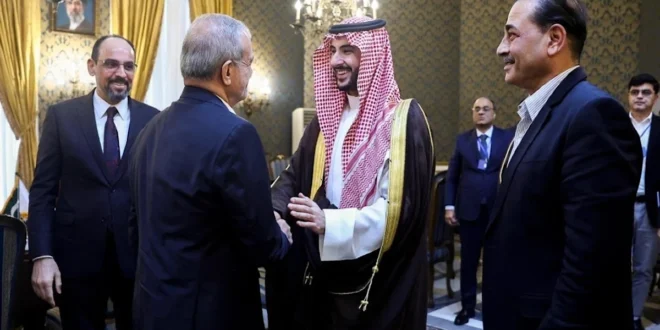
Saudi Defence Minister Khalid bin Salman, Pakistan’s army chief, Field Marshal Asim Munir, and Türkiye’s intelligence chief, Ibrahim Kalin, arrived in Tehran on Sunday and held a joint meeting with senior Iranian officials, including President Masoud Pezeshkian, Foreign Minister Abbas Araghchi and senior national security officials. According to Iranian officials, the visit was initiated by Munir, who had informed his Iranian counterparts during an earlier visit the previous week that the three countries intended to travel to Tehran.
Only two months after its establishment, the Mecca Alliance, conceived as a framework for collective deterrence, appears to be facing two simultaneous tests: its ability to respond to the escalating conflict in Yemen and its capacity to prevent its members from being drawn into a potential US-Israeli war against Iran. These pressures have prompted the three countries to engage Tehran in an effort to contain the consequences of both crises.
Saudi Arabia’s Foreign Ministry said the visit formed part of continuing efforts by the alliance’s members to reduce tensions, encourage dialogue and diplomatic solutions, and support mediation efforts by Qatar and Pakistan.
The more immediate catalyst, however, appears to be the deterioration in relations between Riyadh and Sanaa. In recent days, following the reported seizure of the Bab al-Mandab Strait by Ansar Allah, the movement has launched extensive attacks on major Saudi airports, including Riyadh airport, as well as military bases and energy infrastructure. Saudi Arabia has responded with dozens of airstrikes in Yemen.
As a central member of the Mecca Alliance, Riyadh might have expected its collective-defence partners to rally behind it. Pakistan and Türkiye, however, have reportedly expressed reservations about direct military intervention, given the potential consequences for their own security and regional interests. That hesitation raises questions about the alliance’s practical commitments and whether its collective-defence promises can be translated into action during a crisis.
The visit cannot be separated from the threat of a “third war” against Iran—a conflict that could also expose the alliance’s members, particularly Saudi Arabia, to serious consequences.
The immediate objective of the delegation’s visit to Tehran appears clear: to enlist Iran’s influence in persuading Ansar Allah to halt its attacks. During his previous visit, Munir reportedly asked Iranian officials to use their channels with the movement to help de-escalate the situation. If confirmed, that request would underscore the limits of the Mecca Alliance’s ability to resolve the Yemen crisis on its own. Even a collective-defence framework involving significant military capabilities may struggle to contain a conflict without engaging the regional actors capable of influencing its course.
For Tehran, the visit offers an opportunity to demonstrate that it remains an important player in any effort to reduce tensions in Yemen and the wider region. Iran can argue that regional security cannot be built solely through arrangements led by Riyadh, Islamabad or Ankara, and that lasting stability requires cooperation among regional states rather than dependence on Washington.
Iranian state media framed Tehran’s participation as a prerequisite for developing a new Gulf security architecture. Ali Bagheri, a senior Iranian national security official, argued that Iran and the three visiting countries could work together to establish what he described as “security rooted in the region itself.” Pezeshkian, meanwhile, expressed support for understandings that would strengthen regional security and said Iran was prepared to take steps towards greater regional cooperation and the resolution of disputes.
Yet expectations of a breakthrough in Yemen should be tempered. Iran may possess channels of influence with Ansar Allah, but it would be inaccurate to assume that the movement simply follows Tehran’s instructions. Ansar Allah has its own domestic priorities, political calculations and regional objectives. It is therefore not guaranteed to accept an agreement negotiated by four governments, even if Iran supports it.
Any meaningful de-escalation would consequently require direct or indirect engagement with Ansar Allah itself, alongside efforts to address the underlying political causes of Yemen’s conflict. Iran could facilitate such negotiations, but its influence should not be confused with complete control over the movement’s decisions.
Nor can the confrontation between Ansar Allah and Saudi Arabia be separated from the broader tensions involving Iran, the United States and Israel. The crises are unfolding within the same regional security environment. Tehran’s willingness to help contain the conflict in Yemen may therefore depend, at least in part, on whether the threat of a wider war against Iran is reduced. Iranian officials have repeatedly argued that any settlement must address the conflict across the region’s interconnected fronts.
The second, and perhaps more strategically significant, reason for the visit is the growing concern about a possible new US-Israeli military campaign against Iran. Reports of preparations for what some describe as a “third war” have heightened anxiety across the region. Depending on the scale of any conflict and the nature of Iran’s response, the consequences could extend well beyond Iran itself, affecting energy infrastructure, trade routes, military installations and the security of neighbouring states—including members of the Mecca Alliance.
Seen in this light, the visit can be understood as an attempt to create diplomatic space and reduce the risk of miscalculation. Pakistan has sought to position itself as a mediator through its relationships with Iran, Arab governments and the United States. Türkiye, meanwhile, has maintained channels of communication with a range of regional actors, even as their interests have diverged.
Saudi Arabia has a direct interest in preventing a wider war that could threaten its borders, energy infrastructure and economic ambitions. A renewed confrontation with Iran—or with groups aligned with Tehran—could impose costs that extend well beyond the battlefield. For Riyadh, diplomatic arrangements that reduce the risk of escalation may therefore be preferable to a conflict whose scope and consequences would be difficult to control.
The Tehran visit thus reflects an overlap of interests among the three alliance members, even if their strategic priorities are not identical. Saudi Arabia wants to contain the threat from Yemen and protect its infrastructure. Pakistan has an interest in regional stability and in preserving its role as a diplomatic intermediary. Türkiye seeks to maintain its regional influence while avoiding developments that could destabilise its wider security environment.
Whether these overlapping interests can produce a durable regional security arrangement remains uncertain. The alliance’s response to the Yemen crisis will be an important test of its credibility, while the possibility of a wider war involving Iran may give its members a further incentive to coordinate their diplomacy.
The central question is whether the Mecca Alliance can evolve beyond a framework for collective deterrence into a mechanism capable of managing disputes through sustained political engagement. That would require more than military cooperation among its members. It would also require channels of communication with regional rivals, practical arrangements for crisis management, and a willingness to address conflicts whose causes cannot be resolved through deterrence alone.
For now, Riyadh’s outreach to Tehran suggests that even states seeking stronger collective defence may recognise the limits of military alignment without diplomatic engagement. Iran’s role in any resulting process would remain contested, and its ability to influence Ansar Allah should not be overstated. But the visit highlights a broader reality: the future of regional security may depend not only on who is allied with whom, but also on whether competing powers can find ways to prevent local confrontations from escalating into a wider war.