Geostrategic Media Political Commentary, Analysis, Security, Defense

James Lee
Palestine is no longer a distant foreign-policy issue in Britain, confined to diplomatic statements or parliamentary debates about the Middle East. Over the past several years—and especially since the outbreak of the Gaza war in October 2023—the Palestinian question has moved into Britain’s streets, universities, trade unions, workplaces, local councils, and increasingly into electoral politics. This does not mean that British politics has reached a consensus on Israel and Palestine, nor that the country’s voters share a single position on the conflict. It does mean, however, that Palestine has acquired the ability to influence political behaviour and shape the calculations of parties and candidates. Perhaps the most significant change is that, for a growing section of the British public, Palestine is no longer simply a foreign-policy issue; it has become connected to questions of human rights, social justice, Britain’s international role, and political accountability at home.
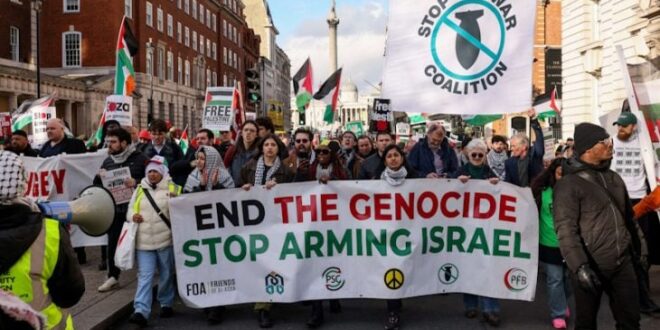
This transformation did not happen overnight, nor was it created by a single political campaign or speech. The Palestine solidarity movement had spent years building networks of activists, trade unions, community organisations and local campaign groups before the Gaza war gave the movement extraordinary momentum. The huge demonstrations in London and other British cities were not simply expressions of opposition to the war. In many cases, they became political and social platforms linking the Palestinian issue to wider debates about human rights, inequality, social justice and British foreign policy. Over time, the movement began moving beyond protest and into political pressure, attempting to influence candidates, political parties, local authorities and elected representatives.
From Foreign Policy to Electoral Politics
The most revealing description of this transformation is the claim made by Palestine solidarity campaigners that Palestine has become an “electoral issue.” That is more than a rhetorical shift. The 2024 general election and subsequent local elections demonstrated that the issue could influence some voters, particularly in constituencies with large Arab and Muslim communities or established traditions of political activism on Palestine. In the 2024 general election, independent and smaller-party candidates who placed Gaza and Palestine at the centre of their campaigns made gains in several constituencies, although electoral outcomes cannot be explained by a single issue. The 2026 local elections also showed that Palestine remained capable of influencing political campaigns in certain parts of the country.
More important than individual election results is the fact that British political parties can no longer easily treat Palestine as a peripheral foreign-policy question. The Gaza war generated significant debate within the Labour movement, including disagreements between party leadership, members, activists and trade unions over the extent to which Britain should pressure Israel. Other parties have also faced pressure from voters and campaigners demanding clearer positions on a ceasefire, arms exports, Israeli settlements and recognition of Palestinian statehood.
This is where the political transformation becomes particularly significant. Palestine is no longer testing only Britain’s position in the Middle East; it is increasingly testing the relationship between voters and the parties they traditionally support. When voters believe that a party they normally support is taking a position fundamentally at odds with their views on a war or humanitarian crisis, traditional party loyalties can become less predictable. In closely contested constituencies, even a relatively small shift in voter priorities can become politically significant.
From Street Protest to Political Organisation
The scale of activism around Palestine helps explain why the issue has gained political influence. The Palestine Solidarity Campaign says its membership increased from around 7,800 at the beginning of 2023 to nearly 17,000, while its newsletter subscribers rose from approximately 70,000 to around 300,000. The organisation and its partners have also organised dozens of national demonstrations since October 2023, some of which drew hundreds of thousands of participants.
Yet numbers alone do not explain political influence. The real strength of the movement lies in its ability to operate across different layers of British society, from national demonstrations to local branches, universities, workplaces, trade unions and local councils. The campaign says it has a network of more than 100 local branches working in communities, universities and workplaces, giving the movement an organisational structure that extends beyond moments of mass protest. That infrastructure has helped transform Palestine from a periodic protest issue into a sustained political campaign.
The campaign also says that dozens of local councils in England and Wales have adopted positions related to divesting pension funds from companies that campaigners accuse of involvement in violations against Palestinians. Palestine has also gained greater visibility within Britain’s trade union movement, where some unions have backed boycotts, divestment and sanctions, as well as workplace campaigns connected to the conflict. Whatever one’s position on these policies, their emergence within institutional settings demonstrates that Palestine has entered broader debates over ethical investment, corporate responsibility and the role of public institutions.
Labour Faces a Difficult Political Test
The Labour Party has faced particularly intense pressure over the issue because of its historical relationship with the trade union movement, the diversity of its electoral base and the depth of debate within its membership. The party has had to navigate tensions between its leadership and activists and voters who believe that the government’s response to the Gaza war has been insufficient. At the same time, Labour has faced another set of pressures involving Britain’s relationship with Israel, national security and concerns about antisemitism.
Against this background, statements by British ministers have taken on political importance. Measures announced by Foreign Secretary Ed Miliband concerning sanctions linked to Israeli settlements in the occupied Palestinian territories were welcomed by supporters of the Palestine movement as evidence of political pressure producing results. Others have interpreted such measures as part of a broader reassessment of British foreign policy rather than simply a response to street mobilisation.
For Labour, however, the political challenge does not end with individual policy announcements. Some activists are demanding much broader measures, including changes to Britain’s arms-export policy, wider restrictions on dealings with Israel and a fundamental reassessment of the political and diplomatic relationship. As a result, almost every government initiative can be interpreted in two very different ways: as evidence that pressure is working, or as inadequate compared with what campaigners are demanding.
This places the government in a difficult political position. It must balance Britain’s international relationships, security commitments and diplomatic interests with a domestic electorate that has become increasingly sensitive to British policy in the Middle East. The longer the war and its humanitarian consequences remain politically visible, the harder it becomes for British parties to return Palestine to the margins of electoral debate.
Trade Unions, Universities and Local Councils
One of the most important developments is that Palestine is no longer an issue confined to specialist advocacy organisations. It has become part of debates within trade unions, universities, local councils, professional associations and civil-society organisations. This institutionalisation matters because it moves the issue from symbolic protest into areas where decisions are made about investments, employment, education and public policy.
On university campuses, Palestine has been linked to student protests and debates over investments and academic partnerships. Within trade unions, the issue has generated positions concerning boycotts, divestment and workplace campaigns. At the local level, activists have sought to influence council policies, pension funds and investment decisions. None of this means that British institutions have reached a unified position on Israel or Palestine. It does, however, demonstrate how far the issue has moved into mainstream political debate.
There is also an important change in the direction of political pressure. Traditionally, foreign policy is often presented as something decided by governments and then debated by the public. The Palestine debate increasingly operates in the opposite direction: pressure begins in communities, universities, trade unions and local organisations, reaches councillors and MPs, and then places pressure on political parties and government. When that cycle continues over an extended period, an issue becomes part of the political process itself.
The Antisemitism Debate
No serious analysis of this transformation can ignore the controversy surrounding some pro-Palestinian demonstrations. Politicians, Jewish organisations and other campaigners have raised concerns that certain slogans, statements or incidents associated with protests can cross into antisemitism. Organisers of the demonstrations and their supporters have rejected attempts to apply such accusations to the movement as a whole, arguing that the overwhelming focus of the protests is on Palestinian rights and opposition to Israeli government policy.
The distinction matters. Criticism of the Israeli government or advocacy for Palestinian rights is not, by itself, antisemitism. At the same time, documented instances of anti-Jewish hatred should not be dismissed simply because they occur within a broader political movement. A serious discussion therefore requires a clear distinction between criticism of Israeli policy, opposition to Zionism, advocacy for Palestinian rights, and hostility directed at Jews as a religious or ethnic group.
This distinction is important for both sides of the debate. Treating every expression of solidarity with Palestinians as antisemitic risks obscuring legitimate political criticism and alienating people who are advocating for Palestinian rights. Conversely, dismissing credible allegations of antisemitism without examination can undermine confidence in the movement and make it easier for opponents to portray the entire campaign through the actions of a minority. The Palestinian issue is likely to have greater political reach in Britain if advocacy for Palestinian rights remains clearly separated from discrimination or hatred directed at Jews or any other community.
Boycott Politics Moves into the Mainstream Debate
The same debate applies to the Boycott, Divestment and Sanctions movement, which has become one of the most controversial aspects of the British discussion. Supporters regard BDS as a non-violent mechanism for applying pressure on governments and companies over policies they believe violate Palestinian rights. Opponents argue that the campaign unfairly singles out Israel or could produce political and economic consequences they do not support. The disagreement has also reached the Labour movement, where senior figures have expressed opposition to adopting the BDS campaign in its current form.
Yet the very fact that BDS is now debated inside major political parties, trade unions, universities and local councils illustrates how much the political landscape has changed. Several years ago, boycott campaigns could be treated as a relatively marginal activity associated with activist groups. Today, they have become part of institutional debates, even when those debates are deeply divided.
Has Palestine Become a Permanent Electoral Issue?
The most important question now is whether this transformation will survive the current war and become a lasting feature of British elections. It would be premature to conclude that Palestine will determine future elections, because British voting behaviour is shaped by a wide range of issues, including the economy, immigration, healthcare, housing, taxation, public services and national security. At the same time, it would be equally difficult to argue that Palestine has not acquired a much stronger organisational and political presence than it had before October 2023.
Its influence will also vary considerably from one constituency to another. It is likely to be more politically visible in areas with large Arab and Muslim populations or established traditions of activism, while it may be less prominent in constituencies where domestic economic and social issues dominate political debate. It would therefore be misleading to treat every British election as a referendum on Palestine. But it would be equally misleading for political parties to assume that the issue can simply be ignored.
The more significant change may not be the number of parliamentary seats affected by Palestine, but the nature of the questions candidates are now expected to answer. In some constituencies, candidates increasingly face questions about Gaza, arms exports, Britain’s relationship with Israel, Palestinian statehood, sanctions and Israeli settlements. Once those questions become part of election meetings, constituency campaigns and direct conversations between candidates and voters, Palestine has already entered domestic politics.
Palestine Is Testing British Foreign Policy
Ultimately, the growing political importance of Palestine reveals something larger than the strength of a protest movement or the difficulties facing one government. It reflects a changing relationship between foreign policy and domestic political values. Some British voters increasingly believe that the government’s approach to the Middle East should be consistent with the principles of human rights and international law that Britain advocates elsewhere. Others argue that foreign policy must also take account of national security, international alliances and Britain’s broader strategic interests.
Between these positions lies a political debate that is unlikely to disappear simply because an election is over. If Palestine remains present within trade unions, universities, local councils and political parties, future British governments will face a different political environment from the one that existed before the Gaza war. The distinction between Britain’s actions abroad and political expectations at home has become harder to maintain.
That may ultimately be the most important meaning of Palestine’s entry into British electoral politics. The story is not simply about pro-Palestinian candidates winning votes, nor about the growth of a protest movement. It is about a growing number of British voters connecting their country’s foreign policy with their own understanding of justice, equality, human rights and political responsibility. If that connection persists, Palestine may no longer be an issue that appears during election campaigns and disappears after the votes are counted. It could become one of the recurring questions through which British voters judge the foreign-policy choices of their political parties—and through which Britain’s wider role in the Middle East is debated at home.