Geostrategic Media Political Commentary, Analysis, Security, Defense

By James Eliott
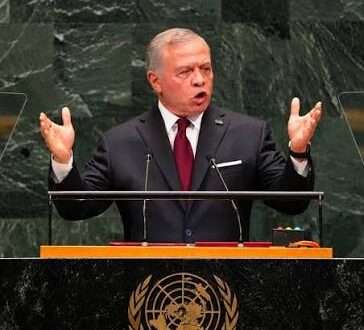
When Jordan’s King Abdullah II takes the podium at the United Nations General Assembly, his address is rarely a routine exercise in diplomatic positioning. It is better understood as an attempt to reorder the international conversation around the Middle East—to move the debate beyond the immediate crises of the moment and toward the deeper political and legal failures that allow those crises to become permanent features of the regional landscape. His address to the eighty-first session of the General Assembly in September 2026 followed precisely this approach, linking the erosion of international attention to the weakening of accountability, the selective application of international law, and the gradual normalization of facts being imposed on the ground. At the same time, it placed Jordan’s own security, water resources, sovereignty, and national interests firmly within the wider debate over the future of the region.
The timing of the speech is important. Between February 2025 and September 2026, Jordan faced repeated missile and drone attacks originating from Iran, according to Jordanian official statements, while the wider Middle East was passing through one of its most volatile periods in decades. Yet the king did not use the UN podium primarily to revisit those attacks or turn the address into an exercise in retaliatory rhetoric. Instead, he concentrated on what Amman considers the deeper strategic danger: the consequences of Israeli expansionist policies, the erosion of international accountability, and the emergence of a regional environment in which temporary crises can gradually become permanent political and geographic realities.
That restraint is itself a form of strategy. For a country situated at the intersection of several regional fault lines, excessive rhetoric can narrow diplomatic room for maneuver without necessarily improving national security. Jordan therefore has an interest in preserving channels of communication even while making clear that certain interests are not negotiable. The result is a diplomatic posture that seeks to separate firmness from escalation. Quiet does not necessarily mean passivity, just as the avoidance of military rhetoric does not mean an absence of deterrence. It can instead reflect the calculations of a state attempting to protect its interests while avoiding being drawn into conflicts whose consequences it cannot fully control.
The structural argument running through the king’s speech begins with a simple but consequential observation: the international system is increasingly characterized by overlapping crises that create what might be described as a condition of permanent emergency. The danger, however, is not merely that there are too many crises competing for attention. It is that international attention itself has become increasingly short-lived. A crisis that disappears from the headlines does not necessarily disappear from the political landscape. It can instead harden into a new reality that becomes progressively more difficult to reverse.
This is the significance of the king’s warning that what the world neglects today can shape its future tomorrow. The principle applies across a geography extending from Gaza and the West Bank to Syria, Lebanon, Yemen, and Sudan. These conflicts differ in their origins, actors, and political dynamics, but their consequences do not remain neatly contained within national borders. War affects shipping routes, energy markets, food prices, migration patterns, national security calculations, and the daily lives of people far beyond the immediate theater of conflict.
The Middle East therefore cannot be treated as a collection of isolated crises. Instability in the region increasingly functions as a transmission mechanism through which local conflicts generate international economic and security consequences. Disruption in the Red Sea or the Gulf, for example, can affect trade routes and energy markets thousands of miles away. A conflict that begins as a territorial or political dispute can eventually become a problem for governments and consumers with no direct connection to the original confrontation.
This places the international community before a broader question of responsibility. The issue is not simply whether the world has the capacity to respond to individual crises, but whether it applies the same principles consistently when confronting them. In the Palestinian context, the king’s argument moves beyond describing the humanitarian consequences of the conflict toward questioning the political and legal framework that permits those conditions to persist.
That is particularly evident in his treatment of Gaza and the West Bank. Separating the two can make the conflict easier to manage administratively, but it risks obscuring the political relationship between war, settlement expansion, land confiscation, displacement, and the transformation of geographic realities. The king’s argument is that these developments should be understood as interconnected components of a broader political process rather than as unrelated events.
This is also why his warning about Israeli expansionism extends beyond the Palestinian territories. When territorial changes, military incursions, or the establishment of new realities begin to affect neighboring states, the consequences become regional. The Syrian theater is particularly significant in this regard. Repeated incursions, territorial expansion, and developments affecting vital water resources cannot easily be dismissed as isolated security incidents. For Jordan, they have potential implications for the strategic environment along its northern frontier and for resources that are directly connected to national security.
Water, in particular, occupies a different category in Jordanian strategic thinking from many conventional foreign-policy issues. Jordan is one of the world’s most water-scarce countries, and any development that affects access to vital water resources can quickly become a national-security concern. The king’s insistence that Jordan will protect its security, water, and national interests should therefore be read not simply as diplomatic language, but as a clear articulation of sovereign priorities.
There is an important distinction here. The statement does not necessarily announce an intention to escalate militarily. Rather, it establishes boundaries around what Amman regards as vital interests. It signals that regional turbulence cannot be used as a justification for altering circumstances around Jordan in ways that affect its security or resources. At the same time, it communicates that Jordan’s preference for diplomacy should not be interpreted as acquiescence.
This distinction lies at the heart of the Jordanian approach. Diplomacy is not presented as an alternative to protecting national interests; it is one of the instruments through which those interests are protected. The commitment to dialogue does not eliminate sovereignty, just as adherence to humanitarian principles does not deprive a state of its right to defend its borders and vital resources.
That is why the king’s warning that Jordan’s commitment to diplomacy should not be mistaken for weakness is so important. The message is less about threatening adversaries than about preventing them from misreading restraint. In an increasingly volatile Middle East, where states are simultaneously negotiating, hedging, rearming, and forming new strategic partnerships, misperception can itself become a security risk.
The same logic appears in the king’s discussion of Christians and the region’s religious heritage. Jordan’s position is not simply that Christian communities should be protected as a matter of minority rights, but that Christianity is historically rooted in the Middle East and forms part of the region’s civilizational heritage. The protection of Christian communities and sites is therefore connected to a broader conception of religious pluralism, just as the protection of Muslim holy sites in Jerusalem is connected to Jordan’s historic role and the Hashemite custodianship.
This approach also challenges the tendency to reduce the Middle East’s conflicts to religious confrontation. The Israeli-Palestinian conflict, in particular, has political, territorial, legal, and national dimensions that cannot be explained adequately through the language of religious war. Turning a political conflict into an exclusively religious one risks obscuring the questions of territory, sovereignty, occupation, rights, and international law that remain at its core.
The Syrian issue, meanwhile, demonstrates how closely Jordan’s domestic security calculations are tied to developments beyond its borders. Amman cannot afford to view southern Syria exclusively through a military lens. Border security intersects with water, trade, smuggling, migration, the stability of the Syrian state, and the possibility that armed conflict could once again spill across borders. Any significant transformation of the security environment in southern Syria therefore has the potential to affect Jordan even when Amman is not itself a direct party to the confrontation.
This explains why the king’s emphasis on security, water, and national interests represents more than a collection of diplomatic talking points. It reflects an attempt to place Jordan’s vital interests at the center of its regional strategy while maintaining enough diplomatic flexibility to prevent those interests from becoming triggers for wider confrontation.
The final section of the king’s speech expands the argument beyond the Middle East and toward the international system itself. The problem, from this perspective, is not simply that the international community has failed to resolve one conflict. It is that inconsistent standards can gradually undermine confidence in international institutions, treaties, and the principles they are supposed to uphold. Military power can destroy, deter, and sometimes compel, but it cannot by itself feed the hungry, return displaced populations, establish political legitimacy, or create durable peace.
This is ultimately where the speech’s various themes converge. The first is that regional crises are interconnected and should not be treated as isolated emergencies. The second is that accountability and consistency are essential to the credibility of international law. The third is that Jordan’s security, water, sovereignty, and national interests constitute non-negotiable components of its foreign-policy calculations.
The result is a form of diplomacy based on strength without agitation.
It is a posture that does not require constant escalation to demonstrate resolve, and does not confuse negotiation with surrender. It seeks to combine international legitimacy with sovereign interests at a time when the regional balance of power is changing rapidly and the boundaries between domestic, regional, and international security are becoming increasingly blurred.
For Jordan, this may be the central strategic challenge of the coming years: preserving diplomatic flexibility without allowing flexibility to become ambiguity; maintaining restraint without allowing restraint to be interpreted as weakness; and defending vital national interests without becoming trapped by the conflicts surrounding the country.
The king’s speech ultimately returns to a simple proposition with consequences far beyond Jordan: the future is shaped not only by what governments choose to do, but also by what the international community chooses to ignore. In the Middle East, what is ignored today may become the geography, security reality, or political crisis that the world is forced to confront tomorrow.