 Geostrategic Media Political Commentary, Analysis, Security, Defense

Dr. Yashwant Singh
Japan’s deepening institutional contact with NATO, summit invitations since 2022, an Individually Tailored Partnership Programme (ITPP), liaison arrangements in Brussels, is frequently (mis)read through a geographic lens: is the alliance “expanding into Asia”? This framing asks the wrong question. NATO’s treaty area is fixed by Article 6 to the North Atlantic; no serious actor in Tokyo, Brussels, or Washington expects that to change, and Beijing’s warnings of “Asian (version of) NATO” containment are best understood as rhetorical positioning rather than analysis of institutional reality. The more consequential development is not geographic extension but functional convergence: the erosion of the analytic wall that once separated Euro-Atlantic and Indo-Pacific security. Russia’s invasion of Ukraine did not merely test European resolve; it became, through semiconductor export controls, North Korean munitions transfers, and Chinese “no-limits” partnership rhetoric, an Indo-Pacific event. Correspondingly, roughly a third of European external trade transitsIndo-Pacific sea lanes, giving European capitals a direct material stake in East Asian maritime order.
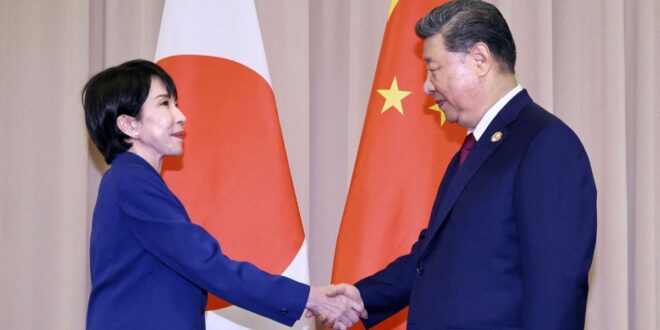
Japan’s NATO outreach should, therefore, be read as a case of networked balancing, an attempt to construct overlapping, non-treaty security relationships that raise the political and material cost of Chinese coercion without formally extending mutual defense guarantees. This essay argues that this behaviour signals a durable shift in Sino-Japanese rivalry toward institutionalized, technologically-inflected competition below the threshold of war, and draws out the more difficult question of what this implies for India, whose posture is often described, usually by others, as “drift.”
The Weight of History
Sino-Japanese competition is frequently narrated as a product of recent events: the Senkaku/Diaoyu dispute, China’s 2010s naval buildup, Abe-era constitutional reinterpretation. This understates the durability of the rivalry’s deeper structure. For most of the premodern era, China anchored a tributary hierarchy that Korea and Vietnam substantially accepted; Japan borrowed Chinese statecraft, script, and Buddhism selectively while never conceding permanent subordination, a divergence that historians of the tribute system, from Fairbank onward, treat as foundational to Japan’s distinct strategic self-conception.
The Meiji Restoration inverted the regional hierarchy with startling speed. Between the First Sino-Japanese War (1894-95) and 1945, Japan defeated Qing China, annexed Taiwan, and occupied Manchuria and much of coastal China, the period China’s own historiography canonizes as the “Century of Humiliation,” and which Japan’s postwar constitutional settlement was substantially built to renounce. The Cold War then froze this inverted hierarchy in place: Japan became the anchor of American forward defense in Asia, while China moved from revolutionary isolation to tacit anti-Soviet alignment with Washington after 1972. What has changed since roughly 2010 is that China’s economic rise has reopenedthe prior hierarchy as a live strategic question. Beijing’s ambition is regional predominance; Tokyo’s strategy is organized, almost entirely, around preventing it. This is not merely a territorial dispute, it is a contest over which historical settlement, tributary or postwar, will govern East Asia’s future.
The Logic of Japan’s NATO Turn
Five calculations explain Tokyo’s behavior, and they are worth distinguishing because they point to different futures.
First, Japan’s threat assessment of China has broadened from a bilateral territorial issue to a systemic one, encompassinganti-access/area-denial architecture, grey-zone coast guard operations, cyber intrusion, and anti-satellite capability, that a bilateral U.S.-Japan alliance, however capable, cannot address alone.
Second, Ukraine functioned as a live-fire demonstration for Japanese planners. It showed that major interstate war is not obsolete, and that Chinese observers were explicitly studying Western sanctions regimes, technology-transfer restrictions, and alliance cohesion as a dress rehearsal for how the world might respond to a Taiwan contingency. The lesson Tokyo drew was that coalition architecture must exist before a crisis, not be improvised during one.
Third, and least appreciated, NATO’s value to Japan is disproportionately technological rather than military in the traditional sense. Interoperability standards, cyber defense cooperation, and emerging work on AI and quantum technologies matter more to Tokyo than any prospect of NATO troop deployment, because 21st century deterrence increasingly runs through supply chains and standards bodies rather than divisions and fleets.
Fourth, engagement carries a signalling function distinct from its substance: it tells Beijing that coercion against one democratic partner risks triggering coordination among a wider set of actors, raising the expected political price of aggression even where no legal trigger for collective defense exists.
Fifth, this fits a broader American demand for allied burden-sharing, visible in Japan’s record defense budgets and its 2022 National Security Strategy revision.
Structural Limits, and Why They Matter Less Than Assumed
NATO will not fight in the Pacific. European navies lack the sustainment capacity for prolonged Indo-Pacific operations, and member-state domestic politics diverge sharply on China policy. But this institutional ceiling coexists with a proliferation of individual European naval deployments: British, French, German, Italian, and Dutch vessels have all transited or exercised in Indo-Pacific waters in recent years. The resulting structure is best described not as alliance extension but as a security network: a lattice of bilateral and minilateral arrangements (Japan-NATO, Japan-Australia, Japan-Philippines, AUKUS-adjacent technology sharing) that functions coalition-like without functioning as an alliance. This is arguably a more resilient form of balancing than a formal treaty would be, since it is harder for Beijing to fracture through pressure on any single node.
The Future Shape of the Rivalry
The evidence points toward persistent, institutionalized competition rather than open conflict. The East China Sea will remain the primary friction point, manifestly through coast guard confrontations, air intercepts, and increasingly unmanned surveillance systems, but nuclear deterrence and deep economic interdependence make deliberate escalation unlikely absent a Taiwan crisis, which both sides now treat as the pivotal variable capable of overriding all other calculations. Simultaneously, competition is migrating into semiconductor supply chains, rare-earth processing, and advanced manufacturing, where “de-risking” rather than full decoupling is the operative strategy on both sides: economic security has become inseparable from national security without becoming a substitute for economic engagement.
India: Drift, or a Different Geometry?
Whether India is “drifting” depends entirely on the yardstick applied. Measured against Japan’s trajectory (expanding NATO contacts, record defense budgets, explicit systemic threat framing), India’s posture (continued Russian defense procurement, comparative restraint on China, uneven Quad momentum) can look like hesitation. But this comparison assumes Japan’s position is the appropriate benchmark, when in fact the two states face structurally different strategic geometries. Japan is a maritime archipelago with no continental land border to defend and a single dominant threat axis. India is simultaneously a continental power with an unresolved Himalayan frontier, a nuclear power with an independent deterrent, a major Indian Ocean power, and a developing economy with substantial equities in multilateral institutions that include China (the SCO, BRICS). What looks like drift from a Tokyo-centric vantage point is more accurately described, in the language of alignment theory, as multi-alignment or hedging: the simultaneous pursuit of American and Japanese security cooperation, Russian equipment dependence, and participation in China-inclusive forums, without formal bloc commitment to any.
This is not costless. Hedging forfeits some of the deterrent clarity that Japan’s more overt balancing provides, and India’s ambiguity toward Russia has real reputational costs among Quad partners. But it is a coherent strategy rather than an absence of one, and it reflects India’s structural position rather than a failure of resolve.
Lessons, Properly Qualified
Japan’s experience offers India genuine, if partial, lessons. Dense security networks, not formal alliances, visibly raise deterrence value for middle powers; India’s expanding naval interoperability with the United States, Japan, and Australia already moves in this direction without requiring treaty commitment. Economic security is now inseparable from strategic security, and Japan’s semiconductor and supply-chain policy is a template India’s manufacturing ambitions cannot ignore. Given China’s centre of maritime gravity, India’s comparative advantage in the Indian Ocean (anti-submarine warfare, maritime domain awareness, indigenous shipbuilding) is an underused source of leverage relative to attention paid to the Himalayan frontier. Finally, and most importantly, both cases confirm that strategic autonomy is credible only when backed by capability; absent that, autonomy risks collapsing into simple dependence dressed in sovereign language.
The Limits of Alignment and the Logic of Capability
Japan’s courtship of NATO does not presage NATO’s arrival in Asia; it signals the consolidation of a functional security network organized around deterring Chinese coercion through technological and diplomatic interoperability rather than treaty obligation. For Sino-Japanese relations, this points toward prolonged competitive coexistence, punctuated by the ever-present risk that a Taiwan contingency could compress today’s parallel structures into an acute crisis. For India, the lesson is not imitation of Japan’s model but recognition that its own hedging strategy, defensible on structural grounds, remains sustainable only insofar as it is underwritten by real military, technological, and economic capability. The states that shape the emerging Indo-Pacific order will not be those that pick the tidiest camp, but those whose independence is backed by the power to make that independence matter.
Author’s Bio:
Dr. Yashwant Singh is an Indian sociologist working at the intersection of urban studies, development, nature and geopolitics. He holds an M.Phil. in Sociology from the University of Delhi and a Ph.D. from the University of Hyderabad, and recently served as Assistant Professor of Sociology at GITAM (Deemed to be) University, Bengaluru. Alongside his academic work, his essays and analyses have been published across several international platforms, including Across Voices, Modern Diplomacy, Geostrategic Media, South Asia Journal, World Geostrategic Insights, and IA-Forum, where he offers sociological and analytical perspectives on global affairs, strategic developments, and the changing dynamics of contemporary societies.