

 Geostrategic Media Political Commentary, Analysis, Security, Defense


Dr. Nessrine Mesto-Assaad
Key Takeaways:
– In the ongoing war between the United States and Israel on one side and Iran on the other, why was the first vital Liquefied Natural Gas (LNG) facility bombed by Iran, the Ras Laffan Industrial Facility in Qatar?
– On whom does the closure of the Strait of Hormuz affect? Who benefits from the closure?
– Why have there been federal helium reserves in the United States? Why was it privatized in 2013?
– Why have helium gas prices risen recently by 100%~125%, and who is the beneficiary?
– What is the relationship between helium and the semiconductor industry?
– Why does China recycle helium in semiconductor factories?
– Why did China and Russia announce a temporary ban on the supply of helium?
This research will answer these questions through an academic techno-political analysis, while the complex geopolitical conflicts in the Middle East will be left for the reader to analyze and deduce causes.
In 2017, Saudi Arabia, the United Arab Emirates, the Kingdom of Bahrain, and the Republic of Egypt imposed restrictions on Qatar’s airspace and land. These countries also announced the severing of diplomatic and economic relations with Qatar due to its extremist policy. Qatar supported the Muslim Brotherhood in the region and had political and economic ties with Iran, with which it shares the Pars natural gas fields. Qatar’s policy at that time did not align with the exclusionary and hostile policy of neighboring countries towards Iran. Therefore, these countries severed relations with Qatar and imposed an economic blockade on it. On the other hand, Qatar rejected these accusations and considered the arbitrary measures imposed on it a violation of its sovereignty and an infringement on its independent policies.
The four-year blockade of Qatar has affected the global supply of LNG and helium. Qatar supplies about 32% of global helium demand and is the second-largest exporter of helium gas in the world after the United States, whose exports are estimated at about 42%. Therefore, the blockade had a strong impact on importing countries, such as China, Taiwan, India, and South Korea, which depend on advanced technological industries.
Qatar was able to regulate supply chains and open new supply lines through the Sultanate of Oman, Iran, and Turkey, but temporary disruptions in helium exports prompted importing countries, led by China, to carefully consider alternative supply sources to address the instability in the helium market.
The Uses of Helium
Helium gas is of great importance to national security in technologically and militarily advanced countries. Liquid helium is used to cool advanced radar systems, quantum computers, missile guidance systems, infrared sensors, and nuclear magnetic resonance devices.
The US Department of Defense and NASA rely on helium in their rocket programs and satellites, and it is also used to accurately detect leaks in nuclear reactors. Helium is also used in optical fiber cables, where it helps cool fibers, increasing transmission speed and preventing breakage of microfibers. Recently, helium has been used in the manufacture of smart semiconductors (electronic chips) by cooling silicon chips during production to improve heat transfer, maintain the quality of micro components, and maintain the distance between nanoparticles during laser engraving on the surface of the manufactured chips. Semiconductor plants consume 24% of global helium production.
Helium is an inert gas, meaning it does not chemically react with other materials. This property makes it uniquely suited for use in nuclear laboratories, advanced laser weapons, smart missile warheads, combat aircraft, and other military defense systems.
Despite its many uses in high-precision industries, helium is considered a rare substance and a volatile gas that cannot be stored for long periods. It is also a substance that cannot be replaced by a similar substance with the same properties and purity. Hence, helium is a very important strategic resource, and any disruptions in supply operations affect the national defense readiness of advanced technological countries and the manufacture of semiconductors.
Helium and Absolute Zero
Helium is extracted from some (but not all) natural gas fields around the world through the fractional distillation of natural gas. Therefore, helium production is always carried out in modern thermal laboratories and facilities that convert natural gas into liquid. After initial treatment, the natural gas is cooled to liquefy and purify it through successive cooling processes to separate various gases, most notably valuable helium gas. When the temperature reaches -268 C° (degrees Celsius), which allows the separation of helium gas from natural gas, the helium is separated from hydrocarbons and other nitrogenous compounds, thus obtaining pure helium at a purity of 80~88%. To obtain a purity of 99.99% from raw helium, hydrogen, oxygen, and water are separated from it at a temperature close to -269 C° (degrees Celsius), which is the critical point, absolute zero, or boiling point. High-purity helium is the most in demand and strategically important, as it is used in data centers for cooling servers and in the manufacture of semiconductors to preserve them and prevent oxidation.
Helium supply chains
Helium supply chains are controlled by five countries: the United States, Qatar, Algeria, Russia, and South Africa.
For a century (1925-2024), the United States maintained a federal reserve of pure helium, which helped meet the needs of its advanced military and technological arsenal. The United States has used geological reservoirs, such as depleted wells and deep rock cavities, to store helium and draw on it when needed. This inventory has supported scientific innovation and technological development in the United States for decades.
Following the discovery of natural gas fields in Texas, Louisiana, and Kansas, the United States has become the world’s leading exporter of helium. In 2013, federal stockpile wells were privatized, and purified helium was sold to local companies, boosting government treasury revenues and helping to end the economic crisis that was dominant at the time. In 2024, the last helium reserves were extracted from the earth’s interior, and those wells were permanently closed.
Qatar is the world’s second-largest exporter of helium, after the United States. It exports about 80% of its helium production to China, which uses it for semiconductors, data center cooling, and military defense systems. In addition to imports from Qatar, China imports helium from Algeria, though in smaller quantities.
After the 2017 Qatar blockade and the helium crisis, China began to rely more on Algeria for helium imports, and it prepared to rely on Russia, especially after the giant “Amur” project, implemented by Gazprom to process natural gas, was scheduled to make Russia the world’s leading exporter of helium, with the possibility of directing a large share to Asian markets, specifically China.
After the operation at the Amur facility concluded in October 2021, a fire broke out at the plant, halting production and liquefaction operations. Russia, with support from Gazprom, quickly rebuilt and rehabilitated the facility, but on January 5, 2022, less than four months after the first fire, another fire broke out on the production lines, and an explosion occurred in part of the facility, which led to the cessation of liquefied gas and helium production units for many months. The explosion caused severe damage that contributed to the postponement of Russia’s plans to become the world’s leading supplier of helium.
The Amur facility has gradually recovered, but restoration and renovation work is still underway to complete the project.
Algeria is the world’s third-largest exporter of helium. The bulk of its production is exported to European and Asian countries. The importance of Algerian exports has increased following disruptions in global supply chains, and Algerian helium has become a strategic alternative and an influential element in the security and balance of supply chains.
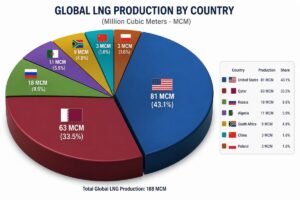
Countries producing Helium – Source: USGS
The Closure of the Strait and its impact on Qatar’s Helium
Helium supply chains have faced significant challenges due to the closure of the Strait of Hormuz. Helium is a very light gas, and its atoms are small and capable of volatilization and rapid diffusion. Although helium is shipped and exported in cooled, ultra-insulated cargo carriers, the life cycle of this gas during shipping operations does not exceed 45~60 days of filling. When storage time exceeds retention time margins, the temperature of the insulating vacuum rises, causing mandatory safety valves to vent gas into the atmosphere, resulting in a shortage of helium in these carriers.
Qatar faced significant challenges in commercial shipping due to this crisis, as its ships were forced to remain for extended periods in the bottleneck area of the Strait of Hormuz to allow passage. Some of these ships were forced to divert around the Cape of Good Hope in Africa, adding 3,500 nautical miles and 10~14 days. These forced delays in ships arriving at designated ports have contributed to significantly reduced delivery volumes and a revenue shortfall for Qatar.
On March 2, 2026, just a week after the conflict between the United States and Iran began, Iran targeted the industrial city of Ras Laffan with drones, causing damage to some production facilities and halting some lines from operating.
On March 18 and 19, 2026, Iran directed smart-headed missiles launched from drones to strike natural gas, helium facilities, and gas liquefaction plants in Ras Laffan City, causing severe damage to Qatar’s gas and helium infrastructure. The attack led to a complete cessation of production capacity in these facilities and left them out of service for some time. On April 1, 2026, the Aqua 1 fuel tanker was targeted by an Iranian missile while still in Qatar’s territorial waters.
These successive targets on production lines and gas tankers led to losses on long-term gas and helium supply contracts with South Korea, China, and Taiwan.
Qatar later stated that natural gas production operations on Lines 4 and 6 in Ras Laffan Industrial City, shared with ExxonMobil, had completely stopped, and that two LNG facilities had been completely destroyed. Qatar also said the rehabilitation of these lines and facilities would take 3 to 5 years.
In a statement, Qatar’s Energy Minister Saad Al-Kaabi indicated that the Iranian attacks had disrupted 17% of Qatar’s LNG exports and 14% of its helium exports, though some analysts believe that the actual percentages may be much higher.
The Impact of the Closure of the Strait on the Global Helium Market
The closure of the Hormuz Strait not only affected LNG trade but also contributed to escalating unrest in the helium supply market, especially in supply chains to China, Taiwan, and South Korea.
The helium market is inflexible, with the United States and Qatar monopolizing more than 75% of global production, making the market more sensitive and less flexible. With the conflicts raging over the Strait, the global market lost Qatar’s helium, equivalent to a third of global production, leading to a supply freeze that affected the global market, specifically China.
The current crisis has restricted Qatar’s production and export markets, with productivity at Ras Laffan declining significantly and several production lines being shut down under pressure from Iran as part of a mandatory non-aggression policy. This forced a halt in Qatar’s gas and helium production, which was offset by a policy of control and regulation in the US market. The closure of the Strait of Hormuz has strengthened the helium market in the United States, at the expense of Qatar’s market, in terms of monopoly on production and prices. In contrast, growing demand for helium as a key agent in advanced industries, especially semiconductors, has prompted the United States to impose strict temporary export laws.
It can be said that the closure of the Strait of Hormuz removed the competition that existed between Qatar and the United States for helium export contracts and limited the arrival of LNG and pure helium in large quantities on China’s shores. Thus, China is the most affected by this crisis.
China’s helium production accounts for less than 2% of global production. This meager output has recently been used as a strategic reserve to address the current crisis. China has also adopted modern operational mechanisms to reduce its dependence on imports. China has established semiconductor manufacturing plants that incorporate reuse systems, also known as helium recycling, which extract helium from the air inside the plants after use and prevent it from leaking into the atmosphere. These new systems have helped reduce supply shortages, particularly in semiconductor manufacturing processes, but they are not long-term solutions, as helium cannot be recycled in all industries in which it is used. China’s helium import policies are currently unstable, and it is experiencing a real crisis in securing stable, long-term contracts.
To mitigate the impact of the crisis, China and Russia rushed to impose a temporary ban on helium exports. Russia has also begun serious work to repair the Amur facility and increase helium production and storage. The United States has quickly supplied Taiwan, especially TSMC, with helium to avoid shortages in Qatar’s supply chains. Thus, the United States’ selective helium supply policy is a national strategic policy to support semiconductor supply chains and meet domestic needs.
The Helium Crisis and its Impact on the Digital Conflict
For many years, Qatar has maintained balanced relations with both the United States and China. It hosts the largest U.S military base in the Middle East (Al Udeid Base) and has security, defense, and intelligence ties with the United States. At the same time, Qatar has growing diplomatic and economic relations with China, particularly in the energy sector. This military and economic balance has made Qatar an important strategic country in the Middle East, especially after the intensification of helium gas production and the conclusion of long-term export contracts with China.
In another context, Qatar and Iran compete in the energy sector, each seeking to increase its LNG production and secure a larger market share. Despite their diplomatic relations, competition remains an essential pillar and an inevitable force shaping their respective strategic and economic interests.
Iran’s goal in striking deep into Qatar’s gas production was not only a response to the attack on its facilities in the Pars field, but also a reaction to Qatar’s unlimited policy and ambition to control gas supply chains, exclude Iran, and prevent Iran from using Middle Eastern countries, specifically Syria, as a corridor to export gas to Europe. This is in addition to Qatar’s strong desire to become the first godfather of Syria’s natural gas, which is likely to be present in the Tartous Rift (for more information, see the previous article, The Race for Data: Syria’s Offshore Gas – The Strategic Importance of the Levant Basin in the Digital Conflict). Qatar’s aspirations were revealed after Qatar Energy Company concluded agreements with the Syrian Petroleum Company, TotalEnergies, and ConocoPhillips to cooperate in gas exploration off the coast of Syria.
Qatar’s desire to reshape the energy map in the region and benefit from Mediterranean gas was the spark that set its oil facilities ablaze and limited production lines for years to come.
Over the past years, the Mediterranean basin has witnessed a hidden conflict and a cold war between Iran and Qatar, the features of which have been revealed through conflicts and wars inside Syria, with both countries using their various arms. On one hand, Iran hoped for a waterfront overlooking Europe and a land corridor it had hoped to develop after the gas agreement with Syria and Iraq in 2011. Qatar, on the other hand, was keen to thwart this agreement and reduce Iran’s influence in the Middle East by supporting jihadists, stirring up chaos and instability in Syria.
Ras Laffan Industrial City was an important strategic target through which Iran sought to weaken Qatar’s economy and restrict gas and helium production in Qatar. By bombing other gas facilities in Kuwait and the Arabian Gulf, Iran also aimed to put pressure on the global economy and disrupt gas and helium supply chains, thereby increasing international pressure on Washington to end the escalation. However, the attack on Qatar’s industrial city provided indirect economic support to the United States, and it is an effective strategic tool in the hands of the U.S to control global helium supply chains and limit China’s technological development.
The repercussions of the war between Iran and the United States go beyond the disruption of the global oil market and the shortage of helium gas. It extends to global supply chains and semiconductor manufacturing. This is in addition to the impacts on sensitive sectors related to the national security of countries and high-precision industries. The worsening blockade would directly affect vital production lines, threatening advanced technology, the economy, research, and studies.
Hence, it can be concluded that this crisis poses two main implications: the first is the fragility of global helium supply chains and the imbalance in the supply market, which allows the controlling country, the United States, to monopolize the market and control the volume of exports and the countries to which they will be exported. The second is the growing importance of scarce natural resources as an essential part of the power equation and an important factor in achieving global governance.
In the world of technology, specifically semiconductor manufacturing, rare metals, natural gas, and helium are considered the motor nerve and backbone of the electronic chip industry, and whoever controls this nerve controls all advanced and sensitive technological industries in the world. In a previous article, we pointed out that global politics is moving toward a dual equation based on two poles: the United States and China (see previous article, The Race for Data: Towards a Bipolar Digital World). This duality becomes clearer the deeper we delve into the composition of advanced technological industries, the basic resources they require, and the governments that control them.
The blockade of the Strait of Hormuz is certainly a tool of political and economic pressure in the hands of Iran, but it has also become a tool of influence and digital technological control in the hands of the United States of America.
Author’s Bio:
Dr. Nessrine Mesto-Assaad is a Doctor of Business Administration and a researcher specializing in e-government, e-file, and Generative Artificial Intelligence (ChatGPT applications) research. Her work focuses on taxpayers’ behavioral intentions to use e-government, the electronic filing system, and the adoption of AI conversational tools when e-filing income tax returns. Currently, she focuses on the intersection between digital technology and its influence on global supremacy.




You must be logged in to post a comment.