Geostrategic Media Political Commentary, Analysis, Security, Defense

Geostrategic Media Desk | Global Affairs | 30 October 2026
Key Points
- Rival US and Russian Security Council drafts on Western Sahara failed on 30 October, leaving the future of MINURSO unresolved.
- The mission’s current mandate is due to expire on 31 October 2026, after 35 years of UN involvement.
- The dispute is no longer only about the mission’s structure; it concerns the balance between Morocco’s autonomy proposal and the Sahrawi people’s right to self-determination.
- A lapse in the mandate would remove an established monitoring and de-escalation mechanism without producing a political settlement.
The United Nations Security Council has failed to agree on the future of Western Sahara at a moment when the territory’s long-running dispute is becoming more closely entangled with great-power competition. On Friday, 30 October, Russia vetoed a US-drafted resolution that would have recast the UN role and endorsed Morocco’s sovereignty claim as the basis for negotiations. The Council then failed to adopt a Russian alternative to extend the existing peacekeeping mandate. With the current mandate due to expire on Saturday, the mission’s future has been left in limbo.
A diplomatic deadlock with immediate consequences
The two proposals reflected competing approaches to the conflict. The US text sought to move away from the original referendum framework and toward a political process built around Morocco’s autonomy proposal. It envisaged ending the peacekeeping mission’s existing role in April 2027 and replacing it with a political mission. Russia’s draft, by contrast, proposed a straightforward one-year extension of the existing mandate. According to the Associated Press, the Russian text received only three votes in favour, one against and 11 abstentions, falling short of the nine votes required for adoption.
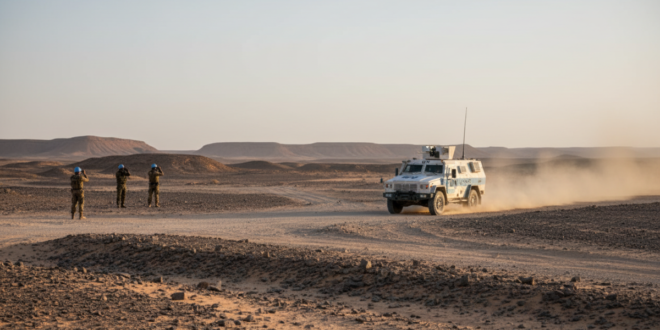
The immediate consequence is procedural but serious. The United Nations Mission for the Referendum in Western Sahara, known as MINURSO, was established in 1991 after a ceasefire between Morocco and the Polisario Front. Its mandate was to monitor the ceasefire and support a process intended to allow the territory’s future to be decided. The referendum never took place, principally because the parties could not agree on who would be eligible to vote. Security Council Resolution 2797, adopted in 2025, extended the mission only until 31 October 2026.
Autonomy, self-determination and the credibility of mediation
Morocco has controlled most of Western Sahara since 1975 and argues that autonomy under Moroccan sovereignty offers a practical basis for settlement. The Polisario Front, which represents the Sahrawi independence movement and is backed by Algeria, rejects any arrangement that forecloses the option of independence. The United States, Britain and France have increasingly supported Morocco’s autonomy proposal as a basis for negotiations, while Russia and China have emphasised the need to preserve the principle of self-determination and the existing UN framework.
The disagreement is not simply a contest over diplomatic language. The terms of a Security Council resolution shape the perceived legitimacy of the negotiating process. If one side concludes that the outcome has been predetermined, it has little incentive to make concessions. Conversely, preserving an unchanged mission indefinitely without a credible political process risks turning peacekeeping into a substitute for diplomacy rather than a bridge toward it.
The regional and strategic implications
Western Sahara sits at the intersection of North African security, relations between Morocco and Algeria, Atlantic access and the wider politics of decolonisation. A weakening of UN monitoring could make it harder to assess military activity and maintain channels of communication. It could also deepen mistrust between the parties at a time when the region faces wider security pressures, including instability in the Sahel and competition over strategic infrastructure and resources.
The dispute also illustrates the limits of the Security Council when permanent members approach a regional conflict through competing geopolitical priorities. Washington wants to consolidate diplomatic support for Morocco’s autonomy proposal; Moscow seeks to prevent the UN from appearing to endorse a predetermined outcome. Neither position, on its own, resolves the central political question or creates incentives for a negotiated compromise.
What happens next?
The expiration of the mandate does not erase the dispute, nor does it automatically create a new political framework. It does, however, force the Council and the UN Secretariat to confront the practical consequences of a lapse: the status of personnel, monitoring arrangements, logistical assets and the UN’s ability to support the Secretary-General’s envoy. A last-minute diplomatic initiative could still change the immediate outcome, but any extension will need to address the substantive disagreements that produced the deadlock.
Geostrategic Media assessment: The most consequential risk is not an immediate return to full-scale war but the erosion of a mechanism that has helped contain tensions without resolving them. A durable settlement will require a process that gives the parties a genuine stake in the outcome, preserves the Sahrawi question of self-determination, and recognises the political realities on the ground. A peacekeeping mandate can create space for negotiations; it cannot replace them.
Sources and further reading
- Associated Press, 30 October 2026: Security Council fails to agree on Western Sahara
- UN Mandate Registry: Security Council Resolution 2797 (2025), MINURSO mandate through 31 October 2026
- UN Security Council Report: Western Sahara vote and draft resolutions, October 2026
- United Nations Mission for the Referendum in Western Sahara (MINURSO): mission mandate and activities
Editorial note: The vote counts and mandate dates above are drawn from the cited reporting and UN records. The assessment of the political and security implications is Geostrategic Media’s analysis.