Geostrategic Media Political Commentary, Analysis, Security, Defense
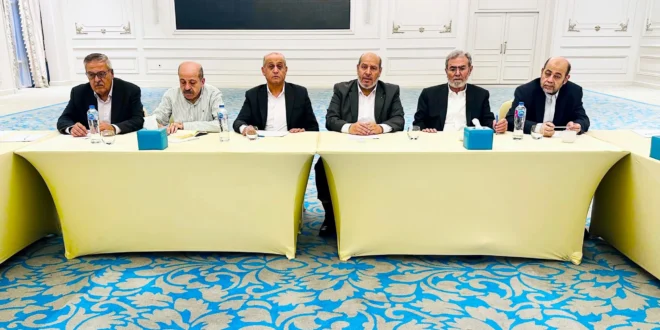

Palestinian politics is approaching a potentially extraordinary moment. With legislative elections scheduled for November 28, 2026, forces that spent years fighting one another may now find themselves sharing the same electoral list. Hamas, which has governed the Gaza Strip since 2007, is seeking the broadest possible political coalition. Among the names being discussed is the Democratic Reform Current within Fatah, led by Mohammed Dahlan, once one of Hamas’s most formidable Palestinian rivals. Joining the discussions are Nasser al-Qudwa, the former Fatah official and nephew of the late Yasser Arafat; the Palestinian left; independent figures; and a range of political and civic actors. The possibility of such an alliance is striking not because these forces have suddenly discovered ideological harmony, but precisely because they have not. Their emerging convergence is less a marriage of political programs than a response to a Palestinian political system undergoing profound change.
The irony is difficult to miss. Hamas and Dahlan represent two sides of one of the bloodiest chapters of the Palestinian political divide. Dahlan was once among the most powerful Fatah figures and security officials in Gaza during the confrontation that culminated in Hamas taking control of the Strip in June 2007. His subsequent conflict with President Mahmoud Abbas eventually resulted in his expulsion from Fatah’s leadership in 2011. For years, Hamas and Dahlan appeared to occupy opposite ends of the Palestinian political battlefield. Yet politics, as Machiavelli understood centuries ago, has a habit of turning yesterday’s enemies into today’s temporary partners when the balance of power changes. Their current dialogue is therefore less about forgetting the past than about recognizing that the political incentives of the present are different.
Egypt has played a crucial role in making that transformation possible. Cairo gradually created channels between Dahlan’s camp and Hamas, particularly after agreements reached in 2017 addressed issues surrounding reconciliation, compensation for victims of the 2007 internal fighting, social solidarity mechanisms, electricity and fuel shortages, and humanitarian concerns in Gaza. Those arrangements did not eliminate the fundamental differences between the two sides, but they established an important precedent: Hamas and Dahlan’s movement could cooperate when their interests overlapped, with Egypt acting as the principal intermediary.
By August 2026, that relationship had moved beyond humanitarian and reconciliation issues toward the future structure of Palestinian politics itself. Hamas and Dahlan’s representatives met in Egypt to discuss the next phase of arrangements in Gaza and what was described as an effort to reorganize the Palestinian political house on the basis of partnership and democracy. The discussions reportedly extended to legislative and presidential elections as well as the Palestinian National Council. That shift is significant. The question is no longer merely how Hamas and Dahlan can coexist in Gaza’s political environment; it is whether they can participate in a broader political coalition capable of challenging the existing balance of power within the Palestinian political system.
For Hamas, the political calculation is particularly consequential because its position has changed dramatically. The movement is no longer simply trying to preserve the governing structure it established in Gaza after 2007. Its relationship with governance, armed power and the postwar administration of the Strip is being reconsidered as part of a broader transition. Hamas has moved toward accepting a technocratic Palestinian administration for Gaza, while discussions over the future of its weapons have increasingly become linked to a wider political settlement. This creates a strategic opening for Hamas to reposition itself from an organization that exercises direct territorial control toward a political movement seeking a place within a broader Palestinian institutional framework.
That transition creates a problem as well as an opportunity. Hamas needs political legitimacy if it is to move from military and territorial power into a recognized political role. Dahlan, meanwhile, needs a route back into Palestinian institutions after more than a decade outside Fatah’s central leadership. Their interests therefore intersect at precisely the point where the Palestinian political system is being reconstructed. Hamas needs political space; Dahlan needs institutional access. Neither side necessarily needs to embrace the other’s ideology. They need one another because the political environment is changing around them.
The proposed coalition becomes even more interesting when the Palestinian left enters the equation. The Popular Front for the Liberation of Palestine, the Democratic Front for the Liberation of Palestine and other leftist actors have been involved in discussions over a possible broad national list, although their final positions remain uncertain. The Popular Front is particularly important. Its historical status within the Palestine Liberation Organization gives it a political identity that is different from both Hamas and Dahlan’s Fatah current. Its participation could transform the proposed list from an unusual Hamas-Dahlan arrangement into something much broader: an attempt to construct a national political platform that cuts across the traditional Islamist, Fatah and leftist divisions.
The position of the Popular Front may therefore prove decisive. The organization has reportedly participated in discussions in Cairo and expressed openness to considering a broad national list while requesting time for internal consultations. Its concerns are not simply electoral. The Front has emphasized the importance of a political program addressing reform of the Palestinian political system and what it considers Palestinian national constants. That means its decision will depend not only on the names appearing on the ballot but also on the political identity of the coalition itself. If the Popular Front joins, the coalition gains ideological breadth and historical legitimacy. If it remains outside, the project risks being perceived primarily as an alliance between Hamas and a dissident Fatah faction.
The Democratic Front faces a similar calculation. Its participation in Cairo indicates that the idea of a broad electoral coalition has reached beyond a narrow group of actors, but its final decision is likely to depend on internal consultations and the political program eventually presented. A coordinated position between the Popular Front and Democratic Front could create a separate leftist electoral current or give the broader coalition a much stronger ideological foundation. Either way, the left is no longer merely a peripheral actor in the electoral arithmetic.
Palestinian Islamic Jihad presents another complication. Reports surrounding its position have been contradictory, with some suggesting preliminary openness to the electoral project and others indicating that the movement may prefer to support a list without formally fielding its own candidates. If Islamic Jihad were to enter electoral politics directly, it would represent a significant departure from its historical posture. If it instead supports a broader coalition from outside, it could provide political backing without assuming the institutional responsibilities associated with parliamentary participation.
The most important question, however, is whether such a coalition could actually challenge Fatah’s dominance. Recent Palestinian polling suggests that the contest remains remarkably close. An August 2026 survey by the Palestinian Center for Policy and Survey Research placed Fatah at roughly 32 percent and Hamas at 29 percent, while other political forces collectively accounted for 18 percent and 21 percent of respondents remained undecided. Those numbers reveal something more important than the narrow gap between the two largest movements: a substantial portion of the Palestinian electorate remains outside the traditional Fatah-Hamas binary.
That electorate could become the decisive battlefield.
The geography of Palestinian political opinion makes the challenge even more complicated. In Gaza, Hamas maintains an advantage over Fatah, while in the West Bank Fatah remains ahead. Yet the West Bank also contains a much larger pool of undecided voters. A broad coalition that brings together Hamas, Dahlan’s supporters, Nasser al-Qudwa, elements of the Palestinian left and prominent independents could therefore attempt to transform political dissatisfaction into an electoral alternative. Its success would depend less on Hamas’s traditional constituency than on its ability to convince voters who oppose the current leadership but are unwilling to vote for Hamas alone.
This is where Marwan Barghouti becomes potentially decisive. His popularity remains considerably greater than that of most Palestinian political figures. Polling has placed him substantially ahead of other potential successors to Mahmoud Abbas, including Khalil al-Hayya and Mohammed Dahlan. Barghouti represents something none of the other factions can easily reproduce: the ability to transcend organizational boundaries. He is associated with Fatah, but his popularity extends well beyond its formal structures. He carries the symbolism of Palestinian resistance, political imprisonment and national unity, making his position potentially critical to any coalition seeking to present itself as broader than a factional alliance.
The political environment in which all of this is occurring is deeply hostile to the existing Palestinian leadership. Large majorities of Palestinians express dissatisfaction with Abbas and the performance of the Palestinian Authority, while significant numbers perceive corruption within its institutions and regard the Authority as more of a burden than an asset. This creates the possibility of a protest vote, but protest votes do not automatically translate into a coherent political alternative. Someone must organize the dissatisfaction, give it a recognizable electoral identity and persuade voters that the coalition represents more than a temporary pact among political elites.
The electoral law could help such a coalition. The Palestinian electoral system uses full proportional representation with closed lists, treating the Palestinian territories as a single electoral district. The threshold has reportedly been reduced to just 1 percent, while the legislature would consist of 132 members and women would have to constitute at least 33 percent of electoral lists. Lowering the electoral threshold makes it easier for smaller political forces to participate independently, but it also increases the strategic value of coalition-building. A broad list would not merely be a technical mechanism for crossing the threshold; its real value would be its ability to aggregate political constituencies that might otherwise divide the opposition vote.
Yet the legal framework contains a potentially explosive contradiction. Electoral lists are required to recognize the Palestine Liberation Organization as the sole legitimate representative of the Palestinian people and to adhere to its political program and relevant international legitimacy. For Hamas and Palestinian Islamic Jihad, the interpretation of this requirement could become one of the most contentious issues surrounding registration. Hamas’s participation in an election under these conditions would require it to navigate the tension between entering the formal Palestinian political system and preserving elements of its own political identity.
That tension illustrates why the proposed alliance is about much more than elections. It is part of a larger struggle over what the Palestinian political system will look like after the Gaza war. If Hamas moves away from direct administration of Gaza, if a technocratic structure assumes governmental responsibilities, and if Palestinian elections become the mechanism for restoring political legitimacy, then the traditional division between governing authority and political movement could begin to disappear.
For Fatah, the threat is obvious. The movement has every incentive to prevent the fragmentation of its electoral base. The experience of the cancelled 2021 elections remains instructive. At that time, Dahlan’s camp prepared its own list while Nasser al-Qudwa was associated with another list supported by Barghouti. Instead of confronting a unified opposition, Fatah risked losing votes to competing currents emerging from within its own political family. The possibility that those currents could now combine with Hamas and the Palestinian left presents an entirely different level of strategic danger.
This explains the importance of the Popular Front. Reports that senior Fatah officials, including Hussein al-Sheikh, Majed Faraj and Rawhi Fattouh, are seeking to engage the Popular Front illustrate how seriously the leadership views the possibility of a broad electoral coalition. The objective is not simply to persuade one faction to abandon Hamas. It is to prevent the formation of a political umbrella capable of combining Islamists, dissident Fatah figures, leftists and independents under one electoral brand.
But there is a deeper question that neither Fatah nor its opponents can avoid. Can a coalition built primarily around opposition to the existing leadership actually govern?
This is the fundamental weakness of the proposed alliance. Hamas, Dahlan, the Palestinian left and independent figures may agree that the existing political order is exhausted, but agreement on what should replace it is much harder. Hamas has a distinct ideological project. Dahlan’s movement represents a particular Fatah tradition and has its own regional relationships. The Palestinian left has historically opposed both Islamist politics and the dominant Fatah establishment. Independent figures will be reluctant to surrender their credibility to a factional bargain. Such differences may be manageable during an election campaign, but they could become destabilizing once political power is at stake.
The coalition’s architects therefore face a choice. They can build an electoral alliance whose primary purpose is to defeat Fatah, or they can attempt something much more ambitious: a national political platform capable of explaining what comes after victory. The first approach may be electorally effective but politically fragile. The second is far more difficult but potentially transformative.
The November election itself remains uncertain. Although the Central Elections Commission has proceeded with preparations, the political and security environment remains extraordinarily complicated, particularly in Gaza, where the postwar transition, Israeli military presence and questions surrounding political participation remain unresolved. Jerusalem presents another major obstacle. The issue was used as a formal justification for postponing the 2021 elections, and there is no guarantee that the political and logistical circumstances surrounding Palestinian participation in Jerusalem will be easier in 2026.
Polling also reflects this uncertainty. While a significant share of Palestinians expects the election to take place in November, confidence that it will actually happen—and that it will be free and fair—is considerably lower. That gap between expectation and confidence may itself become politically significant. Every postponement, procedural dispute or disagreement over participation risks reinforcing the public perception that Palestinian elections remain hostage to factional calculations.
The paradox is that the prospect of an unprecedented coalition may itself increase the pressure to postpone the election. The stronger the emerging list becomes, the greater the incentive for its opponents to prevent it from reaching the ballot box. Conversely, the more credible the election appears, the more pressure will fall on Hamas, Dahlan, Fatah and the left to finalize alliances that could reshape the political map.
What brings yesterday’s enemies together, then, is not friendship. It is convergence.
Hamas sees an opportunity to enter a new political phase without surrendering its relevance. Dahlan sees an opportunity to return to Palestinian institutions without first securing Abbas’s approval. The Palestinian left sees an opportunity to escape political marginalization. Independent figures see the possibility of creating an alternative to the exhausted Fatah-Hamas binary. And many Palestinian voters appear increasingly interested in something beyond the existing political establishment.
Whether that convergence survives the election campaign is another matter. Palestinian politics has repeatedly demonstrated that alliances formed in moments of crisis can collapse when confronted with the realities of power. The history of the Palestinian divide is full of agreements that promised unity and produced another round of fragmentation.
But this moment is different in one important respect. The old Palestinian political order is weakening simultaneously on several fronts. Hamas’s model of direct governance in Gaza is being reconsidered. Fatah’s institutional dominance is facing growing public dissatisfaction. Dahlan is attempting to re-enter the political system. The Palestinian left is being courted as a potential kingmaker. And a large segment of the electorate appears to be searching for an alternative.
The question facing Palestinians is therefore no longer simply whether Hamas and Dahlan can sit at the same table. They already can. The real question is whether they can convince Palestinians that sitting together represents something more than the temporary logic of political survival.
If they can, November 2026 could mark a genuine rupture with the politics that followed the 2007 Gaza split. If they cannot, the proposed alliance may become another chapter in the long history of Palestinian political bargains that were born from necessity and died from mistrust.
The most consequential Palestinian political alliance in years may therefore be emerging not because old enemies have reconciled, but because the old political map no longer provides enough space for any of them to survive alone.