 Geostrategic Media Political Commentary, Analysis, Security, Defense

Dr. Shehab Al-Makahleh
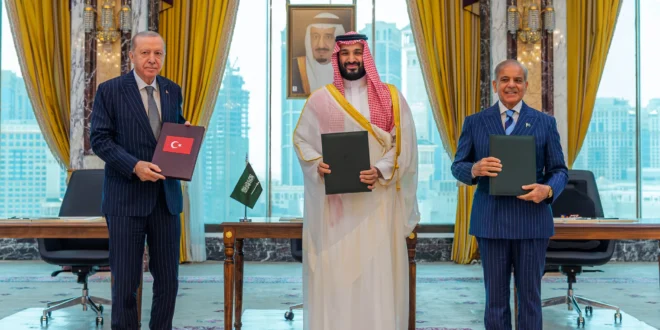
The signing of the Mecca Joint Defence Agreement by Saudi Arabia, Türkiye and Pakistan on 7 August 2026 represents one of the most consequential developments in the reconfiguration of the Middle East’s security architecture in decades. The agreement establishes a collective-defence principle under which aggression against one signatory is treated as aggression against all three, placing it conceptually within the broader genealogy of collective-security arrangements associated with NATO-style deterrence.
The agreement is a major development in regional security cooperation, while Turkish Foreign Minister Hakan Fidan subsequently described the mutual-defence provision as technically comparable to NATO’s Article 5. However, the enticement to classify the Mecca Pact simply as an anti-Iran alliance should be resisted. Both the Turkish and Saudi sides have stressed its defensive character, and Fidan has explicitly rejected the proposition that Iran is its target. Associated Press — Turkey says defense pact is not aimed at Iran. The distinction is strategically important because the political meaning of an alliance depends not merely upon its military capabilities but upon the intentions attributed to it by its adversaries.
The deeper significance of Mecca lies in the emergence of a regional doctrine of strategic autonomy. For decades, the security architecture of the Middle East rested heavily upon external guarantees, above all the military capabilities of the United States. That architecture has not disappeared, but its political reliability is increasingly being reassessed by regional actors. Saudi Arabia, Türkiye and Pakistan are therefore not necessarily attempting to replace Washington; rather, they are attempting to ensure that their national security does not depend upon the strategic preferences of a single external patron. This is a classic form of strategic hedging: the preservation of multiple options in an uncertain international system. Saudi Arabia’s transformation under Vision 2030 makes this imperative particularly acute. Riyadh is attempting to attract investment, develop logistics, tourism, technology and industrial capacity while simultaneously transforming the Kingdom into a major geopolitical and economic hub. The Saudi government’s own strategic communications explicitly connect economic diversification, international partnerships and regional security. Saudi Press Agency — Saudi strategic and economic transformation The geopolitical axiom is straightforward: capital seeks security before it seeks opportunity.
This is where Machiavelli becomes particularly useful. The political philosophy of Niccolò Machiavelli’s The Prince — University of Chicago Press is frequently reduced to a crude maxim concerning ruthlessness, whereas its deeper importance lies in its insistence upon verità effettuale—the effective reality of political life. Machiavelli’s political actor must distinguish between what ought to be and what is, between declared intention and actual capability, and between moral aspiration and the necessities imposed by political contingency. The Mecca Pact can therefore be understood as an exercise in political prudence rather than military adventurism. Saudi Arabia does not need to desire war with Iran to conclude that strategic vulnerability is unacceptable. Türkiye does not need to seek confrontation with Tehran to recognise that regional instability can impose costs upon its interests. Pakistan does not need to become a Gulf combatant to understand that instability along the Arabian Sea, Red Sea and wider Islamic world affects its strategic environment. The logic is not bellum qua bellum—war for the sake of war—but deterrence through the alteration of expectations.
Machiavelli’s conception of virtù is equally relevant. Virtù should not be understood simply as virtue in the modern moral sense; it concerns political capacity, prudence, adaptability and the ability of rulers to exploit circumstances rather than merely endure them. The Mecca Pact can be interpreted as an institutional expression of this principle. Rather than waiting for another crisis to expose the deficiencies of existing security arrangements, Riyadh has attempted to convert uncertainty into institutional capability. The pact therefore represents not merely a response to a crisis but an attempt to shape the strategic environment in advance of the next crisis. This is the essence of preventive statecraft: not preventing every conflict through pacifism, but reducing vulnerability sufficiently to make coercion less attractive.
Mao Zedong offers a radically different but surprisingly complementary analytical framework. Mao’s writings on strategy emphasised that military power cannot be separated from political purpose, strategic time, geography, organisation and the accumulation of relative strength. In On Protracted War, Mao conceptualised conflict not simply as a contest of weapons but as a contest in which the weaker actor could alter the balance through endurance, organisation and the progressive transformation of political and military conditions. Mao Zedong — On Protracted War and Selected Works. Applied cautiously to the contemporary Middle East, this framework suggests that the significance of the Mecca Pact should not be measured simply by the number of aircraft, missiles, soldiers or defence contracts involved. Its deeper significance lies in whether it creates cumulative strategic capacity. Political coordination can generate intelligence cooperation; intelligence cooperation can generate interoperability; interoperability can create credible deterrence; deterrence can create political space for diplomacy. The pact’s power, therefore, may ultimately reside less in its immediate military output than in its ability to institutionalise a process of cumulative strategic convergence.
The Saudi-Pakistani dimension is particularly important because the Mecca Pact did not emerge from a strategic vacuum. Saudi Arabia and Pakistan had already signed a Strategic Mutual Defense Agreement in September 2025, under which aggression against either state would be considered aggression against both. Saudi Press Agency — Saudi-Pakistan Strategic Mutual Defense Agreement. The 2026 Mecca arrangement consequently represents the multilateralisation of an existing bilateral strategic relationship, rather than the sudden invention of a completely new alliance. This is significant because durable alliances are rarely manufactured instantaneously. They generally emerge through the institutionalisation of pre-existing military relationships, political confidence, economic interests and strategic necessities.
Türkiye changes the geometry of that relationship because it introduces a different category of strategic capability. Saudi Arabia contributes capital, energy influence, geographic centrality and diplomatic weight. Pakistan contributes military depth, operational experience and the strategic significance of its nuclear capability. Türkiye contributes an increasingly sophisticated defence-industrial ecosystem encompassing unmanned systems, missiles, electronic warfare, naval platforms and other indigenous technologies. The result is not a perfectly homogeneous coalition but a relationship based upon complementarity rather than uniformity. Pakistan’s principal strategic preoccupation remains India and South Asia; Türkiye’s interests extend across the Black Sea, Caucasus, Syria, Iraq, the Eastern Mediterranean and Europe; Saudi Arabia’s centre of gravity lies in the Gulf, Iran, Yemen, the Red Sea and economic transformation. Yet alliance politics has never required complete congruence. It requires sufficient convergence for cooperation to become preferable to strategic isolation.
Churchill’s experience of coalition politics provides another useful intellectual lens. The significance of Winston Churchill’s The Gathering Storm lies not simply in its narrative of the Second World War but in the broader strategic problem it illustrates: the necessity of constructing political coalitions before an adversary is able to exploit fragmentation. The lesson is not that the Middle East is analogous to Europe in the 1930s; it plainly is not. The analytical parallel is narrower. States with different interests can nonetheless conclude that collective security is preferable to isolated vulnerability. The Mecca Pact represents precisely such a calculation. Saudi Arabia, Türkiye and Pakistan do not share identical foreign policies, but they increasingly share an interest in preventing regional instability from becoming strategically unmanageable.
The central mechanism through which this arrangement operates is deterrence. An adversary contemplating military action against one member must now consider the possibility that the conflict could generate political, intelligence, logistical or military involvement from the other two. The precise response is not mechanically predetermined, which may actually strengthen the deterrent effect because the adversary cannot perfectly calculate the limits of collective action. Deterrence is fundamentally a psychological and political phenomenon: its purpose is to modify the expected utility of aggression before aggression occurs. The pact therefore does not need to promise automatic war to be effective. It needs to convince a potential aggressor that war may produce consequences beyond those originally anticipated.
This is the paradox at the centre of strategic deterrence: the credibility of force is ultimately judged by its capacity to prevent the use of force. The stronger the perceived likelihood of collective retaliation, the less attractive aggression becomes. In that sense, the Mecca Pact can be interpreted as a form of strategic insurance. It does not guarantee that war will never occur; rather, it attempts to raise the premium that an aggressor must pay for initiating it.
Iran will inevitably interpret the agreement through the prism of its own security dilemma. From Tehran’s perspective, the simultaneous alignment of Saudi Arabia, Türkiye and Pakistan at a moment of acute regional instability could appear to constitute the institutionalisation of strategic encirclement. Yet the distinction between deterrence and containment must remain analytically precise. A defensive architecture can acquire offensive characteristics, but it does not follow that its initial purpose is offensive. Fidan’s explicit statement that Iran is not the target of the pact is therefore strategically relevant rather than merely diplomatic theatre. Associated Press — Turkey says Iran is not the target
The danger is that Tehran could interpret defensive preparations as offensive intentions and respond accordingly. Iran’s response could include greater reliance upon missile capabilities, unmanned systems, maritime pressure and regional partners. Such a response would then reinforce the threat perceptions of Saudi Arabia, Türkiye and Pakistan, encouraging them to deepen the very security architecture Tehran fears. This is the classic security dilemma: measures undertaken by one actor to increase its own security simultaneously reduce the perceived security of another. The resulting dialectic can become self-perpetuating. Every defensive measure becomes evidence of hostile intent; every countermeasure becomes evidence that the original fear was justified.
The Stimson Center has argued that Gulf economic development cannot be separated from a reduction in permanent confrontation with Iran and that cooperation and dialogue between the GCC and Tehran remain necessary. Stimson Center — To succeed, the GCC requires cooperation with Iran This proposition becomes even more important after the creation of the Mecca Pact. A stronger deterrent does not make diplomacy obsolete. On the contrary, deterrence can provide the strategic equilibrium within which diplomacy becomes politically sustainable. The appropriate formula is therefore not deterrence or dialogue but deterrence plus dialogue.
The military transformation now underway in the Gulf reinforces this conclusion. Post-war security thinking is increasingly shifting away from an exclusive emphasis on prestige platforms and toward layered air and missile defence, resilient infrastructure, unmanned systems, electronic warfare, intelligence capabilities and domestic defence production. Stimson Center — The post-war Gulf: Arms competition, nuclear latency, and regional security This is more than a procurement trend. It represents a transformation in the meaning of strategic sovereignty. The sovereign state of the twenty-first century must possess not merely the capacity to retaliate but the capacity to absorb coercion without systemic paralysis.
The Mecca Pact also exposes the institutional limitations of the GCC. The Gulf states share geographical proximity but do not always share identical threat perceptions, strategic cultures or foreign-policy preferences. Recent analysis by the Stimson Center has highlighted precisely this sovereignty dilemma within GCC security integration. Stimson Center — The sovereignty paradox: Why GCC security integration remains elusive Riyadh’s decision to deepen security relations with Türkiye and Pakistan can therefore be interpreted as modular regionalism: constructing smaller, functional security networks around particular strategic requirements rather than waiting for an all-encompassing regional command structure.
The emerging R4 framework involving Saudi Arabia, Türkiye, Pakistan and Egypt provides a potentially complementary political dimension. The Indian Council of World Affairs has examined the emergence of this quartet within the broader restructuring of West Asian diplomacy. Indian Council of World Affairs — Ongoing turmoil and an emerging new quartet in West Asia The strategic architecture could consequently develop a division of labour: R4 as a political consultation mechanism and the Mecca Pact as a defence and deterrence mechanism. Such a structure would be more sophisticated than a conventional military bloc because it would combine political consultation, economic interests and coercive credibility.
Egypt’s possible future participation would further transform the geometry. Cairo controls the Suez Canal, possesses one of the region’s largest military establishments and maintains strategic interests in Gaza, Sudan, Libya, the Red Sea and the Mediterranean. Egyptian participation cannot be presumed, but its possibility demonstrates the potential for the Mecca Pact to become the nucleus of a broader regional network rather than remaining a static trilateral arrangement.
The Red Sea represents perhaps the clearest geographical link among the three powers. Saudi Arabia occupies the Red Sea’s eastern shore; Türkiye has growing commercial and strategic interests in maritime security; and Pakistan’s position on the Arabian Sea connects the arrangement to the Indian Ocean. This creates a strategic continuum linking the Indian Ocean, Arabian Sea, Red Sea and Mediterranean. The implications extend beyond conventional military defence to shipping, energy, critical infrastructure and global commerce. The security of maritime chokepoints is therefore becoming inseparable from the security of national economies.
Washington should consequently resist the temptation to interpret Mecca as an anti-American development. Saudi Arabia remains a major American partner, Türkiye remains a NATO member and Pakistan continues to maintain important relations with Washington. The more accurate interpretation is regional burden-sharing. The United States may ultimately benefit from a regional order in which capable states assume greater responsibility for their own security while continuing to cooperate with Washington. American primacy is not necessarily preserved by making regional actors dependent; it can also be preserved through partnerships among increasingly capable regional powers.
The economic logic is equally compelling. Saudi Arabia’s Vision 2030 cannot be separated from geopolitical risk. Investors require confidence that airports, ports, tourism developments, industrial zones, logistics corridors and digital infrastructure will remain functional during periods of crisis. The same principle applies to Türkiye and Pakistan. A functioning security architecture can therefore become an economic asset by reducing perceptions of geopolitical risk, protecting maritime trade and encouraging defence-industrial cooperation. The Mecca Pact consequently belongs not only to the history of Middle Eastern alliances but also to the political economy of the post-oil Gulf.
Yet the pact should not be romanticised. Political declarations do not automatically generate military interoperability. The three governments will need mechanisms for intelligence-sharing, command-and-control coordination, joint exercises, logistics, air and missile defence, maritime security and crisis communication. The proposed ministerial mechanism and Saudi-based secretariat will therefore matter considerably more than the symbolism of the signing ceremony. The real test will arrive during the first major crisis: will intelligence move quickly enough, will political leaders agree on thresholds for action, and will military institutions possess the interoperability necessary to convert political commitments into operational effect?
Pakistan’s nuclear capability introduces an additional layer of strategic ambiguity. It would be analytically unsound to describe the Mecca Pact as establishing a formal Saudi nuclear umbrella without explicit evidence of such a commitment. What can be said is that Pakistan’s nuclear status alters the strategic context in which potential adversaries calculate escalation. This distinction is crucial. Nuclear deterrence operates not merely through weapons but through perceptions of risk, uncertainty and escalation. Yet ambiguity can also create miscalculation. The greater the association between the pact and nuclear deterrence, the greater the requirement for crisis-management mechanisms and strategic communication.
The philosophical question is therefore more profound than whether the pact increases military power. It is whether power can be organised so that its very existence reduces the probability of its use. Here, the intellectual traditions of Machiavelli, Mao and Churchill converge despite their radically different historical contexts. Machiavelli teaches the primacy of political realism and the necessity of understanding power as it exists. Mao demonstrates that strategic power is cumulative and that political, military and economic capabilities must be integrated into a coherent long-term strategy. Churchill demonstrates the importance of coalition-building and credible resistance when the alternative is strategic vulnerability. These are not interchangeable doctrines, but together they offer a useful methodology for understanding the Mecca Pact as an exercise in strategic statecraft.
Iran’s response will ultimately determine whether the pact becomes a stabilising mechanism or another accelerator of regional polarisation. Tehran can interpret the agreement as evidence of encirclement and respond through counter-alignment, asymmetric capabilities and increased military pressure. Or it can recognise that a stronger regional deterrent may create the very strategic equilibrium necessary for serious diplomacy. Iran is too large, too geographically consequential and too deeply embedded in the Gulf’s political economy to be permanently excluded from a sustainable regional security architecture. The objective therefore should not be the permanent defeat or exclusion of Iran, nor the creation of a sectarian military bloc, but the construction of an equilibrium in which every major actor understands that aggression carries unacceptable costs.
The Middle East has spent decades oscillating between dependence upon external security guarantees and fragmented national attempts to construct unilateral deterrence. Neither model has produced durable stability. The Mecca Pact potentially represents a third model: regional collective security supported by external partnerships but not dependent upon them. It is a manifestation of regional agency, not necessarily an act of geopolitical rebellion. It is an attempt to convert uncertainty into institutional capability, vulnerability into resilience and bilateral relationships into a broader network.
The final test is therefore whether Mecca becomes a sword or a shield. If the pact evolves into an explicitly anti-Iran military bloc, it could intensify the security dilemma and encourage precisely the escalation it was designed to prevent. If, however, it remains anchored in deterrence, strategic autonomy, economic resilience, maritime security and diplomacy, it could become the foundation of a new regional security bargain. Its success should not be measured by the number of weapons acquired or states recruited. It should be measured by whether it changes the strategic calculus sufficiently to make aggression less rational while preserving diplomatic alternatives.
The strongest security architecture is not necessarily the one capable of winning the next war. It is the one capable of making the next war unnecessary. That is ultimately the strategic wager of Mecca: not peace through weakness, nor security through permanent confrontation, but stability through credible power, strategic prudence and diplomatic possibility.