Geostrategic Media Political Commentary, Analysis, Security, Defense
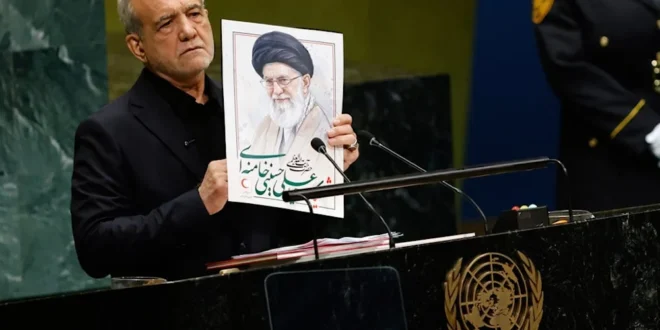

Masoud Pezeshkian’s address to the United Nations General Assembly came at a moment when the space between diplomacy and war has become increasingly difficult to define. Just one day after Donald Trump used the same international stage to warn Iran of potentially devastating consequences, the Iranian president stood before the world and delivered a message that was defiant, but not closed to diplomacy.
Iran, Pezeshkian made clear, will not surrender under pressure. But neither, he insisted, has Tehran abandoned negotiations.
That distinction is at the heart of Iran’s position.
Tehran is trying to demonstrate that military pressure, economic sanctions and threats cannot force it to accept terms dictated from Washington, while at the same time keeping open a channel through which a political settlement might eventually be reached. It is a difficult balance, particularly at a time when the risk of another round of military escalation remains real.
Pezeshkian’s speech was therefore less a declaration of victory than a statement of political endurance. Iran has absorbed considerable pressure, but it still wants to retain the ability to negotiate from what it considers a position of sovereignty rather than submission.
Tehran’s answer to Washington
The timing of the speech was important.
Trump had presented the confrontation in stark terms, warning Iran of severe consequences and demanding that Tehran accept a different strategic reality. Pezeshkian responded by rejecting the premise that pressure should determine the outcome of negotiations.
For Iran, this is not simply a dispute over one agreement or one round of talks. It is tied to a much broader question: who has the right to determine Iran’s security, military capabilities and technological future?
Pezeshkian’s answer was unmistakable. Those decisions, he argued, belong to Iran.
That does not mean Tehran is unwilling to compromise. It means that any compromise must be negotiated rather than imposed.
This distinction is likely to remain one of the biggest obstacles to a U.S.-Iran agreement. Washington wants restrictions that it considers sufficient to prevent Iran from developing a nuclear weapons capability and to reduce the wider security threat posed by Tehran. Iran, meanwhile, wants guarantees that negotiations will not simply become another mechanism for imposing unilateral restrictions on the country.
The two positions remain far apart.
But the fact that both sides continue to leave a door open to negotiations is significant.
Iran does not see strength and diplomacy as opposites
One of the more revealing aspects of Pezeshkian’s address was the way he connected military strength with diplomacy.
From the Iranian perspective, negotiations conducted from a position of weakness are unlikely to produce a durable agreement. Tehran therefore sees its military capabilities not only as instruments of confrontation but also as deterrents intended to prevent its adversaries from believing that Iran can be attacked without consequences.
This is an argument that Washington and many of its allies reject.
Yet understanding it is important because it explains why attempts to force Iran into unilateral concessions have repeatedly encountered resistance.
Iran’s leadership has spent decades operating under the assumption that the country must be able to defend itself independently. The experience of repeated sanctions, assassinations, military strikes and external pressure has reinforced that perception.
Pezeshkian was therefore speaking to more than the international community. He was also speaking to an Iranian public that has been told repeatedly that national survival depends on resilience.
His message was essentially that Iran can negotiate without capitulating.
The nuclear question remains the hardest problem
Nothing illustrates the gap between Tehran and Washington more clearly than the nuclear issue.
Pezeshkian reiterated that Iran does not seek nuclear weapons, while insisting that the country has the right to develop nuclear technology for peaceful purposes.
To Tehran, this is a question of national sovereignty and technological development. Nuclear technology is connected not only to energy but also to medicine, agriculture, research and industrial development.
For Washington, however, the central concern is not simply what Iran says it intends to do. It is whether Iran could develop the technical capability to move toward a nuclear weapon if it chose to do so.
That is where the disagreement becomes difficult to bridge.
The argument is therefore not simply about whether Iran should have nuclear technology. It is about how much capability Iran can retain, what restrictions would apply, how inspections would work, what guarantees would be provided and what would happen if either side believed the other had violated an agreement.
Those details will ultimately matter far more than the rhetoric delivered from the UN podium.
Gaza remains inseparable from Iran’s regional message
Pezeshkian also devoted considerable attention to Gaza and the Palestinian question.
For Tehran, the war in Gaza cannot be separated from the broader crisis in the Middle East. Iran continues to portray the Palestinian issue as evidence of a wider imbalance in the international system, particularly in the way different states respond to civilian casualties, occupation and military force.
Whether one accepts Tehran’s broader political narrative or not, the Palestinian issue remains central to Iran’s regional diplomacy.
It provides Tehran with a powerful political language through which it connects its confrontation with Israel and the United States to a much wider regional audience.
This also explains why it is difficult to isolate the Iranian nuclear issue from the rest of the Middle Eastern security environment.
Iran does not view the nuclear dispute as a standalone technical problem. It sees it within a regional order in which Israel possesses substantial military capabilities, the United States maintains extensive military assets, and Gulf states remain heavily connected to Washington while simultaneously developing relationships with other major powers.
Tehran wants that regional balance to change.
Hormuz is more than a bargaining chip
Pezeshkian’s comments about the Strait of Hormuz deserve particular attention.
Hormuz is one of the most sensitive points in the global energy system. Any serious disruption would immediately extend the consequences of the Iranian-American confrontation well beyond the Middle East.
Iran understands this.
But so does everyone else.
The Strait gives Tehran leverage, yet using that leverage too aggressively could also damage Iran’s own economic interests and alienate countries that might otherwise prefer diplomatic engagement with Tehran.
This is why the future of Hormuz could become central to any eventual de-escalation.
The issue is not simply whether the waterway remains open. It is whether a broader regional security arrangement can be developed in which Iran feels secure enough not to view the Strait as a necessary instrument of deterrence, while other states have confidence that commercial shipping will remain protected.
That is a much harder diplomatic problem.
But it is also a more realistic one.
Iran’s neighbors do not want another regional war
There is another actor whose importance is growing: Iran’s neighbors.
The Gulf states have little interest in seeing the current confrontation develop into a prolonged regional war.
Their economies depend on stable energy markets, secure shipping, foreign investment and political stability. A major conflict involving Iran would threaten all four.
This has encouraged Gulf governments to pursue a more complicated diplomatic strategy.
They continue to maintain close security relationships with Washington, but they have also expanded their diplomatic and economic relationships with Beijing, Moscow, Ankara and other powers.
They are not necessarily choosing one side against another.
They are trying to ensure that they have options.
That broader regional trend is important because it limits the ability of either Washington or Tehran to define the Middle East entirely on its own terms.
The region is becoming more politically autonomous.
The real question is what happens after the rhetoric
The most important part of Pezeshkian’s speech may ultimately have been the part that received the least attention: his insistence that Iran remains willing to talk.
It would be a mistake to interpret that as evidence that an agreement is close.
It is not.
The disagreements between Iran and the United States remain profound. Washington wants meaningful restrictions on Iran’s nuclear program and broader changes to its regional behavior. Tehran wants recognition of its sovereignty, relief from economic pressure and guarantees that diplomacy will not simply become another form of coercion.
Neither side has yet demonstrated that it is prepared to give the other everything it wants.
But diplomacy rarely begins when both sides already agree.
It begins when both sides recognize that continuing the existing confrontation carries costs that eventually become greater than the cost of compromise.
The question is whether Washington and Tehran are approaching that point.
A confrontation neither side can easily control
There is a temptation to describe the current crisis purely in terms of American military superiority versus Iranian resistance.
The reality is considerably more complicated.
The United States possesses overwhelming military and economic advantages. Iran, however, has geography, strategic depth, a large population, significant missile capabilities, regional relationships and the ability to impose costs far beyond its borders.
Neither side can simply wish away the other’s strengths.
That is precisely why the possibility of diplomacy remains alive.
Military force can destroy infrastructure. Economic pressure can weaken an economy. Sanctions can constrain a government.
But none of these automatically produces political surrender.
Eventually, someone has to decide what political outcome the use of force is supposed to achieve.
That is where the current confrontation becomes much more difficult.
Iran’s message is ultimately about the terms of diplomacy
Pezeshkian’s UN address should therefore not be read simply as another Iranian rejection of American pressure.
Its deeper message was more complicated.
Iran is prepared to negotiate, but it wants the negotiations to recognize that it remains a sovereign regional power.
It will defend its military capabilities.
It will insist on what it considers its right to peaceful nuclear technology.
It will continue to place Palestine at the center of its regional narrative.
And it will resist any settlement that it believes amounts to capitulation.
At the same time, Tehran appears to understand that permanent confrontation with the United States carries enormous economic and strategic costs.
That is why diplomacy remains on the table.
The challenge now falls on both governments.
Washington must determine whether its objective is to force Iran into submission or to negotiate an agreement that Iran can realistically accept and sustain.
Tehran must determine how far it is prepared to compromise without undermining the sovereignty and security principles it has placed at the center of its strategy.
Neither question has an easy answer.
But Pezeshkian’s message at the United Nations was clear enough.
Iran will talk.
Iran may negotiate.
But Iran does not intend to surrender.
And as the Middle East moves toward a more fragmented and multipolar security order, the ability of either Washington or Tehran to impose its preferred outcome on the other may be considerably more limited than either side would like to admit.