


 Geostrategic Media Political Commentary, Analysis, Security, Defense

Geostrategic Media | Strategic Analysis | 30 October 2026
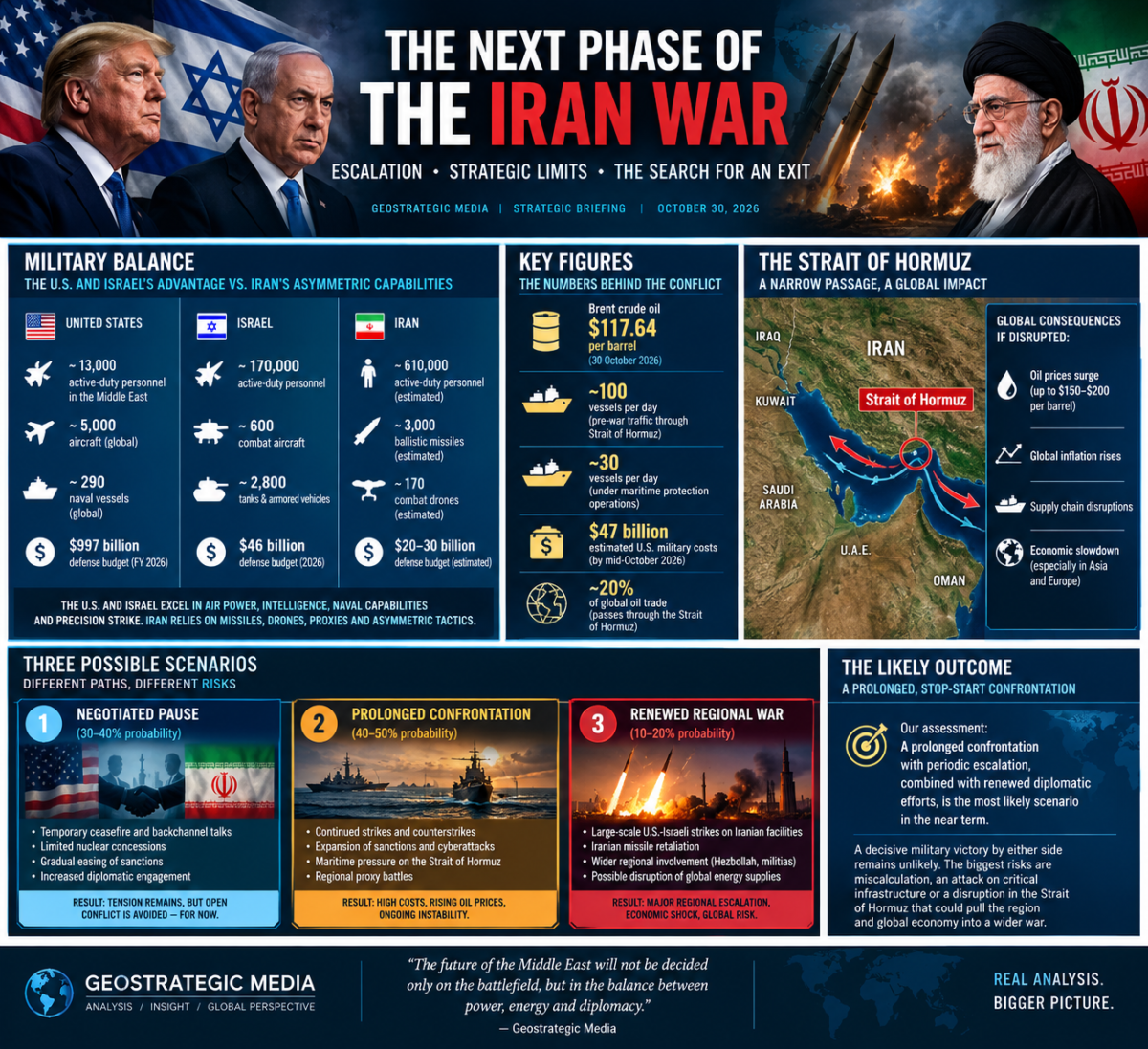
The central question facing the Middle East is no longer whether the United States, Israel and Iran can return to large-scale war. They have already crossed that threshold. The question now is whether the fragile pause and intermittent confrontation can be converted into a political arrangement—or whether the next phase will bring another round of strikes, retaliation and disruption across the Gulf.
As of 30 October, the warning signs are substantial. Maritime incidents in and around the Strait of Hormuz have intensified, oil prices have climbed to their highest levels since late April, and diplomatic activity involving Qatar is continuing even as military options remain under discussion. These developments point to a conflict that is neither settled nor safely contained.
A war that has changed the strategic map
The US-Israeli strikes that began on 28 February 2026 transformed the regional balance and killed Iran’s Supreme Leader Ali Khamenei, according to the UK House of Commons Library’s conflict briefing. The campaign targeted nuclear and military infrastructure, while Iran responded with attacks on Israel, US positions and locations in Arab states. A Pakistan-mediated ceasefire and subsequent understandings interrupted the large-scale fighting, but did not resolve the core disputes: Iran’s nuclear programme, sanctions, maritime access and the future security architecture of the Gulf.
The conflict has demonstrated the difference between destroying targets and securing a political outcome. Air power can damage facilities, command nodes and weapons stocks. It cannot by itself guarantee the surrender of enriched uranium, eliminate the knowledge behind a nuclear programme, or persuade a state to accept a settlement it regards as strategically fatal. Iran, meanwhile, has shown that it can impose costs beyond its borders through missiles, drones, maritime pressure and the threat of further disruption.
Hormuz: the pressure point with global consequences
The Strait of Hormuz remains the conflict’s most consequential economic lever. The UK Parliament’s June briefing noted that roughly one-fifth of global petroleum and one-fifth of liquefied natural gas normally transit the waterway. By 30 October, shipping remained vulnerable despite efforts to restore traffic. The Washington Post reported that US-led protection operations had helped raise oil exports to about 80 per cent of pre-war levels by mid-October and enabled at least 30 ships a day to transit, but also described continuing attacks, vessel losses and reluctance among private operators.
Events at the end of October underline that fragility. Reuters reported that Brent crude settled at $117.64 a barrel on 30 October, up 2.4 per cent on the day, while West Texas Intermediate settled at $104.12. Reuters also reported a tanker attack involving explosive devices in the Strait. The Iranian Revolutionary Guards’ claims that several tankers had struck mines were not independently verified; the UK maritime agency separately reported a tanker hit by an unknown projectile. The distinction matters: confirmed maritime incidents are serious enough without presenting unverified battlefield claims as established fact.
For Gulf governments, the danger is not limited to the price of oil. It includes insurance premiums, shipping availability, investor confidence, energy infrastructure, desalination facilities and the security of ports and undersea communications. A prolonged period of intermittent disruption could impose strategic costs even if Iran never achieves a complete closure of the Strait.
Three plausible paths from here
1. A negotiated interim pause
This is the least damaging path, but it requires both sides to accept sequencing and verification arrangements they currently distrust. The Financial Times reported on 30 October that Qatari mediators had returned to Tehran and that an interim proposal under discussion involved a seven-day framework to reopen Hormuz in exchange for steps by Washington on its blockade and Iranian oil exports, followed by negotiations on a broader settlement. The central obstacles remain the order of concessions, access for international inspectors and the fate of Iran’s reported stockpile of 440 kilograms of uranium enriched to 60 per cent. These are reported negotiating positions, not an agreed deal.
2. Continued confrontation below the threshold of full-scale war
This is a credible near-term outcome. The parties could continue naval pressure, sanctions, cyber activity, intelligence operations and selective attacks while keeping channels open through Qatar, Pakistan and other intermediaries. Such a pattern would avoid the immediate costs of a major campaign but would leave commercial shipping and regional infrastructure exposed. It would also create a persistent risk that a miscalculation, mass-casualty incident or attack on critical infrastructure could trigger a wider response.
3. Renewed major strikes and regional escalation
A new US or Israeli strike campaign could target remaining missile capabilities, air defences, command structures or nuclear-related facilities. Iran would have incentives to retaliate against military assets, shipping and potentially energy infrastructure in the Gulf. Armed groups aligned with Tehran could widen the theatre, while attacks by the Houthis or other actors could pull additional states into the crisis. The risk is not simply a larger exchange between three countries; it is the fragmentation of regional security into several simultaneous fronts.
Who has the advantage?
The United States and Israel retain overwhelming advantages in conventional air power, intelligence, precision strike capacity and the ability to sustain operations at long range. Their challenge is converting those advantages into a durable political settlement without an open-ended military commitment or unacceptable costs to regional partners and the global economy.
Iran’s conventional forces are under pressure, but Tehran does not need to defeat the United States or Israel in a conventional contest to frustrate their objectives. It can seek to survive, preserve elements of its strategic programmes, raise the cost of maritime security and demonstrate that any attempt to isolate it carries consequences for neighbouring states and international markets. This is a strategy of denial and endurance, not evidence that Iran can win a conventional war.
Gulf states are therefore not passive observers. They face the immediate consequences of attacks and disruption, yet they also have strong reasons to prevent their territory and infrastructure from becoming launch platforms or retaliation targets. Their diplomacy, air-defence coordination and decisions about access to military facilities will shape the limits of any renewed campaign.
Assessment: the most likely endgame is an imperfect bargain
Geostrategic Media assessment: the most plausible near-term trajectory is continued coercive confrontation accompanied by intermittent mediation, rather than a clean military victory by either side. This is an analytical judgment, not a confirmed intelligence assessment or a prediction with statistical certainty. The balance could change rapidly if negotiations collapse, a major maritime incident causes mass casualties, or a new strike campaign begins.
A durable agreement would need to address at least four linked questions: the status and verification of Iran’s nuclear material and facilities; sanctions and frozen assets; the reopening and security of the Strait of Hormuz; and credible assurances for Gulf states and Israel. A temporary maritime arrangement could reduce immediate economic pressure, but it would not resolve the nuclear dispute or the wider regional security dilemma.
The central lesson of this war is that military superiority can shape the battlefield but cannot, on its own, settle the political order that follows. The next phase will be decided not only by the targets struck, but by the ability of Washington, Tehran, Jerusalem and regional capitals to define an arrangement that each can live with. Without that bargain, the Middle East will remain one incident away from another escalation—and the consequences will be felt far beyond the region.
Sources and further reading
- Reuters, 30 October 2026: Oil rises as supply concerns intensify
- Reuters, 30 October 2026: Tanker incidents in the Strait of Hormuz
- Financial Times, 30 October 2026: Qatari mediation and the proposed interim arrangement
- The Washington Post, 30 October 2026: Fragile gains in Hormuz
- UK House of Commons Library: Israel/US-Iran conflict and reopening the Strait of Hormuz
- Council on Foreign Relations: Conflict with Iran, updated 23 October 2026


You must be logged in to post a comment.