Geostrategic Media Political Commentary, Analysis, Security, Defense
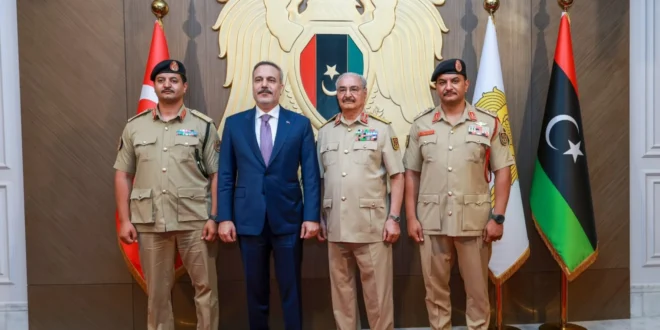

Libya’s eastern parliament has approved the 2019 maritime agreement with Turkey, marking a significant shift in the country’s fractured political landscape. The decision, adopted on October 20, 2026, reverses years of opposition by the eastern camp aligned with military commander Khalifa Haftar and opens a new chapter in the competition for influence across Libya and the Eastern Mediterranean.
The implications extend far beyond the disputed maritime boundaries. The agreement challenges the strategic calculations of Egypt, the United Arab Emirates and Greece, while raising concerns in Cyprus and Israel over Turkey’s expanding regional influence. Yet the most important question is whether this political realignment will translate into lasting changes on the ground—or remain another bargaining instrument in Libya’s unsettled power struggle.
Egypt and the UAE Face a Changing Landscape
For years, Egypt and the UAE cultivated close security and political ties with Haftar’s eastern camp. Cairo viewed eastern Libya as vital to its border security, while both countries invested in relationships that helped them maintain influence over Libya’s future.
Turkey, meanwhile, intervened militarily in support of the internationally recognized government in Tripoli during the 2019–2020 conflict, helping repel Haftar’s offensive against the capital.
The emerging rapprochement between Ankara and Haftar’s camp therefore represents a notable reversal. By building relationships on both sides of Libya’s political divide, Turkey is positioning itself to participate more directly in discussions over military cooperation, institutional reunification and reconstruction.
Egypt’s concerns are particularly immediate. Beyond security, Egyptian companies have secured substantial reconstruction and infrastructure contracts in eastern Libya. Turkish construction firms, which have a long history in the Libyan market, could now compete more aggressively for projects previously dominated by Egyptian businesses.
The UAE faces a different calculation. Improving relations with Turkey could allow Abu Dhabi to accommodate Ankara’s growing presence while preserving its own ties with Haftar’s camp. Rather than a straightforward displacement of Emirati influence, the shift could produce a more complicated contest involving cooperation, competition and overlapping partnerships.
Greece and the Maritime Dispute
The agreement’s most direct geopolitical consequences concern Greece, which disputes Turkey’s interpretation of maritime boundaries in the Eastern Mediterranean.
Signed in November 2019 by Turkey and Libya’s former Government of National Accord, the agreement established a maritime boundary claimed by Ankara and Tripoli. Greece and Egypt reject its implications for their maritime rights, arguing that it fails to account adequately for the entitlements of Greek islands under international maritime law.
The eastern parliament’s endorsement strengthens Turkey’s political argument that the agreement has support within Libya. However, parliamentary approval does not resolve the underlying legal dispute or automatically establish internationally accepted maritime boundaries.
The stakes are economic as well as diplomatic. Greece has advanced offshore exploration agreements south of Crete, while Libya and Turkey have expanded cooperation in offshore energy exploration. If competing claims overlap, companies could face legal uncertainty, operational delays and increased political risk.
Energy projects connecting Greece, Cyprus and Israel could also encounter further complications if disagreements over maritime jurisdiction affect seabed surveys or infrastructure routes.
Energy, Security and Strategic Leverage
Turkey’s growing engagement with eastern Libya reflects a broader strategy of combining military relationships, commercial partnerships and maritime interests. Its offshore energy cooperation with Libya could provide additional economic incentives for closer ties, while reconstruction projects offer opportunities to expand its commercial presence.
For Cyprus and Israel, the principal concern is the changing balance of regional partnerships. Both have developed energy and security cooperation with Greece, and greater Turkish influence could complicate diplomatic coordination. Nevertheless, the direct impact on individual gas fields and infrastructure projects will depend on their locations and the precise boundaries under dispute.
The European Union faces its own dilemma. Greece and Cyprus expect European support for their maritime claims, but European governments also have interests in Libyan stability, migration management, energy security and commercial relations with Turkey. These competing priorities could limit the effectiveness of punitive measures.
From Political Approval to Practical Consequences
The agreement’s significance will ultimately depend on what follows. New exploration licenses, seismic surveys and drilling activities in disputed areas would provide a clearer indication of its practical consequences than parliamentary approval alone.
International energy companies are unlikely to ignore legal and security risks simply because a political agreement has gained additional support. Competing licenses and unresolved jurisdictional questions could deter investment even as governments seek to expand cooperation.
Diplomacy remains another avenue. Turkey, Egypt and the UAE have improved their relations in recent years, creating channels through which disagreements might be managed. Dialogue between Ankara and Athens could also help prevent maritime disputes from disrupting commercial projects and regional security.
Haftar’s rapprochement with Turkey has not eliminated Libya’s competing loyalties. Instead, it has introduced another variable into an already complex regional equation.
The central issue is no longer simply whether Turkey can secure support for its maritime agreement. It is whether Libya’s shifting alliances will encourage a more negotiated regional order or deepen the competition for territory, energy and influence.
For now, the agreement has strengthened Ankara’s political position while forcing its regional rivals to reconsider their options. Whether that advantage produces lasting economic and strategic gains will depend on the difficult work of implementation, legal negotiation and regional diplomacy.
ChatGPT is AI and can make mistakes.