Geostrategic Media Political Commentary, Analysis, Security, Defense
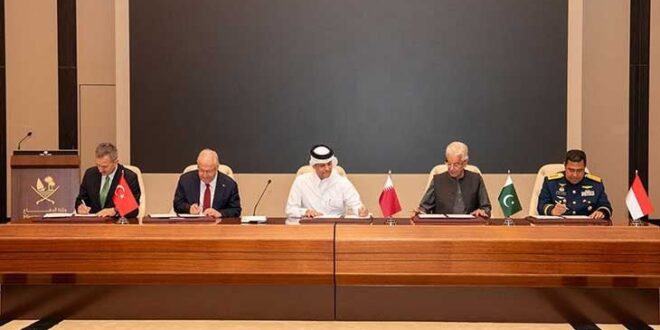

Qatar, Türkiye, Pakistan, and Indonesia signed a “multilateral” military memorandum ofunderstandingyesterday, Wednesday, named “Badr,” according to a statement by the QatarNews Agency. The statementsaid that the four countries “complement one another” andthat the memorandum would enable themto “leverage each country’s capabilities in the fieldof defense manufacturing.” It also described theagreement as being of “great economicimportance” because it would meet the needs of “allied and friendlycountries.” The reportnoted that the memorandum is open to the accession of “other friendly countries.”
The memorandum comes around two months after the signing of the “Mecca Agreement” onmutualdefense between Saudi Arabia and two of the countries joining the Badr memorandum.This is happeningas regional insecurity continues across the Gulf and surrounding countriesbecause of the US-Israeliconflict with Iran, while the risks posed by the war in Yemen andits impact on Saudi Arabia are growing.At the same time, military cooperation between Israeland its partners is deepening as part of a strategicrapprochement that includes Cyprus.
Although these arrangements differ in their nature and obligations, their timing reveals aprofoundtransformation that reflects a crisis in the old regional security order. Its participants havebegunseeking new guarantees outside the traditional frameworks on which they previously relied.
For decades, the security equation in the Gulf and the Middle East rested on American militarysuperiority,which provided protection for allies in exchange for Washington’s extensivepolitical, economic, and strategicinfluence. The repercussions of the US-Israeli war againstIran have dramatically altered this arrangement.
That war led to a substantial increase in threats to maritime routes, energy facilities, and theinfrastructureof Arab countries, exposing the limits of American security guarantees. Matterswere made worse bythe crude pragmatism and excessive opportunism of US PresidentDonald Trump’s administration.
All of this has driven countries in the region to reconsider the cost of depending on a singlepowerwhose priorities do not align with the interests of its allies. The question facing thesecountries is nolonger how much weaponry they can afford to purchase, but whether theycan control the sourcesof their own strength and their security decisions.
The transition from the “Mecca alliance” to the “Badr memorandum” carries significancethat goesbeyond geography and timing. The first agreement establishes a commitmentto mutual defense, whilethe second seeks to build a network for military-industrial andtechnological cooperation. In practice,both initiatives reflect an attempt to move from“importing ready-made protection” to producing someof the tools needed to provide it,and from bilateral security relationships to multilateral arrangements.
The same dynamic is evident on the other side of the equation, as Israel and Greece strengthentheirdefense cooperation through the “Achilles Shield” project amid growing competitionfor influence, maritimeroutes, and energy resources in the eastern Mediterranean. Theinteraction of these projects threatensto turn areas of strategic overlap into new arenasfor an arms race. Each side presents its arrangementsas defensive, while the other mayperceive them as a threat requiring further military fortification.
The emerging alliances on the Arab-Islamic side point to a declining belief in America’s ability toprotectthe region, as well as growing doubts about the selectivity of its commitment to regionalsecurity.When Israel is concerned, fleets and bombers are deployed, bombs fall, and air-defensesystems areinstalled. Yet the Arabian Gulf has experienced various forms of attack againstwhich Washington hasshown neither the same enthusiasm nor the same offensive or defensivecapabilities. This became evenmore evident following the serious Houthi attacks on Saudi Arabia,when American forces deliberatelyrefrained from helping Riyadh intercept missiles and drones.
Nevertheless, the emerging Arab-Islamic alliances recognize that they are not sufficient to free theregionfrom the sphere of American influence. Türkiye is a member of NATO, while Saudi Arabiamaintainsclose security ties with Washington, which considers Israel a key ally in the region.
These developments point to a move toward diversifying arms suppliers and strategicpartnerships.However, they also raise questions about the efforts of Arab states to adapt strategicallytothe consequences of the wars unfolding across the Arabian Gulf, as well as Israel’s dangerousactionsin Palestine, Lebanon, Syria, and the eastern Mediterranean.
Perhaps the real test of the new Middle East will be whether the Arab-Islamic countries of the regioncandefend themselves militarily, resolve their disputes politically, and establish a more independentandcooperative regional order. Such an order would need to be capable of confronting the waveof Israeliexpansionism moving toward the ethnic cleansing of Palestinians, continuing effortsto weaken neighboringArab states—including Lebanon, Syria, and even Jordan—and resolvingregional problems involvingIran and the forces aligned with it in Yemen, Iraq, and Lebanon.