Geostrategic Media Political Commentary, Analysis, Security, Defense

By Dr. Shehab Al Makahleh
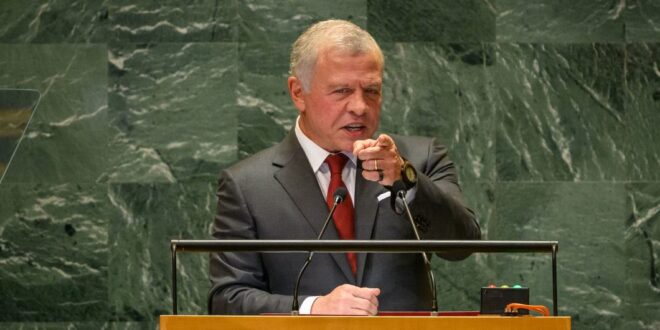
There was something unusually revealing about King Abdullah II’s address to the United Nations General Assembly this week. At a time when the international system is being overwhelmed by wars, competing crises, strategic rivalries, and an ever-shortening public attention span, the Jordanian monarch did not simply add another list of grievances to the global agenda. He began with a more fundamental question: what happens to crises when the world stops paying attention to them?
That question became the organizing idea of a speech that was, at its core, an argument about the consequences of international distraction. The King noted that attention itself has become a scarce resource, and that in a world where one emergency quickly displaces another, some crises receive sustained scrutiny while others are gradually normalized. His warning was straightforward: injustice requires sustained attention, not merely a brief moment in the news cycle.
This is more than a rhetorical observation. It is an increasingly important feature of international politics.
The Middle East has become a region of overlapping emergencies. Gaza competes for attention with Ukraine, Sudan, Yemen, Lebanon, Syria and wider strategic tensions. Governments respond to the crisis that is most urgent at a given moment, while the underlying disputes that produced those crises remain unresolved. The result is a form of international crisis management in which diplomacy moves from one fire to another without necessarily addressing the conditions that keep producing the fires.
King Abdullah’s speech challenged that approach directly.
His central message on Palestine was not simply that Gaza is suffering, although he made clear the scale of the humanitarian catastrophe. It was that Gaza cannot be separated from the West Bank, and that neither can be separated from the larger political question of Palestinian statehood. The destruction in Gaza and the continuing expansion of settlements, land confiscation, violence and displacement in the West Bank are not, in this reading, separate problems. They are different manifestations of the same unresolved conflict and of an increasingly entrenched political reality.
That distinction matters.
For years, the international community has treated the Israeli-Palestinian conflict as something to be contained rather than resolved. Ceasefires, humanitarian arrangements, security coordination and diplomatic initiatives have periodically reduced the temperature, but they have not addressed the fundamental political questions of territory, sovereignty, self-determination and the future of Jerusalem.
The danger is that crisis management can eventually become a substitute for conflict resolution.
A temporary arrangement can become permanent. A settlement expansion can become an established fact. A displaced population can become a demographic reality. A security measure can become an enduring political structure. What was once described as provisional can gradually become irreversible.
That is perhaps the most consequential argument embedded in the King’s speech: the international community cannot manage the Israeli-Palestinian conflict indefinitely without eventually helping to shape the outcome it claims to oppose.
The longer the conflict remains unresolved, the more the facts on the ground determine the political possibilities available to future generations.
This is also why the King’s emphasis on international law was significant. His argument was not merely that international law should exist as a set of principles. It was that the credibility of the international system depends on whether those principles are actually enforced.
The problem, therefore, is not simply the existence of violations. It is the widening gap between rules and consequences.
If international institutions repeatedly declare that certain actions violate international law but fail to produce meaningful consequences, the damage extends beyond the particular conflict involved. It weakens confidence in the institutions themselves. States begin to calculate not what the rules say, but how much political power they possess to avoid the consequences of breaking them.
That is a dangerous trajectory for an international system that depends, however imperfectly, on the idea that rules matter.
The King’s reference to measures such as sanctions, asset freezes, export restrictions and diplomatic isolation therefore carried significance beyond the Palestinian question. The underlying argument was that international law cannot retain credibility if enforcement is perceived as selective.
This is where the speech moved from being an expression of Jordanian foreign policy to a broader challenge to the international order.
Jordan has particular reasons for making that argument. It is a relatively small state situated in one of the world’s most unstable neighborhoods. It has repeatedly absorbed the consequences of conflicts that it did not start and cannot end by itself. Its borders connect it to some of the region’s most volatile theatres, while its economy and resources remain exposed to developments beyond its control.
For Amman, therefore, regional instability is never merely a matter of foreign policy.
It is a matter of national survival.
That explains the King’s unusually explicit reference to Jordan’s northern border and water security. He stated without ambiguity that any threat to either constitutes a threat to Jordan’s national security.
That sentence deserves more attention than it has received.
Jordan has traditionally been described as a country that prefers diplomacy, moderation and mediation. All of that remains true. But the speech made clear that Jordan’s preference for diplomacy should not be confused with an absence of red lines.
This distinction is central to understanding Amman’s regional strategy.
Jordan does not seek confrontation with its neighbors. It has every interest in avoiding another regional war. It has consistently advocated political solutions and maintained channels of communication with actors across the region. But diplomacy, from the Jordanian perspective, is a means of protecting national interests—not a substitute for them.
The King’s formulation was therefore both diplomatic and strategic: Jordan is prepared to talk to everyone and work with anyone seeking peace, but its commitment to diplomacy will never supersede its commitment to human values, sovereignty and national security. Nor should its diplomatic posture be mistaken for weakness.
That message is directed not only toward Israel or Jordan’s immediate neighbors. It is also directed toward Jordan’s international partners.
Amman is effectively saying that there are limits to the risks a state can be expected to absorb simply because it occupies a strategically important geographic position.
Jordan’s water security, borders, economic stability and social resilience cannot be treated as secondary considerations in regional diplomacy. The Kingdom has spent decades managing the consequences of conflicts elsewhere. Its message now is that regional stability must also take into account the security requirements of the states that have carried much of the burden of that instability.
The speech also contained an important rejection of the increasingly dangerous tendency to frame the Israeli-Palestinian conflict as a religious confrontation.
The King argued that the conflict should not be understood as a war between religions. That distinction is essential. Once a territorial and political dispute is transformed into a religious war, compromise becomes dramatically more difficult. Political disputes can, at least theoretically, be negotiated. Religious absolutism is far less amenable to compromise.
The danger is not theoretical. A religious framing of the conflict can feed extremism among Muslims, Jews and Christians alike, while allowing political actors to present territorial or security disputes as existential struggles between civilizations.
Jordan has a particular interest in preventing that transformation.
The Kingdom’s position on Jerusalem is rooted in both history and law, including the Hashemite Custodianship over Muslim and Christian holy sites. The King reiterated Jordan’s commitment to protecting Christian communities and heritage and to preserving the historic and legal status quo at Jerusalem’s holy sites.
This is why Jerusalem occupies such a central place in Jordanian diplomacy. It is not simply another issue in the Israeli-Palestinian conflict. For Jordan, it connects history, religion, international law, Palestinian national aspirations and the Kingdom’s own historical role.
But perhaps the most consequential part of the speech was what came after Palestine.
The King did not allow the Palestinian issue to consume the entirety of Jordan’s strategic agenda. He returned to the question of what Jordan itself is trying to build amid regional disorder.
That is an important distinction.
Jordan does not want to be defined permanently by the crises around it.
The Kingdom is seeking to strengthen connections from the Gulf to the Mediterranean, develop its role in trade, industry and technology, reinforce its own defenses, combat terrorism and narcotics trafficking, and maintain its role as a country capable of working across political divides.
This suggests a broader conception of Jordanian strategic resilience.
Security is not simply the ability to protect a border. It is also the ability to remain economically viable, technologically relevant and diplomatically useful while surrounded by instability.
For Jordan, economic geography is therefore becoming increasingly important to national security.
A country that can serve as a corridor linking the Gulf to the Mediterranean, participate in regional trade and supply chains, develop technological capabilities and maintain political relationships across competing blocs has more strategic room to maneuver than a country whose security depends entirely on external assistance.
That is particularly important in a region where alliances are becoming less predictable.
The Middle East is not simply moving from an American order to a Chinese order. The reality is considerably more complicated. Saudi Arabia, the UAE, Türkiye, Qatar and other regional powers are developing wider diplomatic and economic relationships while maintaining important security and political ties with Washington. China is expanding its economic and diplomatic footprint, while Iran continues to pursue its own regional interests. Israel is recalibrating its security doctrine. None of these developments fits neatly into the old language of blocs.
The emerging Middle East is increasingly characterized by strategic hedging. Jordan has little choice but to operate in that environment.
Its answer, as reflected in the King’s speech, is not to choose a single camp but to remain principled, open and steady. Those three words may ultimately prove more significant than many of the individual policy statements in the address.
They describe a foreign policy designed for an era in which certainty is disappearing.
The King was also making a broader argument about the limitations of military power. His statement that military force cannot feed the hungry, return displaced people or build peace was not an argument against legitimate defense. It was an argument against treating military force as a substitute for political solutions.
That distinction is particularly relevant after years in which the region has repeatedly witnessed the same cycle: escalation, military intervention, temporary containment, humanitarian crisis and then renewed escalation.
Military power can change facts on the ground. It cannot, by itself, resolve competing national claims.
It can destroy infrastructure. It cannot create political legitimacy.
It can deter an adversary. It cannot build a durable peace between populations that remain locked in conflict.
That is why the King’s insistence on institutions, legitimacy and trust was so important. International agreements work only when states believe that commitments will be honored and rules will be enforced. Once that confidence disappears, every negotiation becomes harder and every security dilemma becomes more dangerous.
The real test of the speech, therefore, will not be how warmly it is received in Amman.
It will be whether the international community is willing to confront the uncomfortable implications of its argument.
Can the world continue to speak about a two-state solution while allowing the political and territorial conditions necessary for that solution to erode?
Can international law remain credible if its application is perceived to depend on the identity and strategic importance of the actor involved?
Can Jordan and other neighboring states be expected indefinitely to absorb the security, economic and humanitarian consequences of regional conflicts without those consequences becoming part of the international policy response?
And can diplomacy remain meaningful if the facts on the ground are allowed to change faster than diplomacy can respond?
These are not questions that Jordan can answer alone. But Jordan has a particular reason to ask them.
Its geography has made it a frontline state for generations. Its diplomacy has often required it to balance between competing powers and conflicting regional interests. Its stability has frequently been treated as an asset by international partners, while the pressures placed upon that stability have sometimes been treated as someone else’s problem.
The King’s speech challenged that assumption. It effectively told the international community that Jordan will remain committed to diplomacy, moderation and peace—but that these commitments are strengths, not blank checks. That may be the most important message of all.
There is a tendency in international politics to mistake restraint for weakness. States that avoid confrontation are sometimes assumed to have fewer options. Yet restraint can also be a deliberate form of strategy, particularly for a country that understands the costs of escalation better than most.
Jordan’s approach is rooted in that calculation.
The Kingdom has no interest in another regional war. It has no interest in transforming the Palestinian question into a religious confrontation. It has no interest in seeing Syria, Iraq, Lebanon or the Red Sea become additional theatres of instability. And it has no interest in allowing its own borders or water resources to become bargaining chips in conflicts beyond its control.
But avoiding confrontation does not mean accepting every consequence of the regional disorder.
That is the balance King Abdullah sought to communicate at the United Nations: peace without passivity, diplomacy without ambiguity, and openness without surrendering national interests.
The speech ultimately amounted to a warning about something larger than the current crisis.
The danger facing the international system is not only that wars continue. It is that the world can gradually become accustomed to them.
A crisis becomes a headline. The headline becomes a statistic. The statistic becomes background noise. And eventually, what once seemed unacceptable becomes normal.
That is how temporary realities become permanent ones.
The King’s closing argument was therefore perhaps the most important: the future is shaped not only by what governments choose to do, but also by what they choose to ignore.
For Jordan, that principle has immediate implications. The Kingdom will continue to defend Palestinian rights, support a just peace, uphold the status of Jerusalem’s holy sites, and insist on a political horizon based on Palestinian statehood. At the same time, it will defend its northern borders, water security and national sovereignty.
For the international community, the choice is harder.
It can continue managing the Middle East one crisis at a time, hoping that each temporary arrangement will hold until the next emergency arrives: Or it can confront the deeper political failures that keep producing the crises.
King Abdullah’s speech made clear where Jordan stands.
The Middle East does not need another mechanism for managing conflict. It needs a political order capable of ending it.
And that begins with a principle that should not be controversial: international law cannot survive on paper alone; diplomacy cannot substitute indefinitely for political resolution; and peace cannot be built by asking people to accept the permanence of an injustice simply because the world has grown accustomed to it.
Jordan’s message at the United Nations was therefore not simply that the world should pay attention to Palestine.
It was that the world should be careful about what happens when it stops paying attention.
Because eventually, what the international community chooses to ignore becomes part of the international order it has helped create.