Geostrategic Media Political Commentary, Analysis, Security, Defense

A humanitarian gesture, or a geopolitical land grab disguised as mercy?
When twin earthquakes—measuring 7.2 and 7.5 on the Richter scale—struck Venezuela on June 24, 2026, they left behind a trail of devastation that would stagger any nation: over 5,300 dead, nearly 17,000 injured, and more than 850 buildings reduced to rubble. The international community responded with an outpouring of aid. But one delegation stood out—not for its size, but for its symbolism.
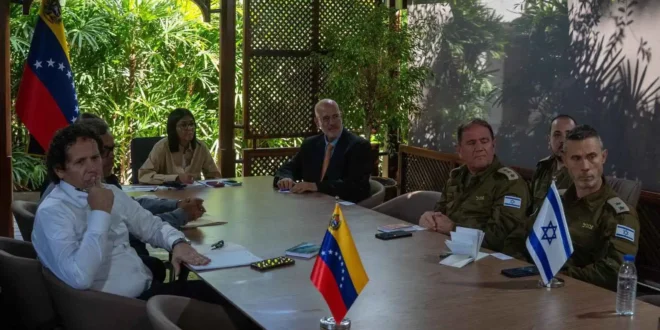
A 16-person Israeli search-and-rescue team arrived in Caracas. Within days, they were joined by military engineers from the Israel Defense Forces’ Home Front Command. They assessed collapsed structures, designed contingency plans, and prepared a national reconstruction strategy. Israel’s largest humanitarian NGO, IsraAID, deployed its own team to provide water filtration and psychological support. The Israeli company SmartAID installed solar panels, water purification systems, and Starlink connectivity for camps and clinics.
On the surface, this was humanitarianism in its purest form. But in the Middle East, nothing is ever that simple.
A Political Earthquake of Its Own
Venezuela’s interim president, Delcy Rodríguez, did not merely thank the Israeli delegation. She publicly praised them as a “highly professional and skilled team”. She revealed the backchannel that made it possible: coordination with Venezuela’s Chief Rabbi Isaac Cohen, direct contact with the Israeli government, and the support of the local Jewish community.
This was not a routine diplomatic nicety. This was a revolution in rhetoric.
For seventeen years, Venezuela had been one of Israel’s most vocal adversaries. In 2009, President Hugo Chávez severed diplomatic ties to protest Operation Cast Lead in Gaza. His successor, Nicolás Maduro, deepened the rupture, calling Israel a “genocidal” state and maintaining close ties with Iran. Maduro’s government even accused Israel’s Mossad of conspiring with U.S. intelligence to destabilize Venezuela. The Jewish community in Venezuela, once 25,000 strong, shrank to roughly 5,000 under the pressure of state-sanctioned hostility.
Now, Rodríguez—Maduro’s former vice president, who assumed power after U.S. forces captured him in a January 2026 military raid—was embracing the very state her predecessors had vilified.
A Calculated Embrace
The timing is telling. Rodríguez came to power with U.S. backing and is navigating a treacherous political landscape. She faces opposition from hardline Chavistas who view any rapprochement with Israel as a betrayal of the Bolivarian Revolution. Diosdado Cabello, the powerful interior minister, has publicly accused Israel of being the “mastermind” behind the U.S. operation that captured Maduro.
Yet Rodríguez has pressed forward. In April 2026, she sent Passover greetings to Venezuela’s Jewish community—a gesture her predecessors would never have made. When the U.S. and Israel struck Iran in late February, her government notably refrained from condemning either, instead calling for “dialogue”. The earthquake provided the perfect cover to accelerate this diplomatic pivot.
As one analyst put it, “Venezuela’s turn to Israel is about survival, not conviction”. Rodríguez needs Washington’s support to consolidate power, and aligning with Israel is a powerful signal of her willingness to play by the new rules of the hemispheric order.
The Israeli Calculus
For Israel, the opportunity is equally strategic. Prime Minister Benjamin Netanyahu did not mince words: the delegation was “rebuilding relations” with Caracas. This is not just about earthquake relief. It is about breaking out of diplomatic isolation.
Israel has spent years cultivating ties with countries that once shunned it—from the Gulf states through the Abraham Accords to Sudan and Morocco. Venezuela, with its vast oil reserves and strategic location in America’s backyard, represents a new frontier. The delegation included not just rescue workers but military engineers and Foreign Ministry officials. They prepared a national reconstruction plan for Caracas and surrounding areas, assessing nearly 1,300 buildings. This is not emergency response; this is nation-building.
Israeli officials have been explicit about their ambitions. Yotam Polizer, CEO of IsraAID, described the earthquake as creating an opportunity to build a “beautiful bridge” of communication. Shahar Zahavi, founding director of SmartAID, called Rodríguez’s public thanks “conclusive proof” that humanitarian diplomacy can show “another face of Israel”.
But Is It That Simple?
Critics see a darker picture. Middle East Eye accused Israel of “humanitarian whitewashing”—using disaster relief to distract from its military campaign in Gaza, where at least 73,000 Palestinians have been killed since October 2023. “Israel’s humanitarian gestures are never anything more than gestures,” said Tariq Kenney-Shawa, a policy fellow at Al-Shabaka.
There is also the matter of Venezuela’s internal politics. The rapprochement is far from universally accepted. In July 2026, dozens of protesters took to the streets of Caracas, demanding that Rodríguez “immediately expel” the Israeli and American rescue teams. Diosdado Cabello has warned against foreign powers “sinking their claws” into Venezuela under the cover of aid.
The Jewish community, once a target of state hostility, now finds itself in an awkward position—acting as a bridge between two governments while its own members remain divided over the wisdom of this embrace.
What Comes Next?
Will diplomatic relations be formally restored? Not immediately. The Chavista base is too fractured, and the opposition too vocal. But the trajectory is clear.
Informal contacts will continue. Technical cooperation will expand. Venezuelan oil has already found its way to Israel through intermediaries, as recently as February 2026. The reconstruction plan approved by Rodríguez will keep Israeli experts engaged for months, if not years. Each meeting, each handshake, each photograph of Rodríguez with uniformed IDF officers—as captured in images that circulated globally—erodes the seventeen-year wall of hostility.
The earthquake that shattered Venezuela’s coastline may also have cracked open the door to a new geopolitical alignment. Whether that door leads to genuine partnership or exploitation depends on who is doing the pushing—and who is being pushed.
The Bottom Line
Humanitarianism and geopolitics are never mutually exclusive. Israel’s aid to Venezuela is both genuine relief and strategic calculation. Rodríguez’s embrace of that aid is both desperate pragmatism and political signal.
The question is not whether Israel is using the earthquake to “sink its claws” into Venezuela. The question is whether Venezuela—fractured, desperate, and searching for a lifeline—has any choice but to let them.
In the Middle East and beyond, disaster often becomes diplomacy. And diplomacy, in this case, may become the foundation for a new relationship that neither side could have imagined just a year ago.
The rubble is being cleared. But the real reconstruction—of ties, of trust, of alliances—has only just begun.