Geostrategic Media Political Commentary, Analysis, Security, Defense
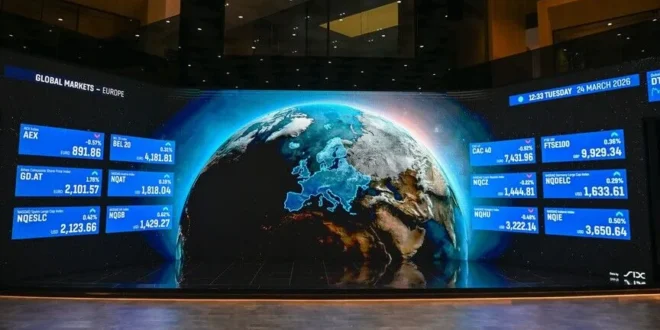

Global markets traded lower Friday as heavy selling in semiconductor shares and escalating US-Iran tensions weighed on investor sentiment.
Chipmakers remained under pressure amid concerns over whether massive artificial intelligence investments will generate sufficient returns. Renewed attacks between Washington and Tehran also raised fears of further disruption to energy supplies and shipping through the Strait of Hormuz.
Investors were concerned that a sustained rise in oil prices could revive inflationary pressures and complicate the US Federal Reserve’s policy outlook. Although US inflation data this week pointed to easing underlying price pressures, the recent surge in energy costs prompted caution.
Dallas Fed President Lorie Logan said some tightening might be needed if inflation did not move toward the central bank’s 2% target. Kansas City Fed President Jeff Schmid said inflation remained too high.
US retail sales rose 0.2% month-on-month in June, while initial jobless claims fell to 208,000 in the week ending July 11, signaling continued economic resilience.
The US 10-year Treasury yield was flat at 4.55%, while the dollar index rose 0.1% to 100.8. Brent crude climbed 0.1% to $84.10 a barrel and was on course for its strongest weekly gain in three months.
Gold traded flat at $3,976 per ounce as higher oil prices and stronger dollar demand offset safe-haven buying linked to the Middle East conflict.
Wall Street closed lower Thursday as losses in chip stocks overshadowed strong corporate earnings.
Taiwan Semiconductor Manufacturing Co. (TSMC) shares fell 2.3% despite a 77.4% increase in second-quarter profit after the company raised its spending forecast. Intel dropped 5.8%, Micron Technology 5.7%, Arm Holdings 5.4%, AMD 5% and Broadcom 5%.
Alphabet declined 4.4% following reports that it delayed the launch of its Gemini 3.5 Pro artificial intelligence model. Netflix fell 8.9% in after-hours trading despite reporting a 13.4% rise in second-quarter revenue to $12.6 billion.
United Airlines lost 1.8% after warning that higher oil prices could raise its fuel costs by about $6 billion this year.
The Dow Jones Industrial Average fell 0.2%, the S&P 500 dropped 0.51% and the Nasdaq Composite declined 1.47% on Thursday. US indexes opened lower Friday.
European markets also traded lower as weaker-than-expected corporate earnings and concerns over elevated artificial intelligence valuations weighed on sentiment.
The eurozone posted a trade deficit of $8.9 billion in May, compared with a $17.15 billion surplus a year earlier.
On Thursday, the UK’s FTSE 100 gained 0.54%, while France’s CAC 40 fell 0.05%, Germany’s DAX 40 lost 0.34% and Italy’s FTSE MIB declined 0.07%.
Asian markets were broadly lower near Friday’s close. Japan’s Nikkei 225 plunged 6.4%, China’s Shanghai Composite fell 1.6% and Hong Kong’s Hang Seng Index dropped 2%. South Korean markets were closed for a holiday.